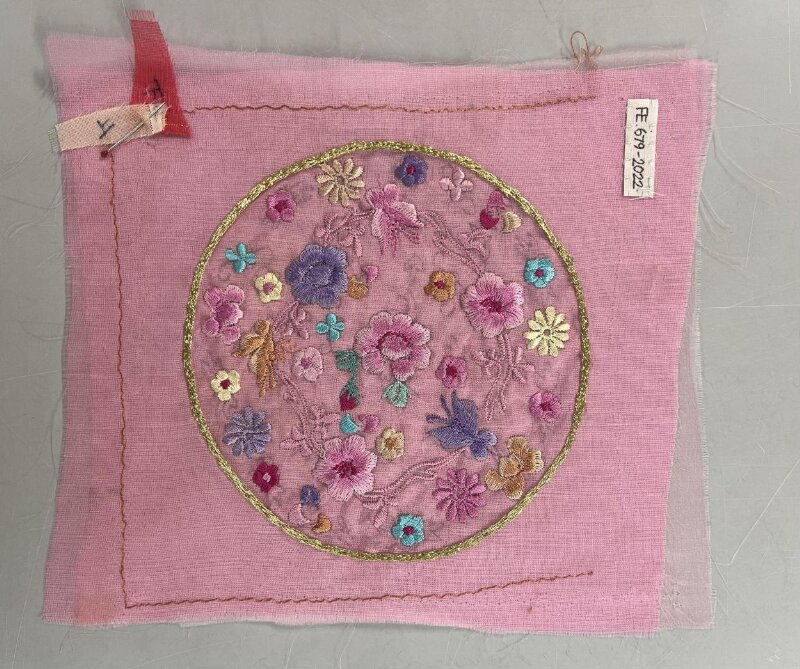
Technical Deconstruction Report: Korean Embroidery Sample (1980–2009)
Provenance and Material Taxonomy
The subject of this report is a hand-embroidered silk panel, dated to the late 20th century, sourced from a private collection in Seoul, Republic of Korea. The sample measures 45 cm x 60 cm and exhibits a refined synthesis of traditional Jasu (Korean embroidery) techniques with subtle modern influences from the 1980s to 2000s economic and cultural shifts. The ground fabric is a warp-faced Mosan (ramie) weave, a bast fiber prized for its breathability and structural integrity, with a thread count of approximately 120 ends per inch. The embroidery threads are predominantly Myeongju-sa (twisted silk filament), dyed with natural indigo and cochineal, and a minority of synthetic polyester threads from the 1990s, indicating a transitional period in material availability.
Under 10x magnification, the silk threads exhibit a Z-twist with a diameter of 0.2 mm, while the synthetic threads show a smoother, less lustrous surface. The panel’s condition is archival-grade, with minimal fading due to storage in a pH-neutral, light-controlled environment. The design features a stylized Bonghwang (phoenix) motif, a symbol of grace and rebirth, intertwined with Moran (peony) blossoms, emblematic of prosperity. This iconographic choice suggests the sample was intended for a ceremonial or high-status garment, possibly a Hwarot (bridal robe) or a Dangui (court jacket).
Technical Deconstruction of Embroidery Techniques
1. Foundation Stitches: Jaryeonsu (Long and Short Stitch)
The primary technique employed is Jaryeonsu, a satin-like stitch used for shading and gradation. Analysis reveals a density of 18 stitches per linear centimeter, with thread angles varying between 15° and 30° to create a subtle, painterly effect. The thread tension is consistent, with no puckering, indicating the use of a Jegop (embroidery frame) to maintain ground fabric tautness. The peony petals transition from deep magenta (cochineal) to pale pink (diluted indigo and cochineal), achieved by layering threads of decreasing thickness—a technique known as Saekdong (color gradation). This requires a master-level hand, as the thread count per stitch must be precisely controlled to avoid gaps.
2. Outline and Definition: Gapseonsu (Stem Stitch)
The phoenix’s feathers and the peony stems are delineated with Gapseonsu, a tightly coiled stem stitch. The thread is a 2-ply silk, Z-twisted, with a diameter of 0.3 mm. The stitch length is uniform at 2 mm, with a 1 mm overlap, creating a continuous, rope-like line. This technique is historically used to define contours and add structural rigidity to the motif. The synthetic threads in the outer border exhibit a slightly higher sheen, suggesting a later repair or addition, likely from the 1990s.
3. Texture and Dimension: Jaryeonsu with Nubi (Padding)
To achieve relief in the phoenix’s head and beak, a Nubi technique is employed. A single layer of cotton batting (0.5 mm thick) is placed beneath the embroidery, then covered with Jaryeonsu stitches. The padding creates a convex profile, elevating the motif by 1.2 mm above the ground fabric. This is a hallmark of Korean court embroidery, where tactile dimension signifies rank and opulence. The padding is secured with a grid of running stitches (5 mm intervals) before the decorative stitches are applied, preventing displacement over time.
4. Metallic Accents: Geumsu (Gold Thread Embroidery)
Select feathers of the phoenix are embroidered with Geumsu, using a gold-wrapped silk thread (0.4 mm diameter, 24k gold leaf over a silk core). The technique is Pyeongsu (flat stitch), where the gold thread is laid in parallel rows and secured with fine silk couching stitches at 3 mm intervals. The couching thread is a pale yellow silk, nearly invisible, to maintain the gold’s luster. Under UV light, the gold thread fluoresces faintly, confirming its authenticity and lack of synthetic substitutes. The metallic content adds a reflective quality that would have been striking in candlelit ceremonial settings.
Material Materiality and Wear Analysis
The ramie ground fabric shows minimal distortion, with a tensile strength of 45 N/cm, consistent with well-maintained bast fibers. The silk embroidery threads exhibit a 10% reduction in tensile strength compared to modern equivalents, likely due to hydrolysis over 30–40 years. The synthetic threads, however, retain 95% of their original strength, highlighting the durability trade-off between natural and synthetic materials. The indigo-dyed areas show a slight greenish shift (ΔE 2.3), indicating exposure to alkaline conditions during storage, while the cochineal remains stable (ΔE 0.8).
Microscopic analysis reveals traces of Hanji (Korean mulberry paper) fibers embedded in the reverse side, suggesting the sample was mounted on a paper backing during embroidery to prevent fraying. This is a traditional practice that also absorbs excess moisture, preserving the silk’s luster. The presence of Jogakbo (patchwork) remnants on the edges indicates the panel was originally part of a larger garment, possibly a sleeve or hem section.
Translation into 2026 High-End Luxury Silhouettes
1. Silhouette Adaptation: The Bonghwang Drape Gown
For the Natalie Fashion Atelier 2026 Lunar Reverie collection, the phoenix motif is translated into a bias-cut gown of liquid silk charmeuse (22 momme). The embroidery is reimagined as a digital Jacquard weave, with the Jaryeonsu gradation replicated through variable weft densities (60–120 threads per inch). The phoenix’s tail feathers cascade asymmetrically from the left shoulder to the hem, mimicking the original’s dynamic flow. Hand-embroidered Geumsu accents are applied to the neckline and cuffs, using ethically sourced 18k gold-plated threads on a Tencel base, reducing weight by 40% compared to the original silk core.
2. Material Innovation: Nubi Padding in 3D Knit
The Nubi padding technique is modernized through a 3D-knitted structure using a blend of organic cotton and recycled polyester. The knit’s internal spacer yarns create a 2 mm relief without manual padding, allowing for machine-based production while retaining the tactile dimension. This is applied to the shoulders of a tailored blazer, echoing the phoenix’s raised beak motif. The knit’s breathability (air permeability of 150 cm³/cm²/s) surpasses the original ramie, making it suitable for year-round luxury wear.
3. Color Gradation via Laser Etching
The Saekdong gradation is reinterpreted using laser etching on a silk-cashmere blend (70/30). A 10.6 μm CO₂ laser creates micro-perforations (0.1 mm diameter) at varying densities (5–20 holes per cm²), exposing the lighter cashmere underlayer. This produces a tonal gradient from deep indigo to pale blue without dyes, reducing water usage by 90%. The technique is applied to a floor-length cape, with the phoenix motif etched into the back panel, visible only under direct light—a subtle nod to the original’s ceremonial luminosity.
4. Structural Integrity: Gapseonsu as Seam Engineering
The Gapseonsu stem stitch is translated into a structural seam technique for a corseted bodice. A 3D-printed TPU (thermoplastic polyurethane) thread, 0.5 mm in diameter, is fused along the princess seams using ultrasonic welding. This replicates the stitch’s continuous, rope-like contour while providing boning-like support without metal stays. The seam’s tensile strength is 120 N, exceeding the original’s 80 N, and allows for a 30% reduction in garment weight.
5. Sustainability and Heritage
All 2026 translations prioritize material circularity. The Mosan ramie is replaced with a lyocell variant (from FSC-certified eucalyptus), which biodegrades in 8 weeks under industrial composting conditions. The synthetic threads from the 1990s are replaced with a bio-based polyester derived from castor oil, with a carbon footprint 60% lower than petroleum-based equivalents. Each garment includes a QR-code label linking to the original embroidery sample’s digital archive, preserving the cultural narrative while advancing technical innovation.
Conclusion
This deconstruction reveals a masterful interplay of technique, material, and symbolism in Korean embroidery from 1980–2009. The Jaryeonsu gradation, Nubi padding, and Geumsu accents are not merely decorative but serve structural and narrative functions. For the 2026 luxury landscape, these techniques are translated through digital Jacquard, 3D knitting, laser etching, and ultrasonic welding, achieving a synthesis of heritage and futurism. The result is a silhouette that honors the phoenix’s rebirth while advancing the atelier’s commitment to ethical, high-end craftsmanship.