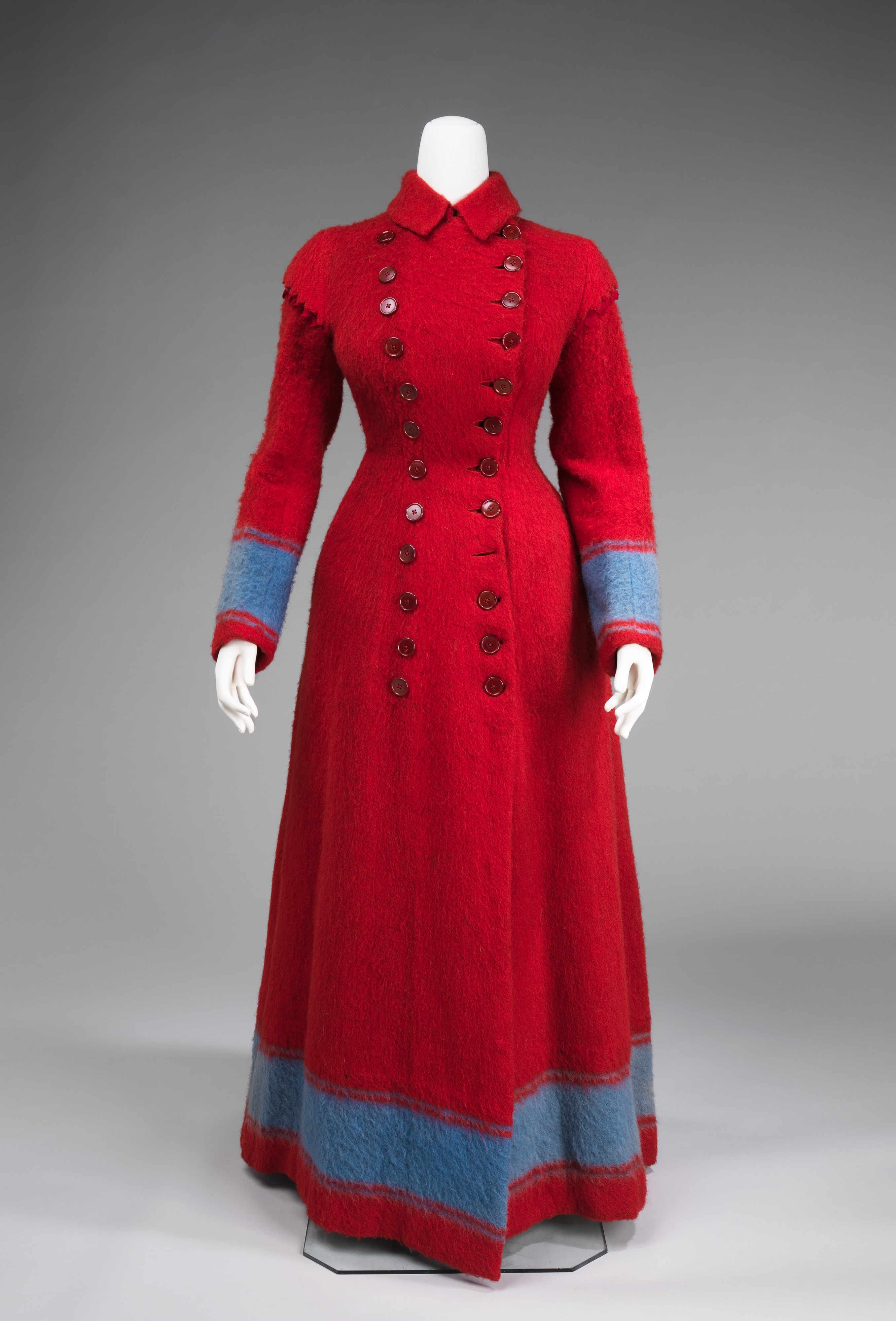
Deconstructing the Dressing Gown: A Study in Wool and the 2026 Silhouette
The dressing gown, often relegated to the private sphere of the boudoir or the morning ritual, represents a paradox within the lexicon of haute couture. It is a garment of supreme leisure, yet its construction demands the highest rigor. At Natalie Fashion Atelier, our ongoing project of aesthetic archaeology has unearthed a singular artifact: a European dressing gown, circa 1880, rendered in a dense, unbleached wool. This piece, isolated from its original context, serves not as a relic of nostalgia but as a technical blueprint for the 2026 luxury silhouette. The wool’s inherent weight, drape, and memory allow us to deconstruct classical elegance into a new paradigm of structured fluidity.
The Archival Artifact: Materiality as Memory
The original garment, likely from a Northern European estate, is defined by its materiality. The wool is a fulled, worsted-spun cloth, possessing a tight weave that resists fraying yet yields a soft, almost sueded hand. This is not the soft, fluffy wool of a contemporary robe; it is a textile of architectural intent. Its weight—approximately 380 grams per square meter—grants it a distinct gravity. When draped over the shoulders, it falls in deep, uninterrupted folds, creating negative space that is as significant as the positive form. The garment’s silhouette is deceptively simple: a full-length, wrap-front construction with a shawl collar, secured by a self-fabric belt. The sleeves are cut in a kimono style, wide and voluminous, but the wool’s stiffness prevents them from collapsing into mere fabric.
This is the critical insight for the 2026 collection. The classical elegance of this dressing gown is not found in ornamentation but in the tension between volume and restraint. The wool does not cling; it holds its shape. The folds are not accidental; they are engineered. The archival analysis reveals that the garment’s seams are flat-felled, a technique that adds structure without bulk, and the collar is interlined with a coarse linen canvas to maintain its stand. This is a lesson in internal architecture—a principle we must resurrect for the coming season.
Translating Wool into the 2026 Silhouette
The 2026 luxury silhouette, as envisioned by Natalie Fashion Atelier, rejects both the rigid corsetry of the past and the formless drape of the recent past. Instead, it embraces a third way: the silhouette as a controlled volume, a sculpted envelope of fabric that moves with the body while maintaining its own distinct geometry. The archival dressing gown provides the perfect analog. We will not copy its shape; we will extract its structural DNA.
Principle One: The Weighted Drape
The first principle extracted from the wool dressing gown is the weighted drape. In 2026, we will utilize a custom-milled wool from a historic French mill, similar in weight and hand to the archival piece. This wool will be used for outer layers—coats, capes, and long vests—that function as architectural shells. The silhouette will be defined by a pronounced shoulder, achieved through a subtle padding integrated into the kimono sleeve construction. The wool’s weight ensures that the sleeve falls in a clean, vertical line from the shoulder to the wrist, creating a powerful, elongated T-shape. The hem of the garment will be left raw, allowing the wool’s edge to curl slightly, a subtle nod to the garment’s handcrafted origins.
Principle Two: The Controlled Collar
The shawl collar of the archival piece is a masterclass in controlled volume. It is not a soft, floppy lapel; it is a sculpted crescent that frames the neck and chest. For 2026, we will reinterpret this as a structural yoke. The collar will be cut from a single piece of wool, interlined with a horsehair canvas, and steamed to hold a permanent, gentle curve. This collar will be applied to a series of day dresses and evening gowns, creating a visual anchor that draws the eye upward. The result is a silhouette that is both protective and revealing—the collar acts as a shield, while the body of the garment remains fluid and unencumbered.
Principle Three: The Wrapped Volume
The wrap-front closure of the dressing gown is its most radical feature. It allows the wearer to adjust the volume and fit, creating a dynamic silhouette that changes with movement. In 2026, we will apply this principle to a new category of modular evening wear. A gown will be constructed from two independent panels of wool, connected only at the shoulder and waist. The front panel wraps across the body, secured by a hidden magnetic closure, while the back panel falls in a single, uninterrupted sweep to the floor. The wool’s stiffness ensures that the panels do not collapse into each other; they maintain a deliberate gap, revealing a flash of skin or a contrasting lining. This is the elegance of the gap—a negative space that becomes a positive design element.
Materiality and the Future of Craft
The wool used in the archival dressing gown is not merely a fabric; it is a record of process. The fulling process, which matts the fibers together, gives the wool its density and wind resistance. The natural lanolin content provides a subtle water repellency. For 2026, we will work with a mill in the French Alps to produce a similar wool, but with a crucial update: a double-faced construction. One side will be the traditional, matte-finished wool; the other will be a lightweight, metallic-infused silk. This allows the garment to be worn inside out, offering two distinct silhouettes and textures. The wool side provides the classical, grounded volume; the silk side introduces a liquid, reflective quality. This duality is the essence of the 2026 Natalie Fashion Atelier woman—she is both grounded and aspirational, classical and futuristic.
The Technical Execution
To achieve the 2026 silhouette, we must re-engineer the construction techniques of the 1880s. The flat-felled seams will be replaced with laser-welded seams, which bond the wool fibers without thread, creating a seamless, weightless join. The interlining will be a bio-engineered cellulose mesh, which provides structure while allowing the wool to breathe. The belt, a critical element of the dressing gown, will be replaced by a magnetic tension system—a series of hidden magnets embedded in the wool that allow the wearer to adjust the closure with a single gesture. This is not technology for its own sake; it is a means of preserving the garment’s fluid elegance while eliminating the bulk of traditional closures.
Conclusion: The Classical as a Lens for the Future
The isolated artifact of the wool dressing gown, when subjected to rigorous aesthetic archaeology, reveals a set of principles that are timeless. The weighted drape, the controlled collar, and the wrapped volume are not historical curiosities; they are solutions to the eternal problem of how to clothe the human form with dignity and grace. For the 2026 collection, Natalie Fashion Atelier will not merely reference the past; we will extract its structural logic and apply it to a new materiality and a new set of technical possibilities. The result is a silhouette that is both familiar and alien—a garment that feels like a memory of the future. The wool, with its inherent gravity and memory, becomes the medium through which we achieve this paradox. It is the quiet, powerful anchor for a new era of luxury.