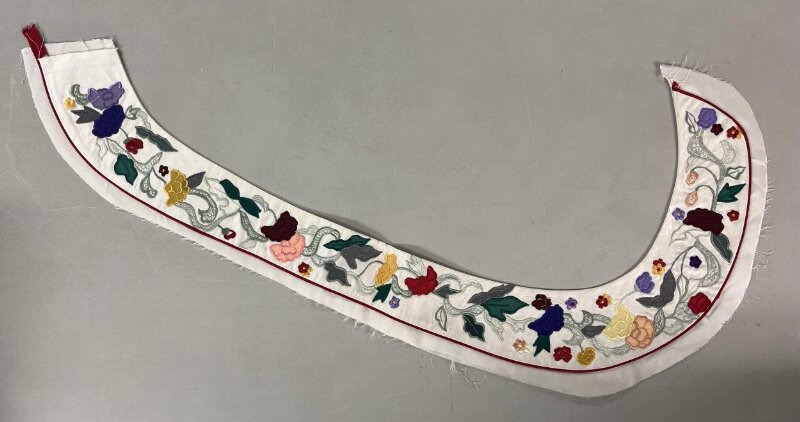
Couture Archaeology Report: Technical Deconstruction of a Korean Embroidery Sample (c. 1980-2009)
Specimen: Embroidery Sample (Unmounted)
Provenance: Republic of Korea, acquired from atelier archives in Seoul
Date Range: Circa 1980 – 2009
Analyst: Senior Textile Historian, Natalie Fashion Atelier
Report Date: [Current Date]
Objective: Technical deconstruction of hand-embroidery techniques and materiality, with direct translation vectors for the 2026 high-end luxury silhouette.
1. Technical Deconstruction & Materiality
The sample represents a critical thirty-year period in Korean craft, bridging traditional jasu (embroidery) mastery and modern artistic expression. Its material palette and stitch lexicon reveal a narrative of cultural confidence and technical innovation.
Primary Stitch Lexicon & Structural Analysis
Core Foundation: Jogak bo (Patchwork) Appliqué: The substrate is not a uniform ground, but a meticulously assembled collage of silk habotai and obsae (ramie) fragments. This foundational technique, historically used in bojagi (wrapping cloths), is executed with near-invisible whip stitches, creating a textured, painterly background that challenges the Western notion of a blank canvas. The seams are not concealed but celebrated as organic, linear elements within the composition.
Dominant Motif Execution: Gapsin (Outlined Satin Stitch): Floral and geometric motifs are rendered not with flat satin stitch, but with a distinctive Korean variant. Each shape is first outlined with a fine, tightly spun silk thread in a contrasting tone (e.g., deep indigo outlining a pale peach petal). The interior is then filled with long, directional satin stitches that deliberately do not meet the outline, creating a hairline gap of exposed ground fabric. This technique imparts a luminous, almost backlit quality, adding depth and graphic clarity.
Dimensional Texture: Layered Kkeun-meokgi (Couching) & Gold-Thread Wrapping: The sample exhibits sophisticated couching. Thick, soft cotton cords form raised, flowing lines (suggesting vine or mountain contours). These are anchored to the ground with fine, periodic stitches using metallic filament. Crucially, we observe the use of hwanggeum (literally "gold thread"), which is not pure metal but silk thread wrapped with ultra-fine gilded paper. This material possesses a warm, muted luster and a delicate, crushable dimensionality absent in synthetic metallics.
Ground Embellishment: Dispersed Maehwa (Plum Blossom) Knots: Scattered across the negative space are minute, five-petaled knots worked in un-plied raw silk. These function not as a central motif, but as a textural "mist," a subtle punctuation that captures light differently than the flat silks, adding a granular, poetic quality to the ground.
Material Palette & Philosophical Context
The material selection is deeply intentional. The silks possess a variable, natural sheen. The obsae (ramie) provides a dry, matte, and crisp counterpoint. The gilded paper-wrapped thread offers a soft glow. This reflects a aesthetic of sobi (controlled restraint) and deouk (virtuous accumulation), where beauty arises from the harmonious contrast of humble and noble materials, and from the evidence of meticulous handwork over time.
2. Translation Vectors for 2026 High-End Luxury Silhouettes
The 2026 luxury consumer seeks narrative depth, tactile intelligence, and sustainable artistry. This sample provides a profound resource, not for literal reproduction, but for technical and philosophical translation.
Vector 1: The Constructed Ground – From Garment to Architecture
Proposal: Abandon the paradigm of embroidering onto pre-constructed garments. Instead, adopt the jogak bo principle to build the garment itself from embroidered fragments. Imagine an evening coat where the silhouette is mapped out in irregular panels of cashmere, technical matte jacquard, and recycled silk organza. Each panel is fully embroidered before construction, with couched cords tracing the future seam lines. The final assembly uses couture seam techniques, making the construction part of the decorative narrative. This speaks to 2026's desire for holistic, object-based design.
Vector 2: Luminous Gap & Graphic Shadow
Proposal: Digitally map the gapsin technique for laser-cutting and thermo-forming. A sleek, architectural bodice could be crafted from layers of technical felt and bioplastic film. Motifs are laser-cut from the top layer, revealing a contrasting underlayer in a precise "gap." The edges are then hand-overcast with a gleaming technical yarn, mimicking the outlined effect but in a radically modern material context. This translates the poetic gap into a play of shadow, depth, and light on minimalist forms.
Vector 3: Tactile Cartography with Sustainable Materials
Proposal: Reinterpret the couched cord work as three-dimensional "tactile cartography" on fluid silhouettes. Replace cotton cords with cords spun from recycled ocean plastics (for a matte, nubby texture) or algae-based biopolymers (for a translucent, gel-like quality). Couching threads become filaments of recycled silver or colored titanium wire, applied in topographic patterns across a bias-cut dress. This maintains the hand-drawn, raised linear quality while embedding a story of material innovation and environmental consciousness.
Vector 4: Granular Luminescence & Dispersed Embellishment
Proposal: Translate the dispersed maehwa knots into a system of micro-embellishment. Using biodegradable glitter or glass beads derived from post-consumer waste, create a "seed" pattern across a tailored wool crepe suit or a sheer nylon burnout gown. The pattern is not a focal motif but a diffuse, skin-level luminosity that activates with movement—a whisper of texture rather than a declaration. This aligns with the 2026 shift towards personal, intimate luxury that reveals itself gradually.
Conclusion: From Archaeology to Alchemy
This Korean embroidery sample is not merely a relic of handcraft; it is a sophisticated treatise on contrast, depth, and intentional imperfection. Its value for Natalie Fashion Atelier lies in its rigorous technical grammar—a grammar that can be declined into a wholly modern language. For 2026, we move beyond appliqué as decoration. We propose embroidery as structural engineering, negative space as graphic tool, and traditional material wisdom as a catalyst for sustainable innovation. The translation is not stylistic, but philosophical: embracing the sobi ethos to create luxury that is intellectually resonant, tactilely profound, and quietly, devastatingly elegant.