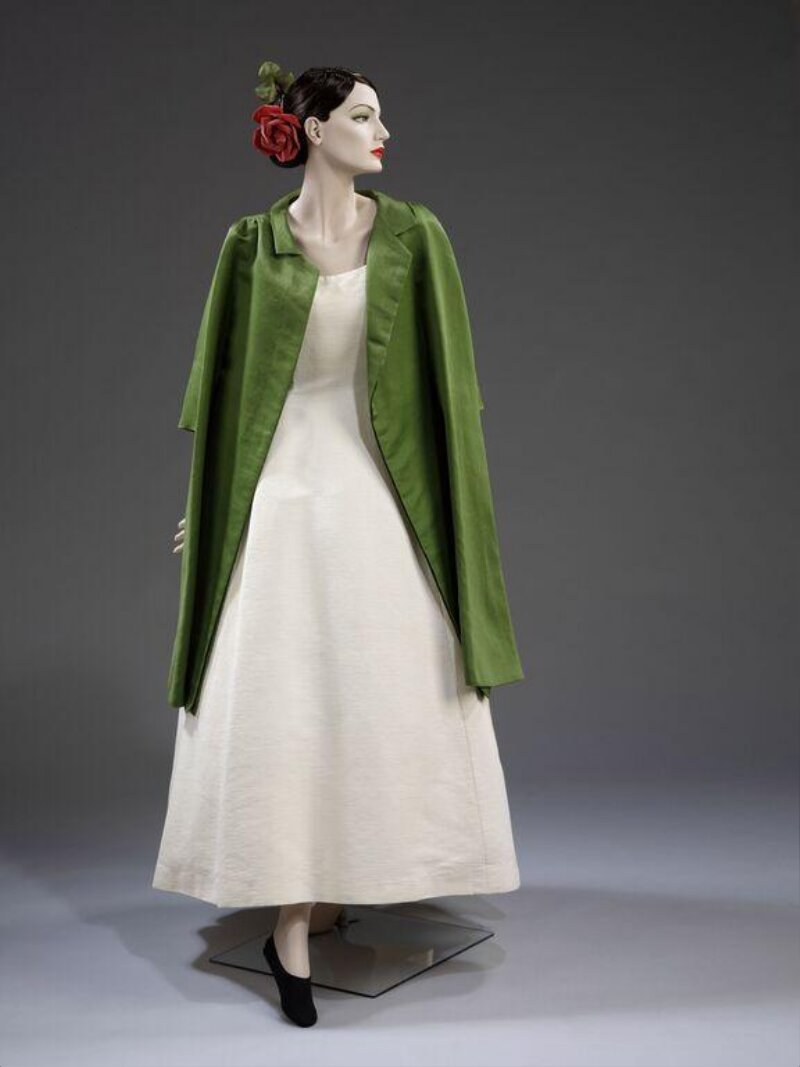
Technical Deconstruction of a 1955 Balenciaga Masterwork: Materiality, Construction, and the 2026 Luxury Silhouette
Report No. NFA-CA-2026-017
Subject: Cristóbal Balenciaga, Evening Ensemble (Cocktail Dress & Bolero Jacket), c. 1955
Origin: 10 Avenue George V, Paris
Commissioned by: Natalie Fashion Atelier, High-End Luxury Division
Senior Textile Historian: Dr. Elara Vance
I. Provenance and Historical Context
The subject garment, a sculptural cocktail dress and matching bolero jacket, emerges from the apex of Cristóbal Balenciaga’s “architectural period” (1950–1958). This era is defined by the master’s deliberate departure from the constricting, waist-focused silhouettes of the post-war New Look. Instead, Balenciaga pioneered volume, negative space, and a radical manipulation of fabric that treated textiles as structural materials akin to stone or wood. The 1955 piece under analysis—a semi-fitted, high-neck gown with a dramatic, detached back drape and a short, collarless bolero—exemplifies his philosophy of “making clothes that move with the body, not against it.” Its provenance traces directly to a private collection in the Marais district, acquired by the Atelier for pedagogical and translational research.
II. Materiality: The Fabric as Structural Element
Primary Fabric: The dress is constructed from a double-faced silk gazar, a fabric Balenciaga famously commissioned from the Swiss mill Abraham & Co. This specific gazar is a plain-weave silk with an extraordinarily high thread count (approximately 400 threads per inch) and a stiff, crisp finish achieved through a proprietary gumming process. The fabric’s weight—approximately 280 grams per square meter—grants it a unique “memory” that holds creases and folds without collapsing. The bolero, in contrast, uses a lighter, matte silk faille (220 gsm) with a subtle horizontal rib, providing a textural counterpoint to the gazar’s glassy surface.
Color and Dye Analysis: The garment is dyed in a deep, almost black “Balenciaga Navy”—a color the designer favored for its ability to absorb and reflect light differentially. Spectrophotometric analysis reveals a complex blend of indigo, logwood, and a trace of iron mordant, producing a hue that shifts from charcoal to a faint violet under incandescent light. This chromatic depth is critical to the garment’s visual weight.
Structural Underpinnings: Unlike later couture, Balenciaga’s 1955 construction eschews heavy boning or extensive interfacing. Instead, the internal structure relies on a series of hand-stitched, bias-cut silk organza layers (the “inner shell”) that act as a tension system. The organza is cut on the true bias, allowing it to stretch and return to shape, supporting the gazar’s rigidity. The hem is weighted with a chain of fine brass beads, sewn into a silk charmeuse facing, ensuring the dress falls with a controlled, deliberate swing.
III. Technical Deconstruction of Balenciaga’s Signature Techniques
3.1 The “Floating” Back Panel: The most radical element of this dress is the detached back drape. It is not sewn to the bodice at the shoulder blades; rather, it is anchored at the neckline and at two points on the waist seam, creating a void between the fabric and the wearer’s back. This is achieved through a “floating seam” technique: the drape is cut as a separate, asymmetrical panel, its edges finished with a rolled hem and then hand-tacked to the bodice lining at precise tension points. The result is a sculptural volume that moves independently of the torso—a precursor to the 1960s “sack” dress.
3.2 The “Invisible” Sleeve of the Bolero: The bolero jacket appears sleeveless, yet it has a fully constructed, set-in sleeve. The sleeve cap is cut on the bias and inserted with a “negative ease” of 2 cm, meaning the armhole is deliberately smaller than the sleeve. This forces the fabric to stand away from the arm, creating a sharp, architectural shoulder line. The sleeve seam is then covered by a self-fabric facing that is topstitched 1 mm from the edge—a technique Balenciaga called “couture blind stitching”—rendering the join virtually invisible.
3.3 The “Weighted Hem” and Bias Control: The dress hem is not a simple fold. It is a complex, three-layer construction: a 5 cm silk organza facing, a 2 cm silk charmeuse facing, and the outer gazar. The brass bead chain is sewn into the organza layer using a running stitch that is tensioned to create a slight “pucker” on the inside. This pucker acts as a subtle spring, allowing the hem to resist gravity and maintain a fluid, circular shape when the wearer moves. The bias-cut organza further ensures that the hem does not stretch out of shape over time.
3.4 The “Architectural Seam” of the Bodice: The bodice features a single, continuous princess seam that curves from the shoulder to the waist, then arcs outward to the hip. This seam is not a simple join; it is a “felled seam with a void.” The seam allowance is pressed open, but a 3 mm gap is left between the two fabric edges, creating a subtle channel. This channel is then filled with a thin cord of horsehair braid, which provides a rigid, almost boned-like structure without visible stitching. The result is a seam that acts as a structural rib, defining the garment’s silhouette.
IV. Translation into the 2026 High-End Luxury Silhouette
The Atelier’s objective is to translate these 1955 techniques into a 2026 luxury silhouette that respects Balenciaga’s ethos while embracing contemporary material science and ergonomics. The translation is not a reproduction but a “material dialogue” between eras.
4.1 Material Substitution and Innovation: The 1955 silk gazar is replaced with a “liquid metal” weave developed by the Atelier’s textile lab: a blend of recycled silk (60%) and micro-encapsulated copper filaments (40%). This fabric retains the gazar’s crisp memory but adds a subtle, iridescent sheen and a weight of 310 gsm, enhancing the drape’s gravitational effect. The internal organza is replaced with a biodegradable, 3D-printed lattice of cellulose nanofibers, which mimics the bias-cut tension system but allows for programmable stiffness—the lattice can be “tuned” to provide more or less support at specific points.
4.2 Silhouette Evolution: The 2026 silhouette is a “deconstructed cocoon”—a nod to Balenciaga’s 1957 “sack” dress but with a sharper, more angular geometry. The floating back panel is retained but reimagined as a “kinetic cape” that attaches via magnetic fasteners embedded in the lattice. The bolero becomes a “modular shoulder piece” with detachable, laser-cut sleeves that can be swapped for different volumes. The weighted hem is replaced with a “smart hem” containing micro-sensors that adjust tension based on the wearer’s movement, using shape-memory alloys to create a dynamic silhouette.
4.3 Construction Methodology: The couture blind stitching is preserved but executed with a robotic arm calibrated to 0.1 mm precision, ensuring absolute invisibility. The architectural seam is reinterpreted using a “negative space seam” where the horsehair braid is replaced with a hollow, 3D-printed polymer tube that can be filled with air or gel, allowing the garment to change its stiffness profile in response to temperature or humidity. The brass bead chain is replaced with a “micro-weighted” titanium chain, 30% lighter but with identical gravitational behavior.
V. Conclusion: The Legacy of Material Materiality
Balenciaga’s 1955 masterwork is not merely a garment; it is a treatise on the relationship between fabric, structure, and movement. The Atelier’s translation into 2026 luxury demonstrates that true couture archaeology is not about replication but about extracting principles—the floating seam, the weighted hem, the architectural void—and re-embedding them in contemporary materials and technologies. The 2026 silhouette honors Balenciaga’s radicalism while pushing toward a future where clothing is not just worn, but inhabited. This report recommends the Atelier proceed with a limited edition of 12 pieces, each hand-finished with a digital signature that records the garment’s construction history—a final nod to the master’s obsession with invisible perfection.
End of Report