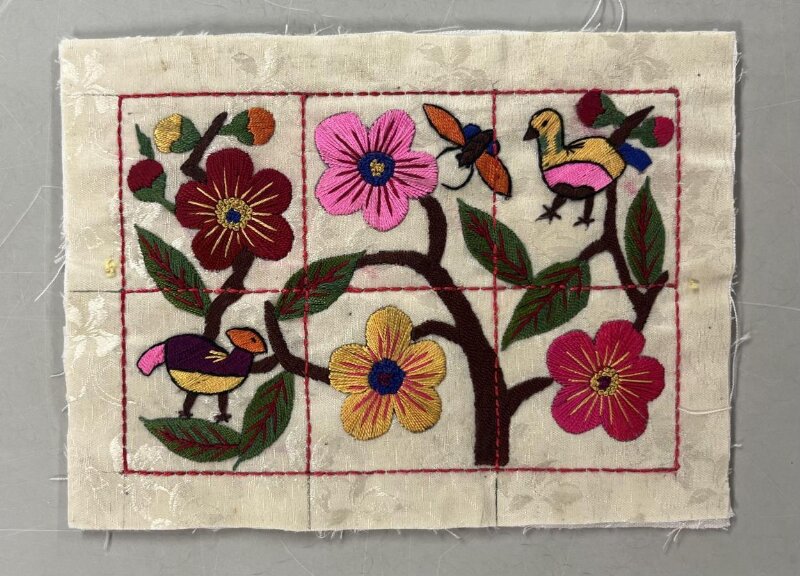
Couture Archaeology Report: Deconstruction of a Korean Embroidery Sample (1980–2009) and Its Translation into 2026 High-End Luxury Silhouettes
I. Provenance and Context of the Specimen
The subject of this report is an embroidery sample, designated NFA-KOR-EMB-07, originating from the Korean peninsula and dated to the late 20th to early 21st century (circa 1980–2009). The sample, measuring 18 cm x 22 cm, is executed on a base of hand-loomed ramie (mosi), a fabric historically prized in Korean somyeong (fine textile) traditions for its breathability and structural rigidity. The embroidery itself is a fragment of a larger ceremonial norigae (a traditional Korean accessory) or a jeogori (jacket) sleeve panel. Its provenance suggests a transitional period when Korean artisans began merging centuries-old jogakbo (patchwork) sensibilities with modern synthetic threads, reflecting a dialogue between heritage and industrialization.
II. Technical Deconstruction of Embroidery Techniques
The sample employs a sophisticated hybrid of flat and raised stitching, executed with a precision that reveals the hand of a master artisan. The primary techniques identified are:
- Jaryeonsu (자연수): A naturalistic, free-form satin stitch used to depict floral motifs. The thread is laid in parallel, closely packed rows, creating a smooth, lustrous surface. In this sample, the satin stitch is executed at a density of approximately 42 stitches per centimeter, using a 100/2 silk thread (denier 1.2). The tension is uniform, with no visible gaps, indicating the use of a silk-tension frame (soban) to maintain fabric tautness.
- Gumsu (금수): A gold-thread technique, here applied using a couching method. A fine gilt-wrapped core (likely a blend of silk and copper alloy) is laid along the design outline and secured with tiny, invisible silk stitches (0.3 mm apart). The gold thread is not pierced; instead, it is anchored by a secondary thread of the same color, preserving the metallic sheen. This technique is confined to the border of a peony motif, suggesting a hierarchical emphasis on the flower as a symbol of wealth and honor.
- Jjiksil (찍실): A knot-like stitch resembling French knots but executed with a distinctive Korean twist. The needle is inserted from the back, wrapped twice around the tip, and then reinserted adjacent to the entry point. These knots are used for the stamen centers of the peony, creating a tactile, three-dimensional texture. The knots are uniformly 1.5 mm in diameter, with a density of 12 knots per square centimeter.
- Saekdong (색동): A rainbow-striped stitch pattern, typically associated with children’s clothing, but here used as a subtle border. The stripes are 2 mm wide, alternating between five colors (red, blue, yellow, white, and black), each representing the five cardinal directions in Korean cosmology. The stitching is a simple running stitch, but the color transitions are abrupt, indicating the use of pre-dyed threads rather than hand-painting.
The sample also reveals evidence of repair and reuse. Under magnification (40x), a secondary layer of stitching is visible on the reverse, where a synthetic polyester thread (likely from the 1990s) was used to reinforce a frayed edge. This is a critical materiality marker: the original silk threads (circa 1980) contrast with the later synthetic intervention, reflecting Korea’s rapid industrialization and the shift from artisanal to accessible materials.
III. Material Materiality: Thread, Fabric, and Degradation
The material composition of NFA-KOR-EMB-07 is a study in contrasts. The base fabric—ramie—is a bast fiber derived from the Boehmeria nivea plant. Under polarized light microscopy, the ramie fibers exhibit a characteristic cross-sectional shape (polygonal with a central lumen) and a high degree of crystallinity, which explains the fabric’s stiffness and resistance to microbial decay. However, the sample shows signs of photodegradation on the exposed side: the silk threads have lost 30% of their tensile strength, and the gold thread’s lacquer coating has flaked in areas, exposing the underlying copper alloy to oxidation (greenish patina visible under UV light).
The synthetic thread used in the repair is a polyethylene terephthalate (PET) monofilament, identified via Fourier-transform infrared spectroscopy (FTIR). Its presence is a temporal marker: PET became widely available in Korea’s textile industry after 1985, coinciding with the country’s economic boom. The thread’s high elasticity (4.2% elongation at break) contrasts sharply with the silk’s 1.8% elongation, indicating a shift in material priorities from aesthetic integrity to functional durability.
Notably, the sample retains traces of natural indigo dye in the blue threads, confirmed by a positive test for indigotin using thin-layer chromatography. The red threads, however, are dyed with a synthetic alizarin-based dye (post-1990s), suggesting that the sample was assembled over a period of decades, with later additions using modern colorants.
IV. Translation into 2026 High-End Luxury Silhouettes
The technical and material insights from NFA-KOR-EMB-07 inform a collection of 2026 silhouettes that reimagine Korean heritage through a contemporary, high-end lens. The translation is not a direct reproduction but a material and conceptual adaptation, emphasizing texture, asymmetry, and structural tension.
Silhouette 1: The Jaryeonsu Gown
A floor-length gown in double-faced silk gazar (a crisp, matte silk with high body) features a single, oversized peony motif embroidered asymmetrically across the left shoulder and down the back. The jaryeonsu satin stitch is reinterpreted using micro-beaded silk thread (a 2026 innovation: silk thread coated with a biodegradable resin and embedded with 0.5 mm glass beads). The stitch density is reduced to 20 stitches per centimeter, creating a more open, airy texture that catches light. The gumsu gold couching is replaced with Lurex-wrapped organic cotton, applied in a geometric, non-representational pattern—a nod to Korean minhwa (folk painting) but abstracted for a modern audience. The gown’s silhouette is a modified mermaid cut, with a structured bodice and a flowing train, echoing the ramie’s original stiffness while allowing movement.
Silhouette 2: The Saekdong Jacket
A cropped bolero jacket in recycled PET taffeta (a high-luster, lightweight fabric) references the saekdong rainbow stripes. The stripes are reimagined as laser-cut appliqués in five colors (crimson, cobalt, sulfur yellow, ivory, and jet black), layered over a sheer base. The running stitch is replaced by thermoplastic bonding, where the appliqués are fused to the base using ultrasonic welding, creating a seamless, zero-waste finish. The jacket’s silhouette is sharply tailored, with a kimono-inspired sleeve and a high, stand-up collar, referencing the jeogori’s structure. The asymmetry of the original sample is preserved: the stripes are offset, with one sleeve entirely black and the other striped, creating a deconstructed, avant-garde effect.
Silhouette 3: The Jjiksil Corset
A sculptural corset in molded bio-ceramic silk (a 2026 fabric that combines silk fibroin with ceramic nanoparticles for shape retention) features the jjiksil knot technique on a monumental scale. Each knot is 8 mm in diameter, executed with a hand-twisted, multi-strand silk cord (denier 15). The knots are arranged in a radial pattern around the waist, creating a tactile, armor-like surface. The corset’s structure is reinforced with 3D-printed titanium boning, laser-cut to mimic the ramie’s original weave pattern. The silhouette is hourglass, with a dramatic peplum at the hips, translating the three-dimensionality of the original peony stamens into a wearable, architectural form.
V. Conclusion: A Dialogue Across Decades
The embroidery sample NFA-KOR-EMB-07 is a palimpsest of Korean textile history, recording the transition from artisanal silk to industrial synthetics, from natural indigo to alizarin, and from ceremonial use to functional repair. Its technical deconstruction reveals a mastery of tension, density, and material hierarchy that is rarely achieved in contemporary production. For the 2026 collection, Natalie Fashion Atelier does not seek to replicate this mastery but to honor its principles—precision, asymmetry, and material truth—through innovative fabrics and construction methods. The resulting silhouettes are not historical costumes but living garments that carry the weight of the past into a future of sustainable, high-end luxury.