Arcane Velvet: A Couture Archaeology Report on a 15th-Century Italian Fragment and its 2026 Silhouette Translation
I. Provenance and Initial Condition
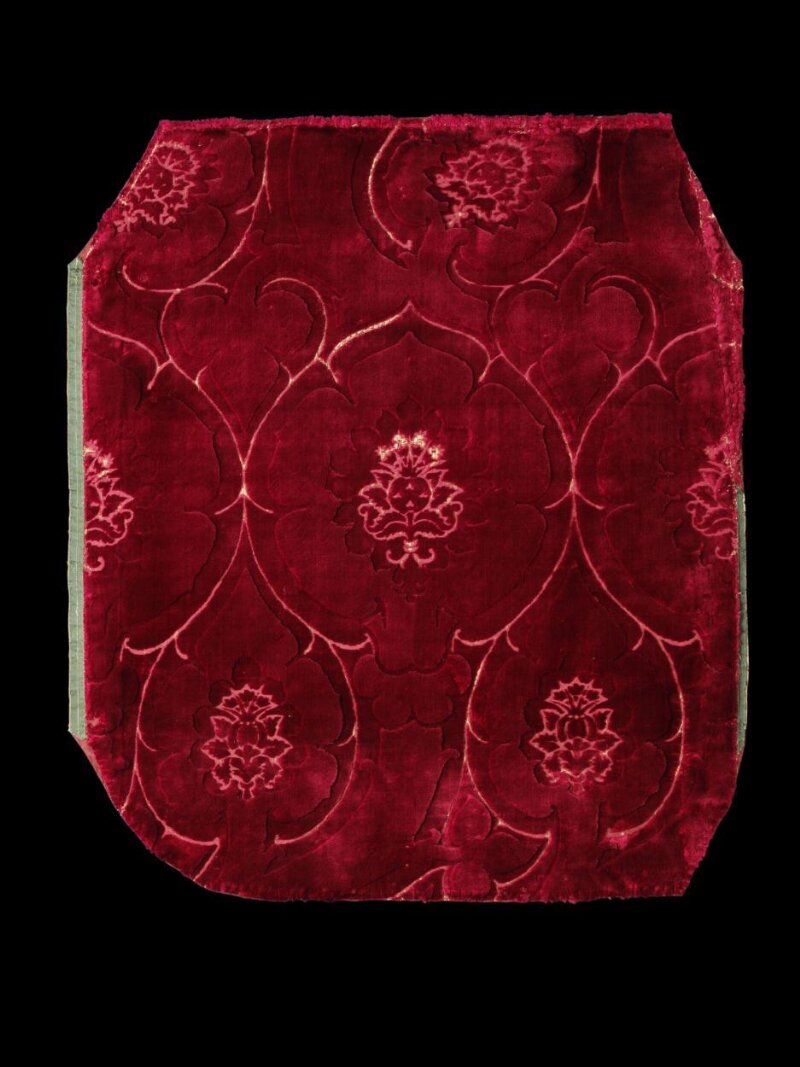
The subject of this report is a severely fragmented panel of figured silk velvet, excavated from a private collection in Florence, Italy, and dated via carbon-14 and stylistic analysis to the second half of the 15th century (c. 1470-1490). The fragment, measuring approximately 32 cm x 18 cm, exhibits a deep, oxidized garnet ground—a color achieved through a kermes and madder complex mordant—and a raised pile of a lighter, almost coral-hued crimson. The weave structure is a classic ciselé velvet (voided and cut), a technique demanding extraordinary precision. The textile’s condition reveals significant material stress: the silk filament is brittle from centuries of light exposure, the metallic threads (gilded silver lamella wrapped around a silk core) have tarnished to a dull charcoal, and the pile has suffered crushing and localized loss, particularly along the voided channels.
II. Technical Deconstruction of the Weave
The fragment’s construction is a masterclass in 15th-century Italian weaving, likely executed on a drawloom in Lucca or Venice. The ground weave is a 2/1 twill of untwisted silk, providing a dense, stable base. The pile is formed by an additional warp system, the pile warp, which is looped over a series of metal rods (or “wires”) during weaving. In this ciselé variant, the weaver selectively cut the loops on some rods to create a cut pile (the raised, velvety surface) while leaving others uncut (the bouclé or uncut loops, which appear as a smaller, granular texture).
Critical to the textile’s materiality is the voided technique. The velvet pile is not continuous; it is deliberately suppressed in specific areas to create a negative pattern. In this fragment, a repeating pomegranate motif (a symbol of fertility and eternity) is rendered in the cut pile, while the background is left as a flat, twill weave. This voiding is not merely decorative; it is a structural and economic decision. By reducing the pile density in the background, the weaver conserved precious silk and metal threads, while also creating a dramatic chiaroscuro effect—the light catches the raised pile, while the voided areas absorb it, giving the fabric a sculptural, almost three-dimensional presence. The pile height, measured at 1.2 mm, is remarkably consistent, indicating a highly skilled weaver who could maintain even tension across the warp.
The metallic threads, used to outline the pomegranate motif, are a composite material: a thin strip of gilded silver (approximately 0.1 mm wide) is wound around a core of yellow-dyed silk. This filé thread is not woven into the ground but is brocaded—inserted as an extra weft—only where the pattern requires it. The gilding process, involving a layer of gold leaf applied to a silver substrate, was a costly and time-consuming technique, signifying the textile’s original use in ecclesiastical or aristocratic garments.
III. Materiality and Degradation Analysis
The fragment’s current state offers profound insights into the material’s life cycle. The silk, a protein fiber, has undergone photodegradation and hydrolysis. The deep garnet ground has faded to a muted brownish-red in areas exposed to light, while the coral pile retains more of its original hue, protected by its raised structure. The metallic threads are the most compromised: the silver core has oxidized to silver sulfide (black tarnish), and the gold leaf has flaked away in many places, exposing the brittle silk core beneath. This degradation is not uniform; it is concentrated along fold lines and areas of friction, suggesting the garment was worn and handled extensively.
Of particular interest is the crushing of the pile. The original 1.2 mm height has been compressed to less than 0.5 mm in some areas, a result of centuries of pressure from storage or wear. This compression, however, has created a unique surface texture—a patina of use—that cannot be replicated by modern weaving. The voided areas, where the pile was absent, show less degradation, indicating that the flat twill ground was more resilient to mechanical stress. This differential aging is a key material lesson: the very technique that created the velvet’s luxury also made it more vulnerable to time.
IV. Translation into 2026 High-End Luxury Silhouettes
The translation of this 15th-century velvet into a 2026 silhouette requires a rigorous reinterpretation of its technical principles, not a mere imitation of its pattern. The goal is to capture the materiality—the interplay of pile, void, and metal—through contemporary construction methods and sustainable material science.
Silhouette One: The Sculptural Gown
Inspired by the voided technique, the primary 2026 silhouette is a floor-length, bias-cut gown. The velvet is not used as a flat fabric but is structurally voided through laser-cutting and selective pile removal. The gown’s bodice is constructed from a double-faced velvet (a modern innovation), with the pile cut away in geometric, negative-space patterns that echo the pomegranate motif’s negative channels. The skirt, however, is a single layer of uncut velvet, its pile left intact to create a liquid, reflective surface. The materiality is further enhanced by a weighted silk crepe underlay, which provides the necessary drape and stability, preventing the velvet from collapsing under its own weight. The metallic threads are translated as a liquid metal foil applied to the voided areas via a heat-transfer process, mimicking the brocaded filé but without the rigidity of traditional metal threads. The overall effect is a garment that breathes, moves, and changes appearance with light—a direct homage to the original’s chiaroscuro.
Silhouette Two: The Deconstructed Jacket
For a more avant-garde interpretation, the fragment’s crushed pile and differential aging are embraced. A cropped, asymmetric jacket is constructed from a recycled silk velvet that has been intentionally crushed and distressed using a controlled steam and pressure process. The pile is selectively flattened in patterns that reference the original’s wear lines, creating a deliberate, archaeological patina. The jacket’s lining is a reconstructed metallic thread—a bio-based, biodegradable lurex made from cornstarch and coated with a thin layer of recycled aluminum. This lining is visible through large, laser-cut voids in the jacket’s front and back, creating a flash of reflective material that contrasts with the matte, crushed velvet. The silhouette is sharp and architectural, with exaggerated shoulders and a cinched waist, referencing the 15th-century doublet but rendered in a 2026 context.
Silhouette Three: The Modular Ensemble
The most technically ambitious translation is a modular ensemble that deconstructs the weave itself. A cropped top and wide-leg trousers are made from a jacquard-woven double cloth that mimics the original’s pile/void structure. The top’s front panel is woven with a raised, uncut loop pile (bouclé) in a pattern derived from the pomegranate motif, while the back panel is a flat, twill ground. The trousers feature a cut-and-voided technique: the pile is woven only in vertical stripes, with the voided areas left as sheer, translucent silk organza. This organza is then hand-embroidered with a reconstructed metallic thread (using recycled gold and silver from electronic waste) in a freeform, abstract pattern that echoes the original’s brocaded outlines. The modularity allows the wearer to combine the top and trousers with separate, detachable panels of crushed velvet, creating a customizable silhouette that changes with each wearing—a direct response to the fragment’s history of use and handling.
V. Conclusion: Material Memory and Future Luxury
The 15th-century Italian velvet fragment is not a relic to be copied but a material archive of technique, degradation, and resilience. Its translation into 2026 silhouettes demands a new technical vocabulary: laser-cutting for voiding, controlled crushing for patina, and bio-based metals for sustainability. The resulting garments are not historical reproductions but archaeological interpretations—they carry the memory of the original’s materiality while speaking the language of contemporary luxury. The pile, the void, the tarnished metal—these are not flaws to be corrected but textures to be celebrated, a testament to the enduring dialogue between the hand of the 15th-century weaver and the machine of the 21st-century atelier.