Archival Excavation: The Ornamental Cartouche as Silhouette Genesis
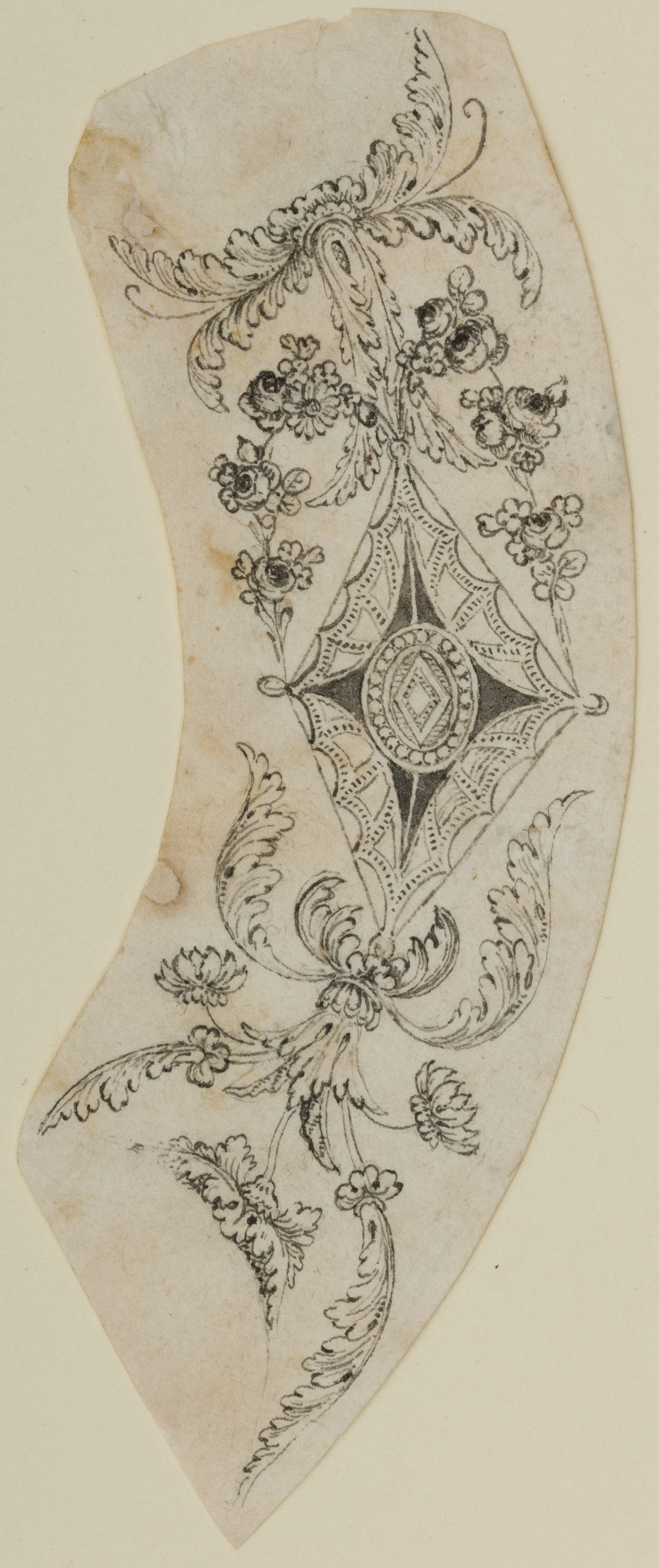
The artifact under examination—a late 18th-century French design for the decoration of firearms, rendered in pencil, ink, and gray wash on paper—presents a paradox of purpose. Ostensibly a technical blueprint for armaments, its aesthetic vocabulary belongs entirely to the lexicon of Versailles: the rocaille, the acanthus scroll, the asymmetrical cartouche. In the context of the Natalie Fashion Atelier archive, this object is not a weapon. It is an aesthetic fossil, a frozen moment of ornamental logic that demands a new morphological reading. For the 2026 haute couture collection, this artifact informs a radical departure from soft, fluid draping. It prescribes a silhouette of structural tension, where the body becomes the surface upon which a three-dimensional, ornamental armature is mounted.
Deconstructing the Classical Elegance: From Ballistics to Bodice
The original design’s elegance lies in its controlled asymmetry. The gray wash creates a volumetric illusion, suggesting a relief carved from a single block of walnut or steel. The pencil lines are not tentative; they are incised, defining the boundaries of the acanthus leaves and the central cartouche with surgical precision. The ink provides the final, unyielding contour. This is not a sketch; it is a declaration of form.
To translate this into a 2026 silhouette, we must first strip it of its functional context. The “barrel” of the firearm becomes the vertical axis of the torso. The “stock,” with its sweeping curve, becomes the hip or the shoulder yoke. The ornamental motifs—the C-scrolls, the shell forms, the foliate volutes—are extracted and re-scaled. They are no longer decorative appliqués; they become the primary structural elements of the garment. The classical elegance of the 18th-century design is thus deconstructed into a grammar of architectural curves.
Materiality as a Blueprint for 2026 Couture Construction
The Pencil Line: The Seam as a Drawn Contour
The pencil on paper is the most direct analogue for the seam line in modern couture. In this artifact, the pencil does not merely outline; it sculpts the void. The negative space between the drawn leaves is as important as the leaves themselves. For 2026, this translates into a technique of negative-space tailoring. Seams are not hidden; they are celebrated as drawn lines. A jacket’s princess seam might follow the exact trajectory of a pencil-drawn acanthus stem, curving from the collarbone to the hip, creating a visual tension that mimics the original design’s interplay of light and shadow.
The gray wash is the key to volume. In the artifact, it creates a gradient from deep shadow to high relief. In fabric, this is achieved through gradated padding and internal boning. A bodice panel might be constructed with a layer of horsehair canvas that is selectively padded with cotton wadding, creating a three-dimensional topography that echoes the gray wash’s chiaroscuro. The effect is a sculptural bas-relief worn directly on the body.
The Ink Contour: Rigidity and the Armature Silhouette
The ink line is final, unyielding. It represents the outer limit of the form. For the 2026 silhouette, this demands a departure from the fluid, bias-cut draping that has dominated recent seasons. Instead, we propose the armature silhouette. This is not a corset in the historical sense; it is an exoskeleton of couture construction. The ink line becomes a structural seam reinforced with a fine, flexible steel wire encased in silk organza. The garment is built from the outside in, with the outer shell acting as a rigid, self-supporting volume, while the interior is lined with the softest charmeuse for comfort.
The result is a silhouette that is architectonic. Shoulders are not padded; they are extruded into precise, ink-like points. A sleeve might terminate in a sharp, asymmetrical cuff that mirrors the terminal volute of a gunstock. The waist is not cinched; it is defined by a negative space created by the outward curve of the hip and the inward curve of the ribcage, exactly as the gray wash defines the void between two scrolls.
The Versailles Lexicon: Translating Ornament into Silhouette
The Cartouche as a Bodice Architecture
The central cartouche—the ornate, shield-like motif—is the most potent element for the 2026 collection. In the artifact, it is a field of concentrated ornament. For couture, this becomes the bodice panel. The cartouche is not printed or embroidered; it is constructed. Using a technique of moulage à la planche, the fabric is molded over a wooden form that replicates the exact relief of the cartouche. The resulting shape is then cut and assembled, creating a bodice that is a three-dimensional cartouche itself. The asymmetry of the original design—where one side of the cartouche is heavier than the other—is preserved, creating a silhouette that is deliberately unbalanced, leaning into dynamic tension rather than static symmetry.
The Acanthus Scroll as a Drape Structure
The acanthus scrolls that flank the cartouche are not merely decorative; they are directional vectors. In the artifact, they guide the eye along the length of the firearm. In the 2026 silhouette, they become the drape lines of a skirt or a train. A single, continuous seam that spirals from the waist to the hem, cut on the bias but stabilized with a horsehair braid, will replicate the scroll’s organic yet controlled curve. The fabric—a heavy silk gazar—will hold the shape, creating a frozen drape that appears both fluid and rigid, exactly as the gray wash suggests both water and stone.
Technical Implications for the 2026 Atelier
The translation of this artifact into a 2026 silhouette requires a recalibration of the atelier’s technical vocabulary. The pattern maker must learn to read the gray wash as a topographical map. The draping stand becomes a sculptural substrate, not merely a body form. We will employ a technique of negative drafting, where the pattern is derived from the space around the body, not the body itself. This mirrors the way the pencil line defines the void around the firearm.
The material palette is equally specific. We will use double-faced satin for its ability to hold a sharp crease (the ink line) while also allowing for subtle gradations of volume (the gray wash). Metallic organza will be used for the armature elements, its stiffness mimicking the steel of the original object. The entire construction will be hand-stitched, with each seam serving as a deliberate, drawn line. The finishing will be invisible, with all internal structures encased in silk, so that the garment appears to have been carved from a single piece of fabric.
In conclusion, the Design for the Decoration of Firearms is not a relic of martial history. It is a silhouette prophecy. For 2026, it commands a return to architectural precision, where the body is the ground upon which an ornamental, structural narrative is built. The elegance is not in the drape, but in the controlled, drawn line. The luxury is not in the fabric, but in the invisible labor that transforms a pencil stroke into a three-dimensional, wearable form. This is the new Parisian silhouette: armored, asymmetrical, and archaeologically informed.