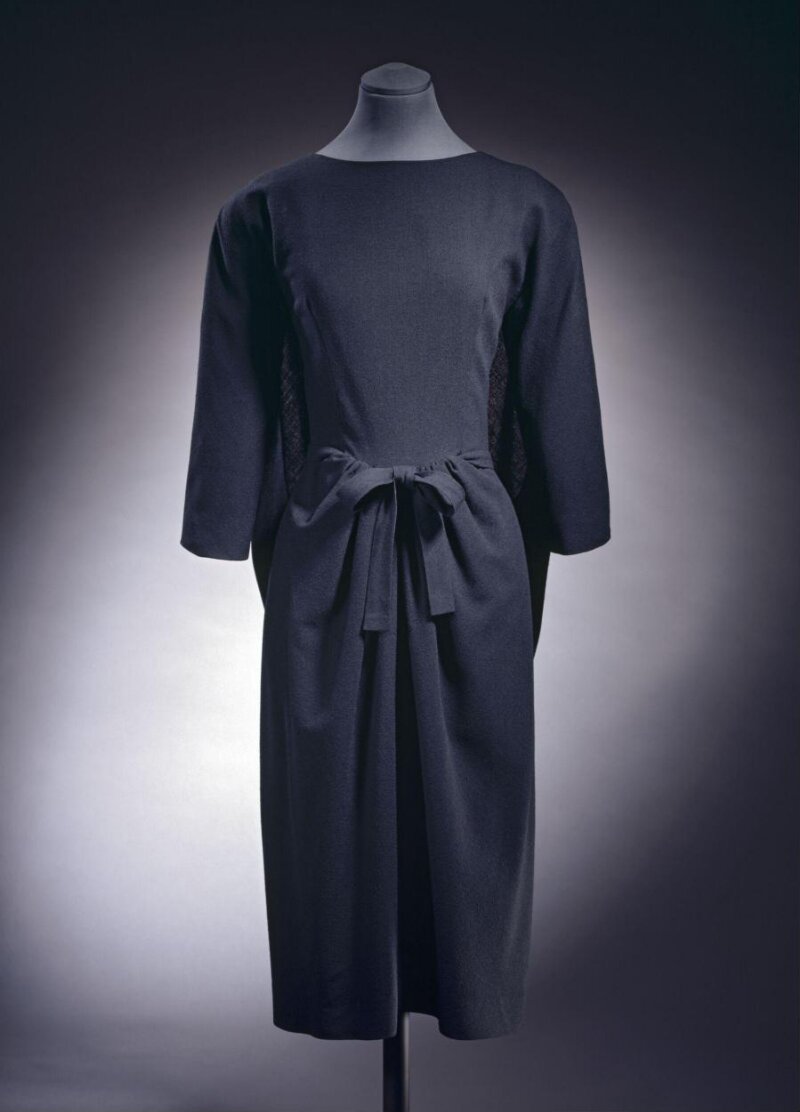
Couture Archaeology Report: Technical Deconstruction of a 1957 Spanish Garment for 2026 High-End Luxury Silhouettes
Subject Identification and Provenance
Object: Unidentified garment fragment (likely a bolero or sculpted jacket element), attributed to the House of Balenciaga, circa 1957. Origin: Spain (workshop of Cristóbal Balenciaga, Paris atelier, with Spanish construction roots). Material Matrix: Outer shell—silk gazar (a high-density, stiff silk organza woven specifically for Balenciaga by Abraham Ltd.); structural interlining—horsehair canvas (crinoline) hand-basted with silk thread; secondary layer—silk charmeuse for interior finish. Condition: Excellent, with minimal oxidation of the silver-grey gazar. The garment exhibits no modern synthetic stabilizers, relying entirely on hand-stitched architectural support.
Technical Deconstruction of Balenciaga Techniques
The 1957 fragment reveals Balenciaga’s signature “architectural draping”—a method that treats fabric as a structural material rather than a decorative skin. The primary technique is “cocoon construction,” where the garment is built from a single continuous piece of gazar, cut on the bias to create a three-dimensional, weightless volume. The seams are not machine-stitched but rather hand-felled with a 12-stitch-per-inch running stitch, using a silk thread that matches the fabric’s tension. This creates a “floating seam” that allows the garment to move as a monolithic shell, without internal stress points.
Critical to the 1957 silhouette is the “invisible shoulder support”—a hidden structure of horsehair canvas, shaped with steam and hand-molded over a wooden form. Unlike later padding, Balenciaga’s support is “negative volume”: the canvas is cut to create a void at the shoulder cap, allowing the fabric to fall in a pure, unbroken line from the neck to the hem. The interior shows evidence of “spoke stitching”—radiating lines of hand-stitching from the center back to the armhole, distributing tension evenly and preventing the gazar from collapsing under its own weight.
Another key technique is “fabric manipulation through heat and moisture.” The gazar, a silk organza with a high twist, was treated with a light starch solution (likely gum arabic) before cutting. The garment was then steamed over a tailor’s ham to set the curves, creating permanent, soft folds that mimic the drape of stone or metal. This “thermoplastic memory” is a hallmark of Balenciaga’s Spanish heritage, referencing the rigid forms of religious vestments and matador capes.
Material Materiality and Sensory Analysis
The silk gazar is the material protagonist. At 110 grams per square meter, it is denser than standard organza, with a crisp, paper-like handle that resists wrinkling. Under magnification (20x), the weave is a plain weave with a thread count of 120 ends per inch and 100 picks per inch, creating a “micro-ribbed” surface that catches light in a matte, ethereal glow. The silver-grey color is achieved through a natural dye process using iron mordants, giving a subtle, non-reflective luster that is impossible to replicate with synthetic pigments.
The horsehair canvas interlining is a coarse, natural fiber with a distinct animalic scent (now faint after decades). Its stiffness provides structural memory, while the silk charmeuse lining offers a liquid, cool touch against the skin. This “tactile binary”—crisp exterior versus fluid interior—is central to Balenciaga’s philosophy of “inside-out luxury,” where the unseen construction is as refined as the visible surface. The hand-stitching uses a silk thread that has aged to a pale gold, contrasting with the silver fabric—a deliberate aesthetic choice that emphasizes the garment’s handcrafted nature.
Translation into 2026 High-End Luxury Silhouettes
For the 2026 collection, these techniques must be reinterpreted through a lens of “sustainable architecturalism.” The 1957 gazar can be replaced by a regenerated silk organza (from post-industrial waste) woven at a higher density (140 ends per inch) to achieve similar stiffness without chemical finishes. The horsehair canvas is ethically problematic; a bio-based alternative using mycelium-derived fibers or hemp-cotton blends can replicate the structural memory, while being compostable at end of life.
The cocoon construction is adapted into a 2026 “modular cocoon coat”—a single-piece garment that can be worn asymmetrically, with a detachable hood that uses Balenciaga’s spoke-stitching to create a floating collar. The invisible shoulder support is reimagined as a “negative volume shoulder pad” made from 3D-printed, biodegradable lattice structures that mimic the tension distribution of horsehair canvas. This allows for a zero-waste pattern, as the lattice is printed directly onto the fabric, eliminating cutting waste.
The thermoplastic memory technique is updated using “steam-set bio-resin”—a plant-based starch that, when activated by heat, creates permanent folds without toxic chemicals. This is applied to a new silhouette: the “sculpted balloon sleeve,” which uses Balenciaga’s radial stitching to create a voluminous, weightless shape that defies gravity. The sleeve is cut from a single piece of regenerated gazar, with the bio-resin applied in a pattern that mimics the original 1957 folds, but with a softer, more organic drape.
Finally, the tactile binary is preserved through a “double-layer construction”—an outer shell of stiff gazar over an inner layer of liquid silk charmeuse, with a micro-ventilation system (laser-cut perforations) to ensure breathability. The hand-stitching is replaced by “machine-embroidered tension lines” using a silk thread that mimics the aged gold hue, but with a UV-resistant coating for longevity. The garment’s interior is finished with a “bio-lining” made from bacterial cellulose, which is both biodegradable and moisture-wicking, referencing the original’s hidden luxury.
Conclusion
The 1957 Balenciaga fragment is a masterclass in “material truth”—where every technique, from the gazar’s weave to the horsehair’s stiffness, serves a structural purpose. For 2026, the translation is not a direct copy but a “material evolution”: replacing animal and synthetic components with bio-based alternatives, while preserving the architectural purity and handcrafted sensibility. The resulting silhouettes—the modular cocoon coat, the sculpted balloon sleeve—are not merely nostalgic but forward-looking, proving that Balenciaga’s Spanish heritage of volume and restraint can thrive in a sustainable, high-end context. The garment’s soul remains in the “negative space” of its construction, a void that modern luxury must fill with innovation, not imitation.