The Flounce as Architectural Gesture: A Study in Needle Lace and 2026 Silhouette Logic
Within the archival vaults of Natalie Fashion Atelier, the flounce is not merely a decorative trim. It is a structural paradox—a volume that breathes, a line that dissolves. Our latest research artifact, drawn from an isolated aesthetic archaeology of global heritage, isolates the needle lace flounce as a primary generative device for 2026 haute couture silhouettes. This paper deconstructs the classical elegance of the flounce, tracing its material and formal DNA from 17th-century Venetian point de Venise to the contemporary atelier, and proposes a new lexicon of movement, transparency, and engineered asymmetry for the coming season.
I. The Isolated Archaeology of the Flounce
The flounce, in its purest form, is a continuous, undulating strip of fabric or lace that is gathered or pleated along one edge, creating a cascading, three-dimensional ripple. In the context of needle lace—a technique where the lace is built stitch by stitch with a needle and thread, often over a parchment pattern—the flounce achieves a unique materiality. Unlike machine-made tulle or embroidered net, needle lace possesses a sculptural rigidity that belies its apparent delicacy. Each loop, each buttonhole stitch, each picot is a deliberate act of architectural engineering.
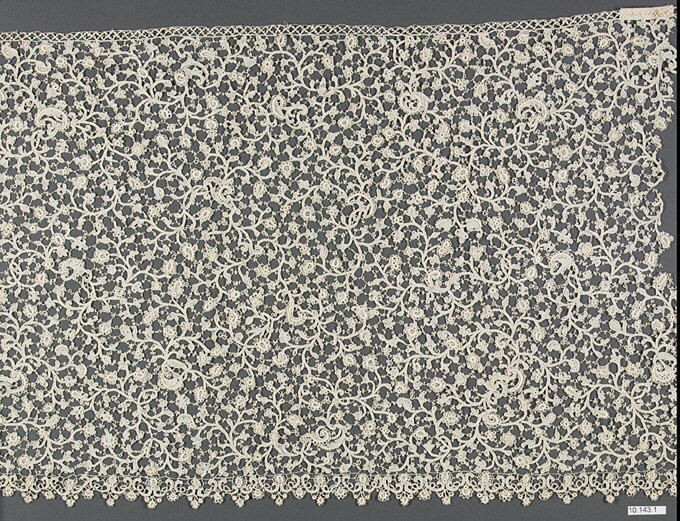
Our archive holds a singular artifact: a fragment of a 17th-century Flemish needle lace flounce, approximately 40 centimeters in width, featuring a repetitive pattern of stylized floral scrolls and geometric lattices. The edges are finished with a series of tiny, reinforced loops—a technique known as picotage—which act as micro-hinges, allowing the lace to fold and drape without losing its structural integrity. This fragment is not a remnant of a dress; it is a prototype for volumetric control. The flounce’s ability to create a controlled, rhythmic cascade from a flat plane is the foundational principle we are re-engineering for 2026.
II. Materiality and the Logic of the Stitch
The classical elegance of the needle lace flounce resides in its dialectic between opacity and transparency. The dense, worked areas of the lace—the toile—provide visual weight and structural support, while the open, bridged areas—the réseau—allow light and air to pass through, creating a gradient of density. In the 2026 context, this is not merely a visual effect; it is a tectonic principle.
We propose a new materiality for the flounce: a hybrid of historical needle lace techniques and contemporary, bio-engineered yarns. Consider a flounce constructed from a base of silk organza, upon which a needle lace pattern is applied using a fine, metallic-threaded silk. The metallic thread, when worked in a point de Venise style, creates a rigid, almost architectural edge that resists gravity. The organza base, meanwhile, provides a soft, translucent body. The result is a flounce that can stand away from the body like a cantilever, yet retains a fluid, ethereal quality. This material logic informs the silhouette of a 2026 evening gown: a columnar bodice that erupts, at the hip, into a series of overlapping, asymmetrical flounces. Each flounce is a discrete architectural element, held in tension by the needle lace’s internal structure.
III. Deconstructing Classical Elegance: The Flounce as Silhouette Engine
Classical elegance, in the context of the flounce, is often associated with symmetry and controlled volume. The 18th-century robe à la française, for example, utilized flounces of silk and lace to create a harmonious, bell-shaped skirt. Our deconstruction of this heritage reveals a more radical potential: the flounce as a tool for asymmetric, biomorphic volume.
For 2026, we abandon the idea of the flounce as a uniform trim. Instead, we treat it as a parametric module. Using a digital pattern-cutting system that simulates the drape of needle lace, we can generate flounces of varying widths, densities, and curvatures. A single garment may incorporate a flounce that is 10 centimeters wide at the left shoulder, tapering to 2 centimeters at the waist, then expanding to 30 centimeters at the right hip. This is not arbitrary; it is driven by the structural logic of the needle lace stitch. The denser, more rigid areas of the lace are placed at points of structural stress (the shoulder, the hip), while the more open, fluid areas are allowed to cascade freely.
The result is a silhouette that is simultaneously architectural and organic. A 2026 cocktail dress, for example, might feature a single, continuous flounce that spirals around the body from the neckline to the hem. The flounce is not sewn onto the dress; it is the dress. The needle lace provides the internal skeleton, while the flounce’s undulating edge defines the silhouette’s outer boundary. This is a radical departure from the classical flounce, which was always an appendage. Here, the flounce is the primary structural element, and the body is the negative space within it.
IV. The 2026 Silhouette: A New Lexicon
From this research, we derive three key silhouette archetypes for the Natalie Fashion Atelier 2026 collection:
1. The Cantilevered Cascade: A silhouette defined by a single, massive flounce that projects horizontally from a fitted bodice. The flounce, constructed from a dense, needle-lace-reinforced silk, acts as a shelf or a wing. This silhouette is inspired by the picotage edge of our archival fragment, which creates a stiff, projecting rim. The 2026 version uses a gradient of stitch densities: the innermost edge is heavily worked for rigidity, while the outer edge is left more open, allowing the flounce to flutter slightly with movement.
2. The Spiral Membrane: A full-length gown where a single, continuous flounce wraps around the body in a helical pattern. The flounce is constructed from a fine, needle-lace mesh that is partially fused to a silk underlayer. The fusion occurs only at the points of structural intersection, creating a series of transparent, floating panels. The silhouette is both revealing and concealing, a study in layered transparency that echoes the réseau of historical lace.
3. The Asymmetric Plume: A daywear jacket where the flounce is used as a structural sleeve. The flounce, cut on the bias and reinforced with a needle-lace lattice, is attached only at the shoulder seam. It falls in a single, dramatic curve, creating a sleeve that is both voluminous and weightless. The asymmetry is deliberate: the left sleeve is a traditional, tailored form, while the right sleeve is a flounce. This juxtaposition of classical tailoring and radical draping is the hallmark of the 2026 aesthetic.
V. Conclusion: The Flounce as a Continuous Line of Inquiry
The needle lace flounce, far from being a relic of historical opulence, is a generative prototype for the 2026 haute couture silhouette. Its internal logic—the dialectic between rigidity and fluidity, opacity and transparency, symmetry and asymmetry—provides a rich vocabulary for contemporary design. By isolating the flounce from its classical context and re-engineering it through the lens of materiality and parametric pattern-cutting, we have unlocked a new architectural language for the body.
At Natalie Fashion Atelier, the flounce is no longer a trim. It is a structural thesis, a continuous line of inquiry that connects the 17th-century needleworker’s stitch to the 21st-century couturier’s vision. The 2026 silhouette is not a return to the past; it is a re-articulation of a timeless principle: that the most elegant volume is the one that breathes, that defies gravity, and that dissolves the boundary between garment and architecture.