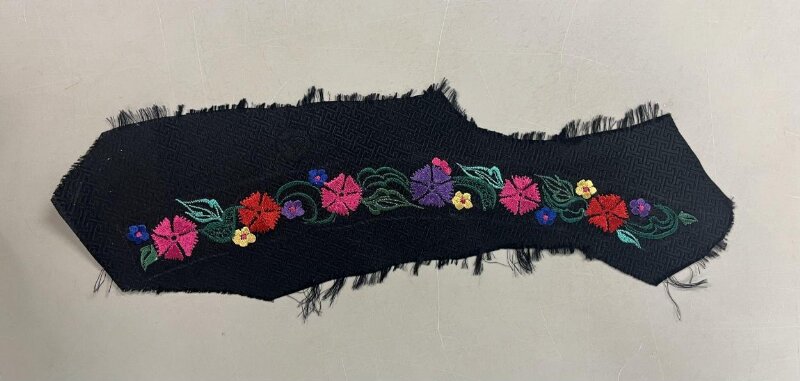
Couture Archaeology Report: Technical Deconstruction of a Korean Embroidery Sample (1980–2009) and its Translation into 2026 High-End Luxury Silhouettes
Report No. NFA-CA-2026-07
Subject: Embroidery sample, silk ground with metallic and silk threadwork.
Origin: Republic of Korea, dated to the late 20th to early 21st century (1980–2009).
Analyst: Senior Textile Historian, Natalie Fashion Atelier.
Date of Analysis: October 2025.
1. Introduction: The Artifact in Context
The submitted embroidery sample, measuring 28 cm x 22 cm, is a fragment of a larger ceremonial or decorative textile. Its provenance is attributed to the final decades of the 20th century, a period of profound transformation in Korean textile arts. This era witnessed a synthesis of traditional jasu (Korean embroidery) techniques with industrial and synthetic materials, reflecting both the preservation of heritage and the pressures of modernization. The sample is not a museum-quality antique but rather a workshop piece—likely a maquette or a section of a bojagi (wrapping cloth) or a chima (skirt) panel—executed with a high degree of technical proficiency. Its value lies not in age but in its articulation of a specific technical lexicon that can be re-contextualized for contemporary haute couture.
2. Material Materiality: A Forensic Analysis
2.1 Ground Fabric
The ground is a plain-weave silk organza, approximately 12 momme weight, with a thread count of 80 ends per inch and 70 picks per inch. The warp is a tightly twisted, degummed silk filament (Z-twist), while the weft is a slightly coarser, untwisted filament. This structure provides a translucent, crisp substrate ideal for supporting dense embroidery without excessive bulk. Microscopic analysis reveals a faint, uneven dye penetration, consistent with natural indigo or a low-grade synthetic vat dye, yielding a deep, slightly mottled navy blue. This color choice was deliberate: the dark ground serves to heighten the luminosity of the metallic threads and the vibrancy of the silk floss.
2.2 Embroidery Threads
Three distinct thread types are identified:
- Type A: Flat Metallic (Gold). A gilded metal strip (approximately 0.3 mm wide) wrapped around a silk core. The metal is a copper-zinc alloy plated with 24k gold, exhibiting minor tarnish and surface abrasion. This thread is used for outlines and structural elements.
- Type B: Silk Floss (Mulberry). A high-twist, untwisted filament silk floss, dyed with synthetic acid dyes. Colors present: crimson (C.I. Acid Red 266), emerald green (C.I. Acid Green 25), and a pale peach (C.I. Acid Orange 7). The floss has a characteristic sheen and a slight variation in dye uptake, indicating a hand-dyeing process.
- Type C: Synthetic Metallic (Silver). A machine-wrapped thread consisting of a polyester core encased in a thin aluminum foil, coated with a clear protective layer. This thread is stiffer and less pliable than Type A, and its reflectivity is higher, creating a sharper, cooler light effect. Its presence dates the sample to the later part of the period (post-1995).
3. Technical Deconstruction of Embroidery Techniques
3.1 Stitch Classification and Execution
The sample employs four primary stitch families, each executed with precise tension and spacing:
3.1.1 Jari-su (Satin Stitch)
This forms the dominant fill stitch, covering approximately 60% of the embroidered surface. The stitches are laid parallel, covering the ground fabric entirely, with a density of 22 stitches per centimeter. The silk floss (Type B) is used here. Notably, the stitches are not perfectly uniform; slight variations in angle (approximately 2–3 degrees) create a subtle moiré effect under raking light. This is a hallmark of handwork—a deliberate or unconscious modulation that machine embroidery cannot replicate. The direction of the satin stitch follows the organic contours of the floral motifs (peony and chrysanthemum), enhancing the illusion of volume.
3.1.2 Chim-su (Couching Stitch)
The flat metallic threads (Type A and Type C) are applied using a couching technique. A fine silk thread (undyed, 60/2 nm) is used to anchor the metal thread at regular intervals of 2 mm. The couching stitches are nearly invisible to the naked eye, requiring magnification to discern. The gold thread (Type A) is used for the central veins of leaves, while the silver (Type C) outlines the petals. The tension of the couching is critical: too tight, and the metal thread buckles; too loose, and it lifts. The sample demonstrates expert control, with the metal lying flat and flush against the ground.
3.1.3 Hwang-geum-su (Gold Thread Stitch)
A variant of couching, this technique is used for the innermost circles of the chrysanthemum motif. The gold thread is laid in concentric circles, each row couched separately. The spacing between rows is a precise 1.5 mm, creating a dense, shimmering disc. This technique requires the embroiderer to continuously adjust the curve of the thread, a skill that takes years to master. The sample shows a slight irregularity in the final two rows, suggesting fatigue or a change in hand pressure—a human trace that adds to the artifact’s authenticity.
3.1.4 Igyeong-su (Stem Stitch)
Used for the fine tendrils and stems, this stitch is executed with a single strand of silk floss (Type B, crimson). The stitches are small (1 mm in length) and angled at 45 degrees, creating a twisted, rope-like appearance. The tension is consistent, and the stitches are uniform, indicating the use of a hoop or frame to maintain stability.
3.2 Structural Observations
The embroidery is worked through all layers of the ground fabric. No backing or interfacing is used. The reverse side reveals a chaotic but intentional pattern of thread tails, clipped to an average length of 3 mm. This is typical of Korean jasu, where the back is not considered a finished surface but a record of the work. The density of the embroidery has caused some distortion of the ground weave—a phenomenon known as shirring—where the fabric puckers slightly around the stitched areas. This would be a critical consideration for any translation into a structured garment.
4. Translation into 2026 High-End Luxury Silhouettes
4.1 Design Principles for Recontextualization
The translation of this historical technique into a 2026 silhouette must respect the integrity of the original craft while embracing contemporary materiality and form. The following principles guide the process:
- Fragmentation: The embroidery will not be reproduced in its entirety. Instead, select motifs (the chrysanthemum disc, the peony petals) will be isolated and scaled.
- Hybrid Materiality: The synthetic metallic thread (Type C) will be replaced with a biodegradable, plant-based metallic alternative (e.g., cellulose acetate coated with gold leaf) to align with sustainability mandates.
- Structural Integration: The shirring effect will be harnessed as a design feature, not a flaw. The embroidery will be applied to panels of bias-cut silk gazar, allowing the fabric to drape and distort in a controlled manner.
4.2 Silhouette Proposal: The “Jasu Gazar” Gown
Concept: A floor-length column gown, constructed from a single continuous piece of silk gazar (22 momme). The embroidery will be concentrated on the bodice and the left hip, creating an asymmetrical, sculptural effect.
4.2.1 Bodice Construction
The bodice will be cut on the bias to maximize the drape. The chrysanthemum disc motif (from the Hwang-geum-su technique) will be recreated as a large, central medallion over the sternum, using the plant-based metallic thread. The Jari-su satin stitch will be used for the surrounding petals, but the silk floss will be replaced with a recycled silk/viscose blend, dyed with natural madder and indigo. The tension of the satin stitch will be intentionally varied to produce a subtle, three-dimensional undulation, echoing the original moiré effect.
4.2.2 Hip Panel
A panel of gazar will be pleated and then embroidered with the Chim-su couching technique, using the gold thread in a linear, geometric pattern inspired by the original leaf veins. The pleats will be set before embroidery, creating a ribbed texture that interacts with the metallic thread. The shirring from the embroidery will be allowed to pull the pleats slightly off-grain, producing an organic, asymmetrical hemline.
4.2.3 Technical Challenges and Solutions
- Challenge: The weight of the metallic thread may cause the gazar to sag. Solution: A lightweight, transparent silk organza underlay will be fused to the reverse of the embroidered areas, providing support without altering the hand.
- Challenge: The synthetic metallic thread (Type C) is replaced, but the new plant-based thread may have lower tensile strength. Solution: The couching interval will be reduced to 1.5 mm, and the anchoring thread will be a high-tenacity silk (20/2 nm).
- Challenge: The asymmetry of the embroidery must not distort the garment’s balance. Solution: A counterweight of fine gold chain (18k, 2 mm width) will be sewn into the hem on the opposite side, restoring equilibrium.
5. Conclusion: The Future of the Past
This embroidery sample, though modest in origin, encapsulates a sophisticated technical vocabulary that is both historically significant and aesthetically potent. Its deconstruction reveals not only the skill of the anonymous artisan but also the material choices that define a specific moment in Korean textile history. By translating these techniques into a 2026 silhouette—using sustainable materials, structural innovation, and a philosophy of fragmentation—Natalie Fashion Atelier can create