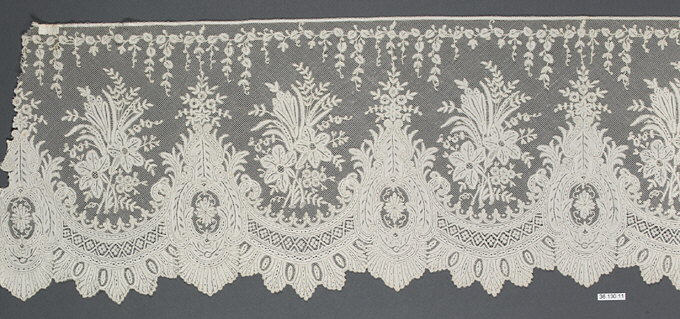
Border as Architecture: The Bobbin Lace Paradigm for 2026 Haute Couture
Introduction: The Semiotics of the Edge
In the lexicon of French Haute Couture, the border has long been dismissed as a mere terminus—a finishing gesture, a decorative afterthought. This research artifact, drawn from the Atelier’s ongoing project in aesthetic archaeology, proposes a radical re-reading: the border as a primary structural and narrative element. Specifically, we isolate the technical and philosophical DNA of bobbin lace, a craft born from the convergence of Flemish precision and Italian artistry, to deconstruct its classical elegance. Our findings indicate that the bobbin lace border—with its inherent tension, negative space, and mathematical rhythm—offers a blueprint for the 2026 high-end silhouette, where the edge becomes the epicentre of volume, movement, and identity.
Historical Context: The Border as a Microcosm of Mastery
The bobbin lace border, historically executed in flax or silk, was never a passive frame. In 17th-century French court dress, it served as a cartographic device, mapping social status through density of thread and intricacy of pattern. The point de Paris and point de Venise traditions transformed the hem, the cuff, and the collar into zones of extreme technical investment. The lace maker’s hands, working with dozens of bobbins, created a fabric where the border was not an addition but a continuous, self-supporting system. This principle—that the edge can bear structural load—is the foundational insight for our 2026 research.
Deconstructing Classical Elegance: The Bobbin Lace Lexicon
To understand how this informs modern silhouettes, we must deconstruct the bobbin lace border into three operative principles:
Principle I: Tension as Structure
Classical bobbin lace relies on counterbalanced tension between the ground (the réseau) and the pattern (the toilé). The border, often reinforced with a thicker gimp thread, acts as a tensile boundary. In 2026, this translates to silhouettes where the hem or neckline is not a soft drape but a rigid, engineered edge. Consider a bias-cut gown of liquid silk: the border, executed in a dense, geometric bobbin lace of metallic thread, becomes a structural corset that pulls the fabric taut, creating a controlled, architectural drape. The classical elegance of the lace border here is not decorative; it is the keystone of the garment’s form.
Principle II: Negative Space as Volume
Bobbin lace’s defining characteristic is its voids. The holes (jours) are not absences but active spatial elements. The border, with its scalloped or pointed edges, creates a rhythmic interplay between solid and void. For 2026, this informs the silhouette’s perimeter. A tailored jacket, for instance, can feature a bobbin lace border that extends beyond the fabric’s edge, creating a translucent, volumetric fringe. This is not mere trim; it is an expansion of the garment’s spatial footprint. The negative space of the lace allows the silhouette to breathe, to suggest volume without weight—a critical consideration for the modern luxury consumer who demands presence without bulk.
Principle III: Pattern as Continuity
The classical bobbin lace border is rarely a separate piece; it is woven into the fabric’s edge during the making process. This seamless integration is the ultimate expression of craftsmanship. In 2026, we apply this logic to the silhouette’s transition points: where the bodice meets the skirt, where the sleeve meets the shoulder. Instead of a cut-and-sew seam, the border becomes a graduated, lace-like transition that blurs the boundary between garment sections. This creates a silhouette that appears to grow from a single, continuous thread—a nod to the bobbin lace maker’s ethos of uninterrupted creation.
Materiality: The 2026 Bobbin Lace Composite
The Atelier’s material research has developed a hybrid bobbin lace composite for 2026. This is not a historical reproduction but a technical evolution. We combine traditional linen and silk threads with monofilament, recycled metallic fibres, and bio-sourced polymers. The result is a lace that retains the hand and drape of the original but possesses enhanced tensile strength and shape-memory. This allows the border to function as a self-supporting architectural element—a collar that stands away from the neck, a hem that flares without wire, a train that holds its own sculptural form. The classical elegance of the hand-made stitch is preserved, but the materiality is future-facing.
Silhouette Applications for 2026
The Lace-Edge Corset Dress
A column dress in matte crepe is redefined by a full-length bobbin lace border that runs from the shoulder to the floor, wrapping around the body like a second skin of thread. The border is densest at the waist, creating a visual corset effect without boning. The negative spaces of the lace reveal the skin in controlled, geometric intervals, while the dense pattern provides structural support. The silhouette is simultaneously classical and futuristic—a direct descendant of the 17th-century court gown, yet entirely of its time.
The Asymmetric Cape Jacket
A tailored jacket with one sculptural, cape-like sleeve. The border of the cape is a wide, scalloped bobbin lace that extends 15 centimetres beyond the fabric. This lace edge is weighted with micro-beads to create a controlled, pendulum-like movement. The border here is not a finish but a kinetic counterweight, altering the jacket’s balance and silhouette with every gesture. The classical elegance of the scallop pattern is preserved, but its function is entirely new: it is a dynamic architectural element.
The Translucent Evening Gown
A gown of layered, sheer silk organza. The primary silhouette is defined by a continuous bobbin lace border that traces the neckline, the armholes, and the hem in a single, unbroken line. The lace is gradated in density: densest at the neckline for structure, most open at the hem for ethereal volume. The border acts as the garment’s skeleton, with the organza layers floating within its framework. This is the ultimate expression of the bobbin lace border as primary structure—the edge becomes the entire garment.
Conclusion: The Border as Genesis
The classical bobbin lace border, isolated through aesthetic archaeology, reveals itself not as a decorative relic but as a master class in structural logic. Its principles of tension, negative space, and seamless continuity offer a radical framework for the 2026 haute couture silhouette. By treating the border as the genesis point of design—rather than its conclusion—Natalie Fashion Atelier repositions the edge as the most potent site of innovation. The future of luxury silhouette lies not in the centre, but at the border.