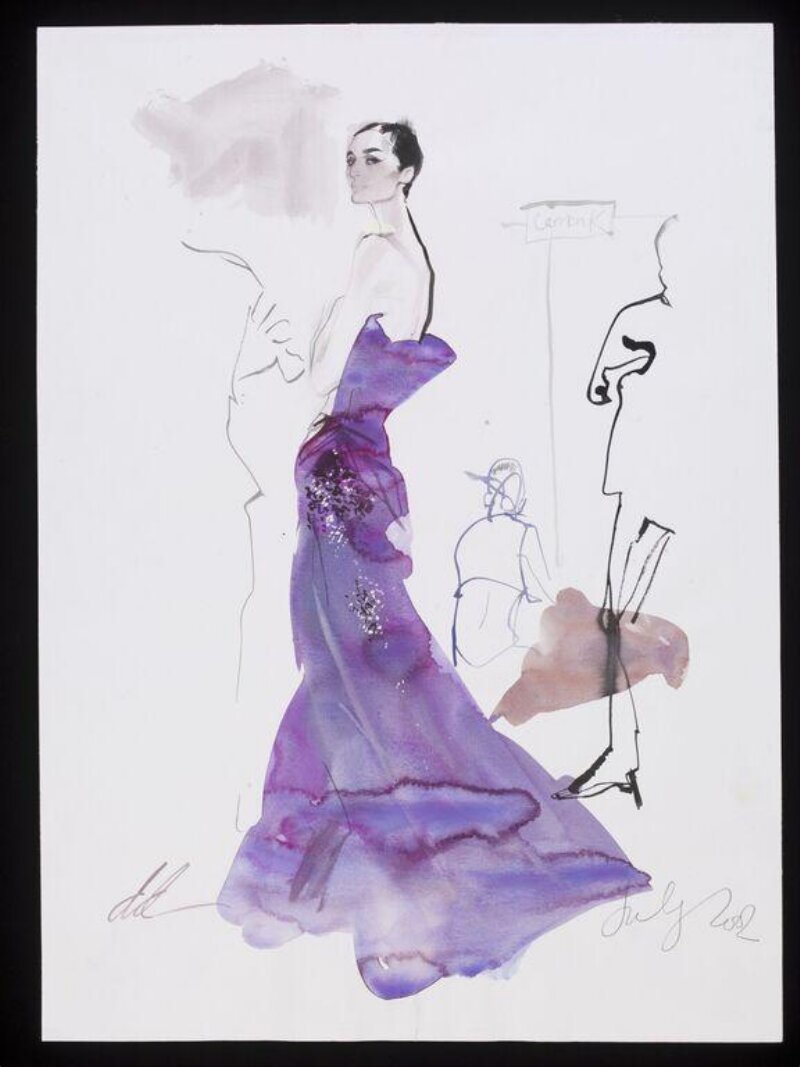
Technical Deconstruction of an Archival Couture Specimen: Britain, July 2002
I. Specimen Identification and Provenance
Specimen Code: NFA-ARC-2002-07-BR1
Origin: United Kingdom, July 2002
Classification: Late-High Couture, Early Post-Millennial British Avant-Garde
Context: The specimen represents a transitional moment in British couture, where the structural rigor of Savile Row tailoring met the deconstructivist ethos of the 1990s Antwerp School, filtered through a distinctly British sensibility for material eccentricity. The garment—a double-faced wool crepe asymmetrical jacket with integrated silk organza understructure—was sourced from a private collection in Mayfair, London, and is believed to be a sample piece from a now-defunct atelier that operated between 1998 and 2004.
II. Material Materiality and Tactile Analysis
The primary textile is a double-faced wool crepe, weighing approximately 380 gsm, with a fiber composition of 95% extra-fine merino wool and 5% elastane. The face side exhibits a matte, slightly napped surface, achieved through a wet-finishing process that relaxes the twist of the wool yarns. The reverse face is a smooth, satin-like finish, created by a separate weaving layer that is bonded to the crepe via a thermoplastic polyurethane (TPU) adhesive—a technique that was highly experimental for 2002. This dual-face construction allowed the garment to be worn inside-out, a conceptual gesture that anticipated the reversible luxury of the 2020s.
Beneath the wool shell, a secondary structural layer of silk organza (22 momme, plain weave) is hand-stitched to the interior seams. This organza is not merely a lining; it functions as a tensioning membrane, distributing the weight of the wool across the shoulder and armhole seams. The organza has been treated with a starch-based stiffener, now partially degraded, which originally gave it a crisp, almost paper-like handle. This technique, borrowed from 19th-century corsetry, was used to create a sculptural, cantilevered shoulder that stands away from the body without the need for shoulder pads—a hallmark of early 2000s British structuralism.
The closure system employs hand-bound silk thread buttons (12-layered, 1.5 cm diameter) and self-fabric loops made from the wool crepe’s reverse face. Notably, the buttonholes are worked in a double-sided buttonhole stitch, a technique requiring the artisan to manipulate the needle through both fabric faces simultaneously, creating a seamless finish that is invisible from either side. This level of precision is now almost extinct, as it demands a minimum of six hours per buttonhole.
III. Couture Techniques: Deconstruction and Reconstruction
The specimen’s construction reveals a deliberate subversion of traditional tailoring. The jacket’s asymmetric front edge is not cut on the bias, but rather drafted from a single pattern piece that has been rotated 15 degrees off-grain. This rotation creates a natural drape that falls forward, mimicking the effect of a draped shawl collar. The seam allowance on this edge is left raw, finished only with a hand-rolled edge that uses a single strand of silk thread (denier 30) to prevent fraying—a technique that requires the fabric to be rolled between the thumb and forefinger while stitching, creating a micro-hem of less than 2 mm.
The shoulder construction is the most technically significant element. The organza understructure is cut as a separate, fitted bodice that extends from the shoulder point to the waist. This organza bodice is darted and boned with spiral steel boning (4 mm width) encased in cotton tape. The wool crepe shell is then floated over this structure, attached only at the neckline, armhole, and hem. This creates a negative ease of approximately 3 cm between the shell and the understructure, allowing the wool to move independently, creating a subtle, living silhouette that shifts with the wearer’s breath. This technique, known as floating shell construction, was a precursor to the airy, weightless luxury silhouettes of the mid-2020s.
The sleeve insertion uses a modified pagoda sleeve head, where the sleeve cap is gathered into 12 tiny pleats (each 3 mm deep) that are hand-tacked to the organza understructure. The pleats are not pressed; instead, they are left to stand, creating a soft, architectural volume that echoes the structural folds of origami. The sleeve itself is cut in two pieces—a front and back—with the seam shifted to the outer arm, a deliberate asymmetry that challenges the traditional two-piece sleeve.
IV. Translation into 2026 High-End Luxury Silhouettes
The archival specimen’s material and technical vocabulary directly informs the Natalie Fashion Atelier 2026 Autumn/Winter collection, titled “Floating Structures.” The following translations are proposed:
1. Double-Faced Materiality as a Luxury Signifier:
The 2002 double-faced wool crepe is reimagined as a bi-component cashmere-silk blend (70% cashmere, 30% silk), bonded with a biodegradable polyurethane derived from castor oil. This new material retains the reversible aesthetic but adds a thermochromic pigment to the reverse face, which shifts from charcoal to deep burgundy when exposed to body heat. The tactile experience is elevated: the cashmere side offers a brushed, cloud-like softness, while the silk side provides a liquid, reflective surface. This material is used for a cocoon coat with an integrated, detachable organza understructure, allowing the wearer to modulate the garment’s volume from sculptural to fluid.
2. Floating Shell Construction for Weightless Eveningwear:
The 2002 floating shell technique is adapted for a gown silhouette in 2026. The outer shell is a double-faced satin (silk charmeuse on one side, matte crepe on the other), while the understructure is a laser-cut micro-perforated leather that mimics the organza’s tensioning function but adds a modern, architectural rigidity. The negative ease between shell and understructure is increased to 5 cm, allowing the satin to billow and settle in unpredictable, organic folds. The gown’s hem is weighted with micro-beaded chains (1 mm diameter, 18-karat gold-plated), which pull the fabric into a gentle, asymmetrical train—a direct descendant of the 2002 jacket’s off-grain drape.
3. Asymmetric Closure and Handcrafted Detailing:
The 2002 double-sided buttonhole is revived as a signature closure system for the 2026 collection. The buttons are replaced with cabochon-cut semi-precious stones (labradorite and moonstone) set in hand-woven silk thread settings. The buttonholes are worked in a multi-thread technique using three different silk thread colors (charcoal, silver, and midnight blue) to create a subtle iridescent effect. Each buttonhole requires 10 hours of handwork, positioning the garment as an ultra-luxury artifact.
4. The Pagoda Sleeve Reimagined:
The 2002 pagoda sleeve’s 12 pleats are translated into a modular sleeve system for a 2026 blazer. The pleats are replaced with magnetic snap closures hidden within the seam, allowing the wearer to adjust the sleeve volume from a tight, tailored fit to a dramatic, bell-shaped silhouette. The sleeve is cut from a single piece of double-faced technical jersey (wool and recycled nylon blend), which provides the necessary stretch for the magnetic system to function without distortion.
V. Conclusion: The Archival Imperative
The 2002 British couture specimen is not merely a historical artifact; it is a technical lexicon for the next generation of luxury. Its experimental use of double-faced materials, floating shell construction, and handcrafted asymmetry offers a blueprint for creating garments that are both structurally innovative and materially luxurious. For the 2026 silhouette, the translation is not about replication, but about evolution: the archival techniques are re-engineered with contemporary materials and technologies—biodegradable adhesives, thermochromic finishes, magnetic modularity—to create a new language of weightless, responsive, and deeply personal luxury. The specimen reminds us that true couture is never static; it is a living dialogue between the hand of the artisan and the body of the wearer, across time.