From Ornamental Armament to Sartorial Armature: Deconstructing the Versailles Arsenal
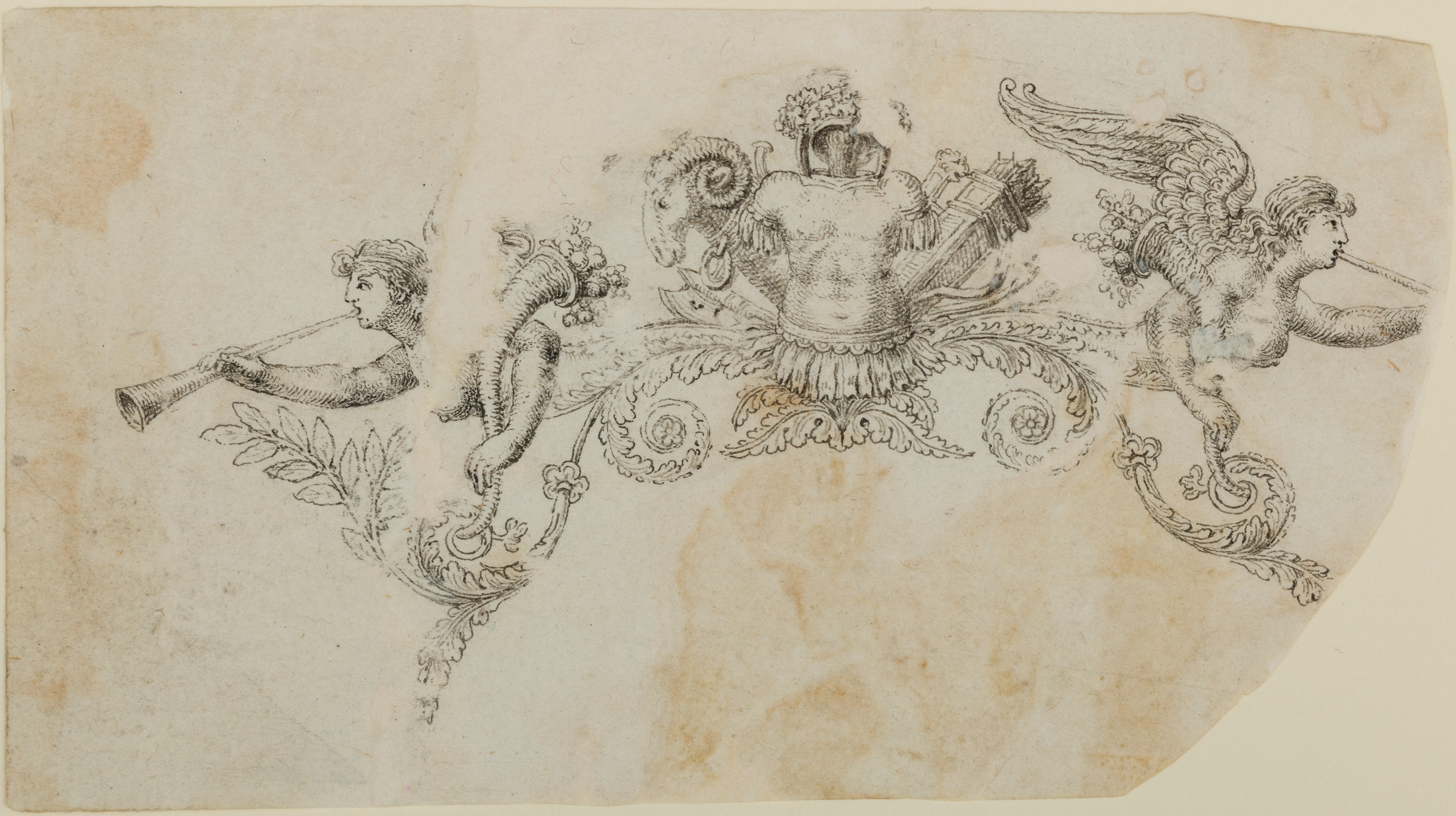
The archival fragment in question—a Design for the Decoration of Firearms, rendered in pencil, ink, and gray wash on paper—originates from the ateliers of the Manufacture Royale de Versailles. This is not a document of warfare, but of courtly theater. The firearm, in the 18th-century French context, was a prosthetic of status, a mobile piece of decorative sculpture. The gray wash technique, applied with surgical precision, creates a volumetric chiaroscuro that transforms a functional steel barrel into a bas-relief of acanthus leaves, mythological chimeras, and rocaille asymmetry. For the 2026 haute couture silhouette, this artifact provides a blueprint for a new kind of structural ornamentalism—one where the body is not merely clothed, but armatured with history.
Materiality as Method: The Gray Wash Gradient
The choice of pencil, ink, and gray wash is not incidental; it is a manifesto of restraint. The pencil provides the architectural skeleton, the ink delivers the decisive contour, and the gray wash introduces a tonal atmosphere that softens the geometry. In translating this to 2026 silhouettes, we must consider the gray wash as a gradient of opacity. It suggests a fabric that moves from dense, structured matte at the shoulder (the ink) to a translucent, watercolor-like chiffon at the hem (the wash). The result is a gradated armature—a jacket that begins as a rigid, sculpted cuirass and dissolves into a fluid, ethereal train. This is the Versailles paradox: the weapon is decorative, the decoration is weaponized.
Architectural Deconstruction: The Barrel as Bodice
The firearm’s barrel, as depicted in the archival sheet, is a study in controlled torsion. The engraved grooves spiral along the metal, creating a visual rhythm of light and shadow. For the 2026 silhouette, this translates directly into a spiral seam construction for the bodice. The pattern cutting must mimic the parabolic curve of the barrel’s octagonal-to-round transition. We propose a molded leather and metallic lace hybrid that wraps the torso in a continuous, ascending spiral. The seams are not hidden; they are celebrated as engraving lines, stitched with a silver-threaded cord that catches the light like the original ink strokes. The pencil-drawn cross-hatching becomes a jacquard weave—a micro-pattern of intersecting diagonals that creates a moiré effect, echoing the gray wash’s tonal modulation.
The Chimerical Motif: Mythological Embroidery as Structural Reinforcement
The gray wash reveals fantastical creatures—griffins, sirens, and foliate masks—intertwined with the firearm’s lock plate and trigger guard. These are not mere appliqués; they are functional decorative elements that reinforce the metal’s stress points. In the 2026 atelier, this translates to embroidered armatures. We will deploy 3D-printed resin filigree (inspired by the ink’s precision) that is hand-painted with a pewter-toned patina to replicate the gray wash’s metallic sheen. These chimerical forms will be positioned at the structural junctions of the garment: the shoulder seam, the hip bone, the clavicle. The mythological motif is not decorative; it is load-bearing. The griffin’s wing becomes a cantilevered shoulder pad; the siren’s tail curves into a supportive waistband. This is aesthetic archaeology—excavating the functional logic of 18th-century ornament and re-embedding it into the body’s architecture.
Silhouette as Armature: The New Versailles Corset
The classical elegance of the Versailles court was predicated on a rigid exterior and a fluid interior. The grand habit de cour was a cage of whalebone and silk, a literal armature for the female form. The firearm decoration, with its etched steel and polished walnut, offers a parallel vocabulary. For 2026, we reject the soft, deconstructed normcore of the previous decade. Instead, we propose the Versailles Armature: a silhouette that is architecturally explicit. The jacket is a double-breasted cuirass, cut from a single piece of horsehair-reinforced wool, with a peplum that fans out like a gunstock. The trousers are tapered, high-waisted, and paneled, with a side stripe of gray-wash silk organza that mimics the barrel’s reflective plane. The overall line is vertical and taut, a direct descendant of the rococo arabesque—curved but controlled, ornate but efficient.
Color Palette: The Monochrome of the Archive
The palette is dictated by the artifact’s materiality: lead gray, sepia ink, parchment white, and oxidized silver. There is no color in the traditional sense; there is only value. The 2026 collection will be a study in monochromatic chiaroscuro. The gray wash informs a layered tonal system: a base of charcoal cashmere, overlaid with a hand-painted silk tulle that graduates from opaque to transparent, exactly as the wash moves from dense ink to diluted water. The pencil lines become fine silver chain mail, woven into the seams to catch the light. The result is a living archive—a garment that breathes with the same tonal depth as the 18th-century drawing.
Conclusion: The Artifact as Generative Code
This Design for the Decoration of Firearms is not a relic; it is a generative codex. It teaches us that ornament is structure, that restraint is power, and that the body can be armored in elegance. For Natalie Fashion Atelier, the 2026 silhouette will be a pencil-drawn, ink-defined, gray-wash-graduated proposition. It will be a weapon of beauty, forged in the ateliers of Versailles and re-calibrated for the contemporary woman. The classical elegance is not lost; it is deconstructed, analyzed, and re-synthesized into a new kind of haute couture armature—one that protects, adorns, and empowers with the precision of a master engraver’s hand.