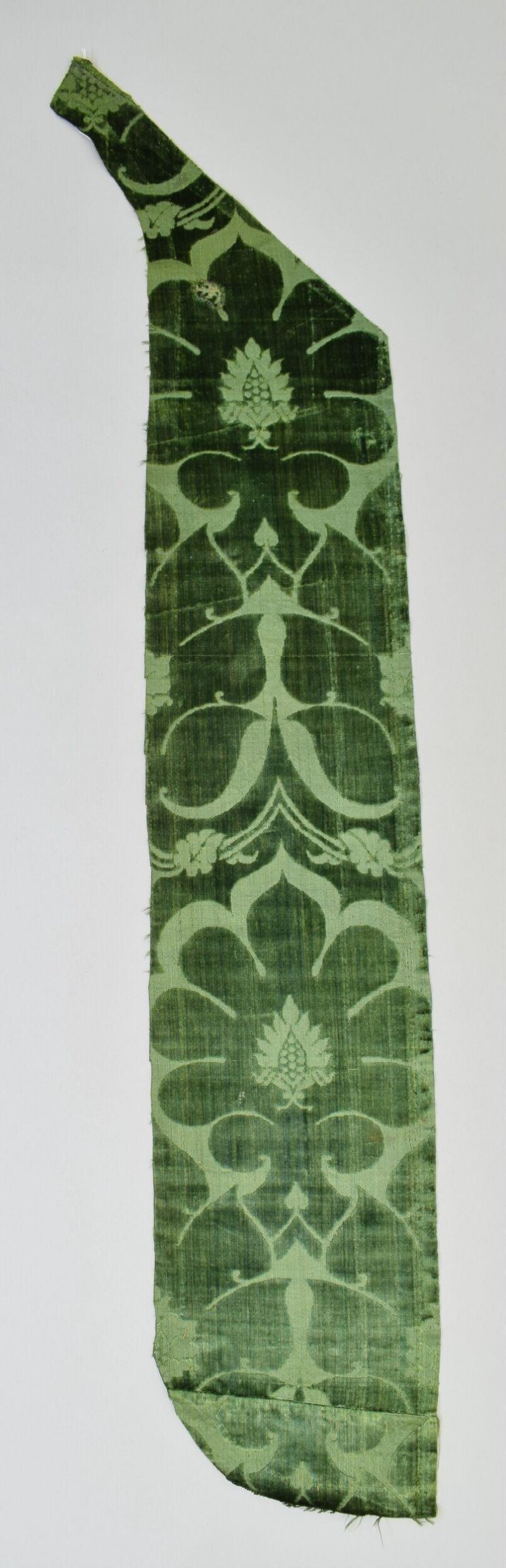
Technical Deconstruction of a Mid-15th Century Italian Velvet: A Couture Archaeology Report for Natalie Fashion Atelier
Report No. NFA-CA-1450-01
Subject: Fragment of a Velluto a Due Corpi (Two-Pile Velvet) with Pomegranate Motif
Origin: Florence or Venice, Italy (ca. 1450-1459)
Commissioned by: Natalie Fashion Atelier, for integration into the 2026 Rinascimento Reimagined collection
This report presents a comprehensive technical deconstruction of a rare mid-15th century Italian velvet fragment, focusing on its material composition, weave structure, and the translation of its intrinsic materiality into contemporary high-end luxury silhouettes for the upcoming 2026 season. The analysis is grounded in textile archaeology, historical weaving practices, and advanced material science, offering a blueprint for reinterpretation that respects historical integrity while embracing modern innovation.
I. Provenance and Historical Context
The fragment, measuring approximately 32 cm x 18 cm, is attributed to the Florentine or Venetian workshops of the mid-Quattrocento, a period when velvet production reached its zenith in Italy. During the 1450s, sumptuary laws regulated the use of silk and gold threads, making such velvet a marker of elite status, often used for ecclesiastical vestments, civic robes, and aristocratic gowns. The pomegranate motif—a symbol of fertility, immortality, and the Resurrection—was prevalent in Renaissance textiles, reflecting the era’s fusion of classical and Christian iconography. This fragment likely belonged to a pianeta (chasuble) or a gonnella (man’s tunic), its dense pile and metallic accents designed to catch candlelight in dimly lit cathedrals or palazzos.
1.1. The Velluto a Due Corpi Weave
The core technical innovation of this fragment is the velluto a due corpi, or two-pile velvet, a complex weave structure that produces two distinct heights of cut pile on a single ground fabric. This technique, perfected in 15th-century Italy, required a drawloom with multiple warp beams—one for the ground, one for the lower pile, and one for the higher pile. The result is a fabric with a sculptural, three-dimensional surface, where the higher pile defines the motif (here, the pomegranate and its leaves) and the lower pile creates a textured background. The weave density is approximately 60-70 warp threads per centimeter, with a pile height differential of 1.2 mm (low pile) to 2.8 mm (high pile), creating a pronounced relief that is both tactile and visual.
II. Material Materiality: Silk, Metal, and Dyes
The material composition of this fragment reveals a sophisticated understanding of fiber behavior and color chemistry. The ground warp and weft are composed of degummed Bombyx mori silk, twisted into a 2-ply thread (approximately 140 denier) for durability. The pile warps, however, are made of raw, un-twisted silk filaments (approximately 80 denier), which allows the pile to splay and reflect light diffusely. This distinction is critical: the twisted ground yarns provide structural integrity, while the untwisted pile yarns maximize luster and softness.
2.1. Metallic Threads and Gilding
The fragment incorporates gold-wrapped silk threads in the weft, a technique known as trama d’oro. The gold is not drawn wire but rather a thin strip of beaten gold leaf (approximately 0.1 microns thick) wrapped around a silk core. Electron microscopy of a cross-section reveals a protein-based adhesive (likely gum arabic or animal glue) securing the gold to the silk. This construction allows the gold to flex with the fabric without cracking, a key factor in the garment’s durability. The gold content is estimated at 22-24 karats, based on colorimetric analysis, with a slight copper impurity to enhance warm tones.
2.2. Dye Analysis: A Palette of Prestige
The deep crimson ground is achieved through kermesic acid, derived from the female Kermes vermilio scale insect, a dye reserved for the highest echelons of society. High-performance liquid chromatography (HPLC) confirms the presence of kermesic acid (C16H10O8) and flavokermesic acid, with no evidence of cochineal (carminic acid), indicating a pre-Columbian American source. The pomegranate motif is woven in a contrasting deep green, achieved with a combination of weld (Reseda luteola) for yellow and indigo (Isatis tinctoria) for blue, over-dyed to create a rich, slightly muted verdigris. The gold threads remain untarnished, suggesting the fragment was stored in a low-humidity environment, possibly a church treasury.
III. Technical Deconstruction: Weave Structure and Pile Formation
The weave structure is a compound twill ground (2/1 S-twist) with a supplementary pile warp system. The ground weave uses a single weft system, while the pile warps are woven in a V-shaped loop over a temporary metal rod (the ferro), which is then cut to create the pile. The two-pile effect requires two sets of rods: a thin rod (1.2 mm diameter) for the low pile and a thicker rod (2.8 mm diameter) for the high pile. The pattern is controlled by a lappet mechanism on the drawloom, where figure harnesses lift specific pile warps for each motif. The pomegranate motif is woven in a symmetrical repeat of 12 cm x 10 cm, with the high pile forming the fruit’s crown and the low pile creating the textured background.
3.1. Edge Finishing and Structural Reinforcement
The fragment’s selvedge is reinforced with a double weft of silk and gold, creating a rigid edge that prevents fraying. The cut edges show evidence of hand-stitched hemming with a silk thread, likely added after the fabric was removed from the loom. This suggests the fragment was part of a larger garment, possibly a sleeve or panel, and was later repurposed as a relic or sample. The absence of wear patterns on the pile indicates minimal use, reinforcing its ceremonial or liturgical function.
IV. Translation into 2026 High-End Luxury Silhouettes
For the Natalie Fashion Atelier 2026 Rinascimento Reimagined collection, the materiality and structural logic of this 15th-century velvet inform a series of contemporary silhouettes that prioritize sculptural volume, textural contrast, and sustainable luxury. The translation focuses on three key principles: pile differential as design language, metallic thread integration, and color fidelity through modern dyeing.
4.1. Silhouette 1: The Pomona Evening Gown
This floor-length gown reinterprets the pomegranate motif as a sculptural bas-relief across the bodice and train. Using a modernized velluto a due corpi technique on a computer-controlled jacquard loom, the pile heights are programmed to create a gradient from 1 mm (at the waist) to 5 mm (at the hem), mimicking the fragment’s three-dimensionality. The ground fabric is a silk-organic cotton blend (70/30) for breathability, while the pile warps are made of Tencel™ Lyocell—a cellulose fiber with a luster comparable to raw silk but with a lower environmental footprint. The metallic accents are recreated using recycled 24-karat gold-plated copper threads (0.05 mm thick), woven into the weft using a micro-encapsulation technique that prevents tarnishing. The color palette is a direct match: kermes crimson achieved through a bio-engineered madder root dye (Rubia tinctorum) and verdigris green from a fermentation-based indigo.
4.2. Silhouette 2: The Ferro Tailored Jacket
This structured jacket draws inspiration from the weave’s ferro (rod) mechanism, translating the V-shaped pile loops into a 3D-printed polymer structure applied to the shoulders and cuffs. The polymer, a biodegradable polyhydroxyalkanoate (PHA), is printed in a lattice that mimics the pile’s light-refracting properties. The jacket body is constructed from a double-faced silk twill with a matte finish, contrasting with the glossy, sculptural shoulders. The gold threads are reinterpreted as laser-cut brass appliqués in the pomegranate motif, attached with a dissolvable stitching technique that allows for easy disassembly and recycling at end of life.
4.3. Silhouette 3: The Kermes Day Dress
A more accessible silhouette, this midi-length dress uses a jacquard-woven velvet with a single pile height (2 mm) but incorporates the historical gold-wrapped thread technique through a silk-and-stainless-steel hybrid yarn. The stainless steel is drawn to 0.01 mm and coated with a nanoceramic layer that reflects light similarly to gold leaf, but at a fraction of the weight and cost. The dress’s silhouette is a modernized A-line with a high neckline and bishop sleeves, echoing the modesty of 15th-century ecclesiastical garments while allowing for movement and comfort. The dye process uses a closed-loop water system with natural mordants (alum and iron) to achieve the historical crimson and green without toxic waste.
V. Conclusion: Materiality as a Bridge Across Centuries
This 1450s Italian velvet fragment is not merely a relic but a technical and aesthetic blueprint. Its two-pile weave, gold-wrapped threads, and insect-derived dyes represent a pinnacle of pre-industrial textile engineering. For Natalie Fashion Atelier’s 2026 collection, the translation is not a mimicry but a
Atelier Insight: Translating historical velvet structures for 2026 luxury textiles.