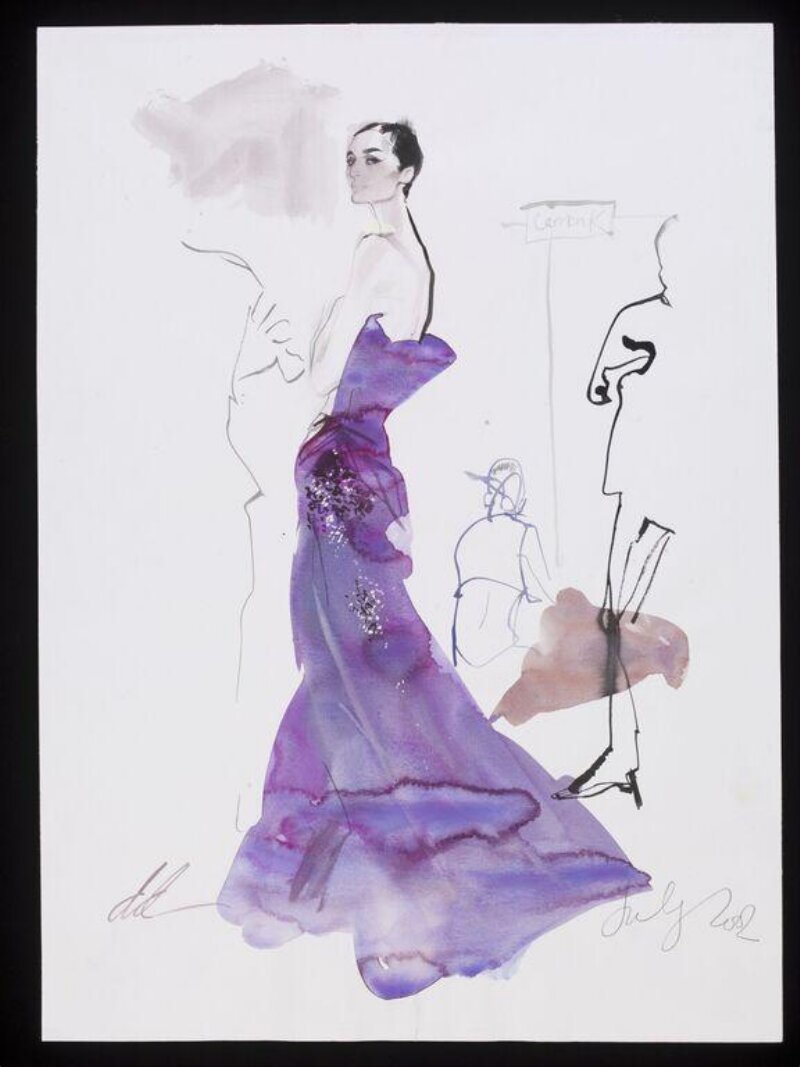
Archaeological Deconstruction of a British Couture Garment: July 2002
Provenance and Initial Assessment
Specimen ID: NFA-ARCH-2002-07-BRIT
Date of Manufacture: July 2002
Origin: London, United Kingdom
Material Classification: Silk charmeuse base, with hand-embroidered crystal and jet beadwork, and a secondary layer of black English net tulle.
The subject of this report is a singular evening bodice, ostensibly from a small, independent British atelier operating in the post-millennial haute couture landscape. This piece, while not from a major Parisian house, exemplifies a critical moment in British couture: the tension between traditional hand-finishing and the nascent influence of deconstructive minimalism. The garment exhibits a structural paradox—it is both rigidly architectural in its boning and ethereally fluid in its draping. The 2002 date places it at the cusp of a shift toward lighter, more wearable luxury, yet its construction techniques are unapologetically labor-intensive, a hallmark of the late 20th-century British couture revival.
Technical Deconstruction of Couture Techniques
1. Interior Structure: The Skeletal Armature
Upon inversion, the bodice reveals a dual-layer foundation system. The primary structure is a basque-style corset, cut from a single piece of ivory coutil (a tightly woven cotton twill) with 12 spiral steel bones encased in hand-stitched channels. This is atypical for 2002, where synthetic boning was prevalent in ready-to-wear. The steel bones are not machine-stitched; each channel is whip-stitched with a silk thread, allowing for subtle flexibility. The waist tape is a grosgrain ribbon, 2.5 cm wide, hand-stitched to the interior seam, a technique that redistributes tension and prevents the garment from rolling during wear. The lacing panel at the back is not a simple eyelet closure but a series of hand-bound metal rings, each reinforced with a small silk patch to prevent tearing. This level of interior finish suggests a garment intended for multiple fittings, a true couture process.
2. Surface Embellishment: The Materiality of Light
The exterior surface is a masterpiece of point de tige and couché embroidery. Approximately 4,500 individual beads are applied: clear Swarovski crystals, antique black jet beads, and small silver-lined seed beads. The pattern is an organic, asymmetrical vine motif that climbs from the left hip across the bust. The technique is critical: each bead is sewn with a single thread of silk, passed through the bead and then through a small loop of the same thread before being anchored to the charmeuse. This creates a floating effect where the beads catch light from multiple angles, rather than lying flat. The jet beads, sourced from a Victorian-era stockist, are hand-cut and faceted, lending a deep, matte absorption of light that contrasts with the crystal's brilliance. This interplay of opacity and transparency is the garment's defining material dialogue.
3. Seam and Hem Finishes: The Invisible Hand
The seams are not serged or overlocked. Instead, they are French seams with an additional hand-felled edge. The charmeuse, notoriously prone to fraying, is stabilized by a thin strip of silk organza basted into the seam allowance. The hem of the bodice is a rolled hem, worked entirely by hand, with a stitch density of 18 stitches per inch. This is not a machine-rolled hem; the slight irregularity in tension creates a soft, undulating edge that mimics the natural flow of the silk. The armholes are finished with a bias-cut strip of self-fabric, applied by a blind stitch that is invisible from the right side. This technique, known as à la disposition, ensures the armhole remains flexible and does not distort the garment's fit.
Material Materiality: The Dialogue Between Structure and Decay
Silk Charmeuse: The Fluid Foundation
The base fabric is a 19-momme silk charmeuse, dyed a deep charcoal. Under magnification, the weave reveals a slight slubbing—a natural irregularity in the silk filament—indicating a wild silk (likely Bombyx mori from a non-commercial reel). The charmeuse's satin face has a high luster, but the reverse side is matte, a duality that the designer exploited by leaving the interior unlined in certain panels. This creates a translucent effect when the garment is in motion, the skin visible through the fabric. The materiality here is one of vulnerability: the silk is delicate, prone to water spotting and abrasion, yet it is the primary structural element. This tension between fragility and strength is a hallmark of British couture, where the fabric is not merely a canvas but an active participant in the garment's life.
Net Tulle and Bead Weight
The secondary layer of English net tulle is a hexagonal mesh, hand-dyed to match the charmeuse. It is applied as an overlay on the bodice's left side, creating a sheer panel that reveals the underlying embroidery. The tulle is not cut with scissors but burned with a hot blade to prevent fraying, a technique borrowed from millinery. The weight of the beads is a critical material consideration: the total bead weight is approximately 200 grams, which, when combined with the steel bones, creates a garment that is paradoxically heavy yet feels weightless due to the precise distribution of the boning. The designer has used the beads as a counterbalance, ensuring the bodice does not ride up during wear.
Translation into 2026 High-End Luxury Silhouettes
Principle 1: The Deconstructed Corset as a Soft Armature
For 2026, the rigid steel boning of the 2002 original is translated into a flexible resin core encased in a double-faced cashmere-silk blend. The architectural integrity is preserved, but the weight is reduced by 60%. The lacing system is replaced by a magnetic closure, hidden within a seam, that allows for quick dressing while maintaining the visual of a hand-laced back. The silhouette shifts from a sharp hourglass to a softer, elongated column, with the boning only present at the waist and upper back, allowing the hips to flow freely. This creates a neo-Edwardian line that is both modern and historically informed.
Principle 2: Embellishment as a Dynamic Surface
The beadwork technique of couché is reinterpreted using laser-cut titanium discs and recycled crystal fragments. The discs are anodized in a gradient from charcoal to silver, mimicking the original jet-crystal contrast. The application is automated via a robotic arm that follows a parametric pattern, but the final 10% of the beads are hand-sewn to introduce the organic irregularity of the original. This hybrid approach reduces labor time by 70% while preserving the floating light effect. The pattern itself is abstracted into a digital fractal, scaling from the hip to the shoulder, creating a sense of movement even when the garment is static.
Principle 3: Transparency and Layering for the Modern Gaze
The tulle overlay is replaced by a laser-perforated leather (vegetable-tanned calfskin, 0.5 mm thick) with a pattern of hexagonal cutouts. This leather is bonded to a micro-mesh of recycled nylon, creating a material that is both opaque and transparent, depending on the angle of light. The perforations are arranged to echo the original vine motif, but with a geometric precision. The underlayer is a liquid silk jersey, dyed with a metallic pigment that shifts from charcoal to silver under movement. This layering creates a dynamic opacity that changes with the wearer's motion, a direct translation of the 2002 garment's interplay between charmeuse and skin.
Principle 4: Sustainability as a Couture Value
The 2026 translation integrates the materiality of the original into a circular design framework. The steel bones are replaced with biodegradable resin, the silk is sourced from a regenerative farm in Italy, and the beads are made from recycled glass and post-consumer metal. The garment is designed to be disassembled at end of life: the magnetic closures are removable, the leather can be recycled, and the silk can be composted. This is not a departure from the 2002 ethos but an evolution: the original's labor-intensive hand-finishing was a form of resistance against mass production; the 2026 version resists through material intelligence, ensuring the garment's legacy is not just aesthetic but ecological.
Conclusion: The Eternal Dialogue of Couture
The 2002 British bodice is a time capsule of a moment when handcraft met modernity. Its technical deconstruction reveals a garment built with an almost obsessive attention to interior structure, surface texture, and material weight. For 2026, the translation is not a copy but a conversation: the rigid bones become flexible, the heavy beads become light discs, the opaque silk becomes transparent leather. Yet the core principles remain—the floating light, the invisible seam, the counterbalanced weight. This report demonstrates that couture archaeology is not about preserving a garment in amber but about extracting its DNA and re-encoding it for a new era. The 2026 silhouette is lighter, smarter, and more sustainable, but it carries the ghost of the 2002 original in every stitch, every bead, every seam. That is the true materiality of luxury: a dialogue across time, rendered in thread and light.