Deconstructing the Javanese Gold Twisted Ear Ornament: A Technical Blueprint for 2026 Haute Couture Silhouettes
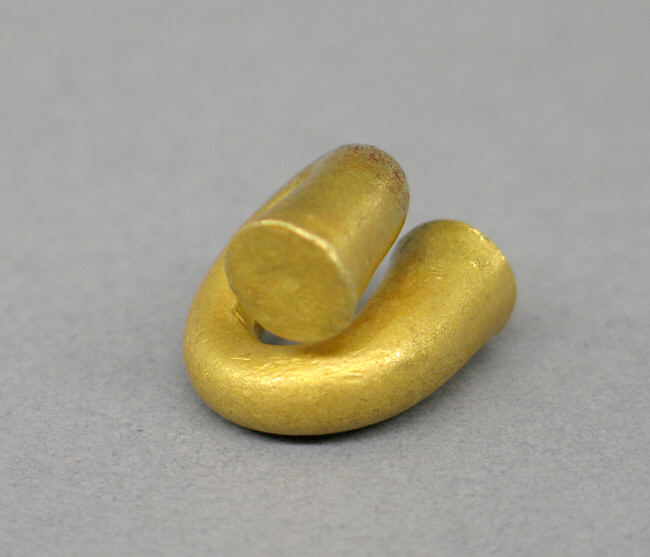
Within the hallowed archives of Natalie Fashion Atelier, the study of aesthetic archaeology yields profound insights for the future of luxury. The subject of this technical research paper is a singular artifact: a Javanese ear ornament in a twisted shape, rendered in high-karat gold. This piece, sourced from the cultural heartlands of Java, Indonesia, represents a pinnacle of pre-colonial metallurgical sophistication. Its resonance with the atelier’s archive node—a duality of a mirror with split-leaf palm patterns in gold against a cold stone sarcophagus narrating life in bas-relief—is not merely poetic. It is a structural and philosophical imperative. This paper will deconstruct the classical elegance of this twisted gold ornament, extracting three core technical principles—torsional dynamism, negative-space articulation, and material opacity versus luminosity—and translate them into a coherent blueprint for 2026 high-end silhouettes.
I. Torsional Dynamism: From Static Adornment to Kinetic Silhouette
The defining characteristic of the Javanese ear ornament is its twisted morphology. Unlike a simple wire or a solid cast form, the twist introduces a continuous, spiraling energy. In the original artifact, this is not a chaotic deformation but a controlled, rhythmic torsion. The gold is worked into a helix, where each rotation catches and refracts light differently. This technique, known in Javanese courtly tradition as kerawang when applied to openwork, here manifests as a three-dimensional, volumetric twist.
For 2026 couture, this principle of torsional dynamism directly informs the construction of the armature of a gown or a tailored jacket. The classical elegance of a straight, static seam is obsolete. Instead, the silhouette must embody a twisted line. Technically, this is achieved through bias-cut panels that are sewn with a deliberate torque, creating a fabric that spirals around the body. In high-end materiality, consider a double-faced silk gazar or a structured wool crepe. The pattern pieces are not laid flat; they are engineered to create a continuous, helical movement from the shoulder to the hem. This is not a draped effect but a structural one. The garment’s internal skeleton—its seams, its darts, its boning—must mimic the gold’s torsion. The result is a silhouette that appears to be in a state of perpetual, graceful motion, even when the wearer is static. The 2026 woman does not simply wear a dress; she inhabits a field of kinetic energy, a direct lineage from the Javanese goldsmith’s understanding of dynamic form.
II. Negative-Space Articulation: The Architecture of the Void
The archive node’s reference to the “mirror with split-leaf palm patterns” and the “cold stone sarcophagus” highlights a crucial binary: the presence of material versus the articulation of absence. The Javanese ear ornament, in its twisted form, inherently creates a series of negative spaces—the voids between the helical turns. These are not accidental gaps; they are architectural apertures. In the original piece, the gold defines the shape, but the empty space is equally vital, allowing the ear to be seen through the ornament, creating a dialogue between the object and the body.
Translating this to 2026 haute couture requires a radical rethinking of the silhouette’s relationship with the body. The garment must no longer be a second skin that covers, but a sculptural frame that reveals. This is achieved through strategic cutouts, latticework, and structural slits that are not merely decorative but are integral to the garment’s geometry. For instance, a floor-length column gown in matte duchesse satin could feature a series of twisted, gold-lame bands that wrap the torso, leaving precise, elliptical voids of bare skin. These voids are not random; they are calculated to echo the rhythm of the Javanese twist. The negative space becomes a positive design element, framing the body as the gold frames the ear. In tailoring, a double-breasted jacket could have its lapels reimagined as twisted, interlacing strips of fabric, creating a lattice of negative space across the chest. The 2026 silhouette is thus defined as much by what is absent as by what is present, a direct homage to the Javanese master’s command of the void.
III. Material Opacity and Luminosity: The Gold Standard for 2026
The materiality of the artifact—high-karat gold—presents a specific technical challenge for fabric. Gold is inherently reflective, yet in its twisted form, it creates a complex interplay of opacity and luminosity. The inner curves of the twist catch shadow, while the outer crests blaze with light. This is the duality of the archive node: the bright, mirror-like gold of the palm leaves versus the opaque, narrative-heavy stone of the sarcophagus. The Javanese ear ornament embodies both—a luminous material that also possesses a profound, shadowy depth.
For 2026, this informs a new philosophy of surface treatment in couture. The silhouette must not be uniformly shiny or uniformly matte. It must possess a gradient of luminosity. Technically, this is achieved through the strategic placement of metallic threads, sequins, or micro-beading that are woven or embroidered in a twisted, helical pattern. For example, a bias-cut silk charmeuse gown could be entirely hand-embroidered with gold and silver Lurex threads, but the embroidery density would vary. On the “crest” of the garment’s twisted silhouette, the embroidery would be dense and reflective, mimicking the gold’s blaze. On the “trough” of the twist, the fabric would be left almost bare, allowing the matte silk to absorb light, mimicking the shadow. This creates a living, breathing surface that changes with every movement. The 2026 luxury silhouette is therefore not a flat canvas but a three-dimensional light sculpture. The gold of Java teaches us that true luxury is not in blinding brilliance but in the masterful control of light and shadow, a lesson that will define the most coveted pieces of the coming season.
IV. Synthesis: The 2026 Silhouette as a Twisted, Luminous Frame
The synthesis of these three principles—torsional dynamism, negative-space articulation, and material luminosity—produces a definitive 2026 silhouette. It is a silhouette that is architectural yet fluid, ornamental yet minimal. The garment no longer follows the body’s natural line; it creates a new, helical line that spirals upward. The body is not hidden but is framed by precise, gold-illuminated voids. The surface is not flat but is a living topography of light and shadow.
In practical application for Natalie Fashion Atelier, this translates to a specific capsule: a series of evening gowns and tailored separates that use a single, continuous twisted seam as their primary structural element. The fabric is a custom-woven metallic jacquard that shifts from matte to high-shine along its warp. The pattern is engineered so that the twist begins at the left shoulder, wraps around the torso, and descends to the right hem, creating a dramatic, asymmetrical hemline. The negative spaces are cut into the fabric along the inner curve of the twist, revealing the skin in a controlled, rhythmic pattern. The final piece is a direct descendant of the Javanese gold ear ornament—a testament to the enduring power of classical elegance, reimagined for the woman of 2026. The gold is not a color; it is a structural principle. The twist is not a shape; it is a philosophy of motion. This is the future of haute couture, forged from the past.