Archaeology of Adornment: Deconstructing a Classical Armature
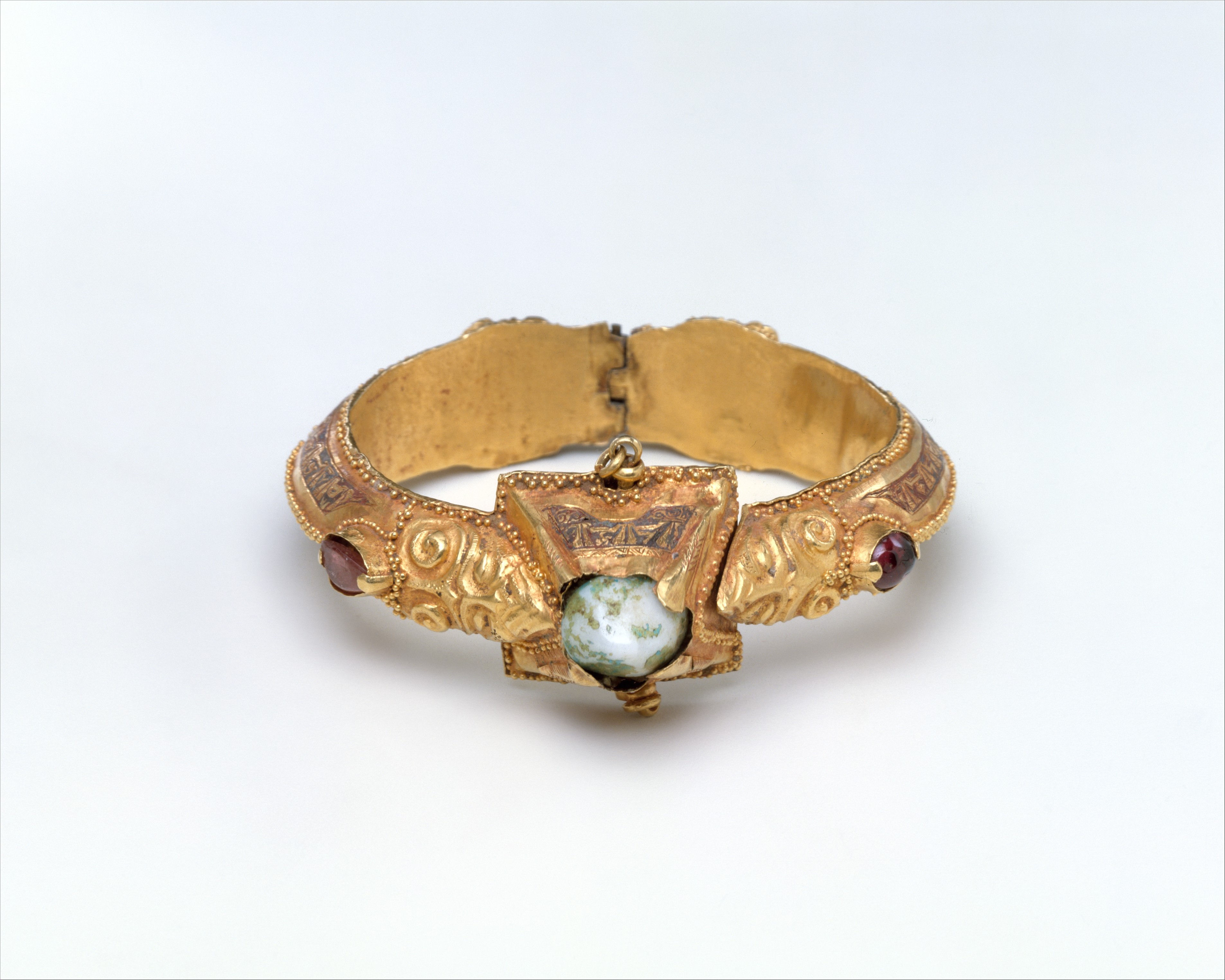
Within the isolated context of aesthetic archaeology, certain artifacts transcend their primary function as ornament to become codices of technical mastery and philosophical intent. The subject bracelet—fabricated from sheet gold and adorned through bitumen-highlighted incising, granulation, repoussé, and a polychromatic stone setting—constitutes such a masterpiece. Its value to the atelier lies not in mere replication, but in the systematic deconstruction of its classical elegance. This elegance is not a singular aesthetic but a complex equation balancing architectural structure (the sheet gold foundation), tactile narrative (the interplay of repoussé and granulation), and chromatic depth (the bitumen and stone matrix). Each technique represents a dialogue between constraint and flourish, where the material's permanence is contrasted with the artistry of its manipulation. This artifact serves as a foundational prototype, demonstrating that true luxury resides in the visible intelligence of construction and the deliberate, meaningful application of hand.
Structural Poetics: The Sheet Gold Foundation and Silhouette Architecture
The bracelet’s core is its fabricated sheet gold armature. This choice of construction—as opposed to casting—imparts a specific character: it is lightweight yet possesses a inherent rigidity, a malleable plane awaiting transformation. This directly informs the 2026 luxury silhouette philosophy, which moves beyond draped fluidity to embrace architectural drapery and structured minimalism. The sheet is analogous to the couture toile—a foundational plane that is cut, curved, and seamed to create volume that appears effortless. For 2026, this translates into silhouettes built from engineered panels, where the integrity of a single, continuous fabric is manipulated through precise cutting and internal infrastructure to create form. The bracelet’s curvature, embracing the wrist, inspires a renewed focus on anatomic precision in tailoring, where garments are conceived as a second skin, articulated at joints and relaxed in between, much like the gold sheet is worked to accommodate the body’s form. The elegance is in the efficiency of the structure, where support is inherent, not added.
Tactile Cartography: Granulation, Repoussé, and Surface Intelligence
The bracelet’s surface is a landscape of varied elevations and textures. The repoussé work creates a bas-relief, a narrative in negative space that catches light and shadow. The granulation introduces a micro-texture, a pointillist shimmer of minute spheres. Crucially, the bitumen-highlighted incising provides graphic, linear contrast, filling engraved lines with a matte, dark substance to accentuate pattern. This triad of techniques is a masterclass in haptic design, which becomes paramount for 2026. Luxury will be experienced through tactile differentiation. We translate this into silhouettes through hybrid fabrications: a sleek wool crepe bodice juxtaposed with a skirt of microscopic 3D-printed textural nodules (granulation). Embossed leather appliqués (repoussé) on fluid silk, and fine, jet-beaded tracery (bitumen incising) defining seam lines or geometric patterns on otherwise plain surfaces. The garment becomes a map to be read by the hand as well as the eye, where ornament is integrated into the construction as intentional, tactile information.
Chromatics of Provenance: Stone Setting and Polychromatic Strategy
The original stone setting—glazed quartz, ruby, garnet, and two lost stones—presents a non-primary, earth-derived palette. The glazed quartz offers a milky, softened translucency; the ruby and garnet provide deep, wine-like reds with varying saturation. This is not mere decoration but a polychromatic strategy rooted in provenance. The stones are fragments of the earth, their colors speaking of specific minerals and origins. For 2026, this informs a move away from flat, synthetic color towards stratified and geological color narratives. Silhouettes will incorporate layers of color through fabric laminations, sheer overlays in tonal variations, and the intentional use of stones and beads in their raw, irregular forms. A single silhouette might transition from the hazy beige of glazed quartz at the shoulders, through a stratum of garnet-red silk georgette, to a hem inlaid with rough, gold-veined quartz fragments. The "missing stones" in the artifact’s history are equally instructive; they invite asymmetric balance and deliberate omission, suggesting that in 2026, a gown may feature a single, spectacular stone clasp or an intentionally vacant setting, making the absence a part of the design narrative.
Synthesis for 2026: The Neo-Classical Silhouette Code
The synthesis of these deconstructed principles culminates in a definitive 2026 silhouette code for Natalie Fashion Atelier: The Armoured Fluid. This code embodies the paradox of the bracelet itself—strength and delicacy, structure and ornament. It manifests in looks defined by a precise, body-conscious architecture derived from the sheet gold principle, perhaps through techniques like gazar molding or thermo-formed technical silks. Upon this clean armature, a curated narrative of texture and color is applied with the intentionality of an ancient goldsmith. A repoussé-inspired volume may appear at a single shoulder or hip, rendered in padded silk or sculpted feathering. Granulation finds its expression in intricate, all-over embroideries of micro-beads or seed pearls that alter the fabric’s hand. The bitumen highlighting translates to graphic, dark seam detailing or lasercut patterns revealing a contrasting underlayer.
The polychromatic stone strategy evolves into a sophisticated layering of materials: sheer membranes of chiffon over metallic lamé, or inserts of burnished leather within cashmere. The overall silhouette, while potentially minimalist in outline, is maximalist in its detail and material intelligence. It speaks to a client who understands luxury as an experiential artifact, where every element—from the internal boning recalling the gold sheet’s curve to the hand-set crystal recalling ancient granulation—carries the weight of considered heritage and forward-looking execution. Thus, the classical bracelet ceases to be a mere relic; through aesthetic archaeology, it is reanimated as the genetic blueprint for a new, profoundly elegant standard in haute couture, where history is not quoted, but encoded into the very DNA of the future silhouette.