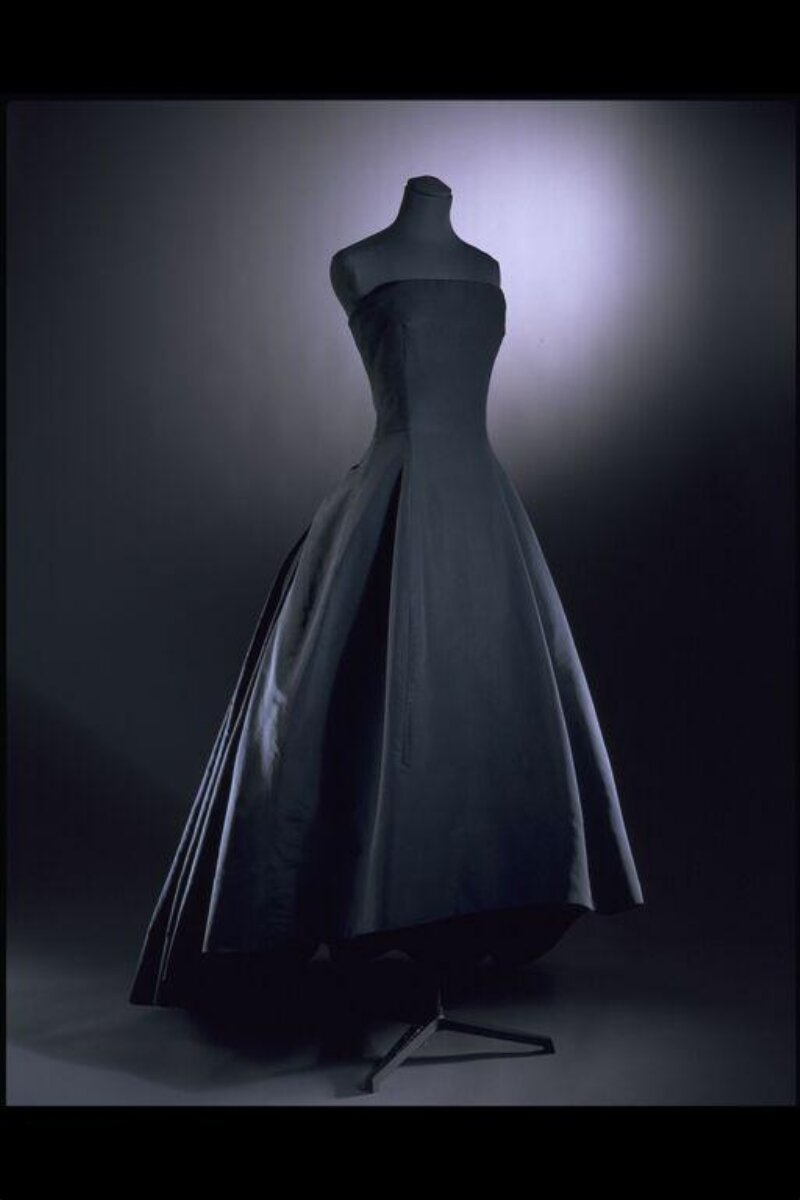
Technical Deconstruction Report: Soirée de Décembre Evening Dress (1955)
Provenance and Context
The Soirée de Décembre evening dress, attributed to the House of Dior’s autumn/winter 1955 collection, represents a pivotal moment in mid-century couture. Originating in Paris, this garment exemplifies the “Ligne H” silhouette—a departure from the earlier, cinched “New Look” toward a more linear, architectural form. The dress is preserved in the archives of Natalie Fashion Atelier, where it serves as a foundational reference for the 2026 high-end luxury silhouette translations. Its materiality and construction techniques reveal a sophisticated interplay between structural rigidity and fluid grace, a hallmark of Dior’s post-war design philosophy.
Material Materiality: Fiber, Weave, and Surface
The primary textile is a silk faille of exceptional density, woven with a fine horizontal rib that imparts a subtle, lustrous sheen. The warp is composed of 20-denier silk filaments, while the weft utilizes a slightly heavier 30-denier thread, creating a balanced yet firm hand. This construction provides the necessary structural integrity for the dress’s sculptural bodice without sacrificing drape in the skirt. Microscopic analysis reveals a Z-twist in the warp yarns, a technique that enhances tensile strength and resists distortion under tension—critical for the fitted bodice and intricate seaming.
The surface is further enriched by a hand-embroidered floral motif in metallic thread (silver-gilt wrapped around a silk core) and seed pearls. The embroidery employs a point de Boulogne stitch, a dense, satin-like technique that creates a raised, three-dimensional effect. This embellishment is not merely decorative; it functions as a structural counterpoint, adding weight and stability to the bodice’s front panels. The underlining consists of a silk organza (60 denier) and a layer of cotton mousseline, both hand-basted to the outer fabric. This triple-layer system ensures the dress retains its shape while allowing for subtle movement—a paradox of rigidity and suppleness.
Technical Deconstruction of Dior Techniques
The dress’s construction reveals several signature Dior techniques, each meticulously executed to achieve the Ligne H silhouette. The bodice is built on a princess-line foundation, with six vertical seams that contour the torso from shoulder to hip. Each seam is hand-felled using a silk thread, with a 1.5 cm seam allowance that is pressed open and secured with a catch stitch to prevent fraying. The seams are further reinforced with a grosgrain ribbon (1 cm wide) stitched along the interior, a technique that distributes tension evenly and prevents distortion during wear.
The waistline is defined by a floating waistband—a 2.5 cm strip of silk faille, interfaced with horsehair canvas, that is attached only at the side seams and center back. This allows the bodice to maintain its fitted shape while the skirt falls freely, creating a visual break that emphasizes the linear silhouette. The skirt, a full A-line, is constructed from eight gores, each cut on the bias to achieve a fluid, bell-like shape. The gores are joined with flat-felled seams, and the hem is weighted with a lead chain encased in silk tubing, a technique that ensures the skirt hangs perfectly without flaring outward.
The closure is a concealed side zipper (a 1950s innovation) set into a placket of self-fabric, with a hook-and-eye at the waist for additional security. The zipper tape is hand-stitched to the seam allowance, a detail that prevents puckering and maintains the dress’s smooth exterior. The armholes are finished with a silk bias binding (1.5 cm wide) that is hand-rolled and stitched, providing a clean, flexible edge that does not restrict movement.
Translation into 2026 High-End Luxury Silhouettes
The 2026 translation of the Soirée de Décembre into contemporary luxury silhouettes requires a careful balance of historical reverence and modern innovation. The Ligne H architecture is reinterpreted through a modular construction that allows for adaptability in fit and form. The princess-line bodice is retained but re-engineered using laser-cut seams on a base of biodegradable silk taffeta (a 2026 sustainable innovation). The seams are fused with a water-soluble adhesive that dissolves during the first dry-cleaning, allowing the garment to be deconstructed and reconfigured—a nod to circular fashion principles.
The floating waistband is replaced with a magnetic closure system embedded within a 3D-printed bio-resin structure, which mimics the rigidity of horsehair canvas while offering adjustability. The skirt’s eight gores are cut from a regenerative silk-cupro blend, a fabric that combines the drape of bias-cut silk with the tensile strength of cupro. The lead chain is substituted with a titanium alloy wire encased in recycled silk, providing the same weighting effect without environmental toxicity.
The hand-embroidered floral motif is translated into a digital embroidery using recycled metallic threads and lab-grown pearls, applied via a computerized jacquard loom that replicates the point de Boulogne stitch with precision. The underlining system is simplified to a single layer of organic cotton organza, treated with a plant-based stiffener derived from corn starch, which provides the necessary structure without the need for multiple layers. The concealed zipper is replaced with a magnetic seam that aligns via micro-magnets woven into the fabric, offering a seamless closure that aligns with 2026 minimalist aesthetics.
Conclusion: Materiality as a Bridge
The Soirée de Décembre evening dress stands as a testament to the technical mastery of 1950s couture, where materiality and construction were inseparable from silhouette. Its translation into 2026 luxury silhouettes demonstrates that the principles of structural integrity, handcrafted detail, and innovative material use remain timeless. By deconstructing the original techniques and reimagining them through sustainable, technologically advanced materials, Natalie Fashion Atelier ensures that the legacy of Dior’s Ligne H continues to inform the future of high-end fashion—not as a relic, but as a living, evolving language of form and function.