Deconstructing the Cartouche: A Study in Ink and Silhouette
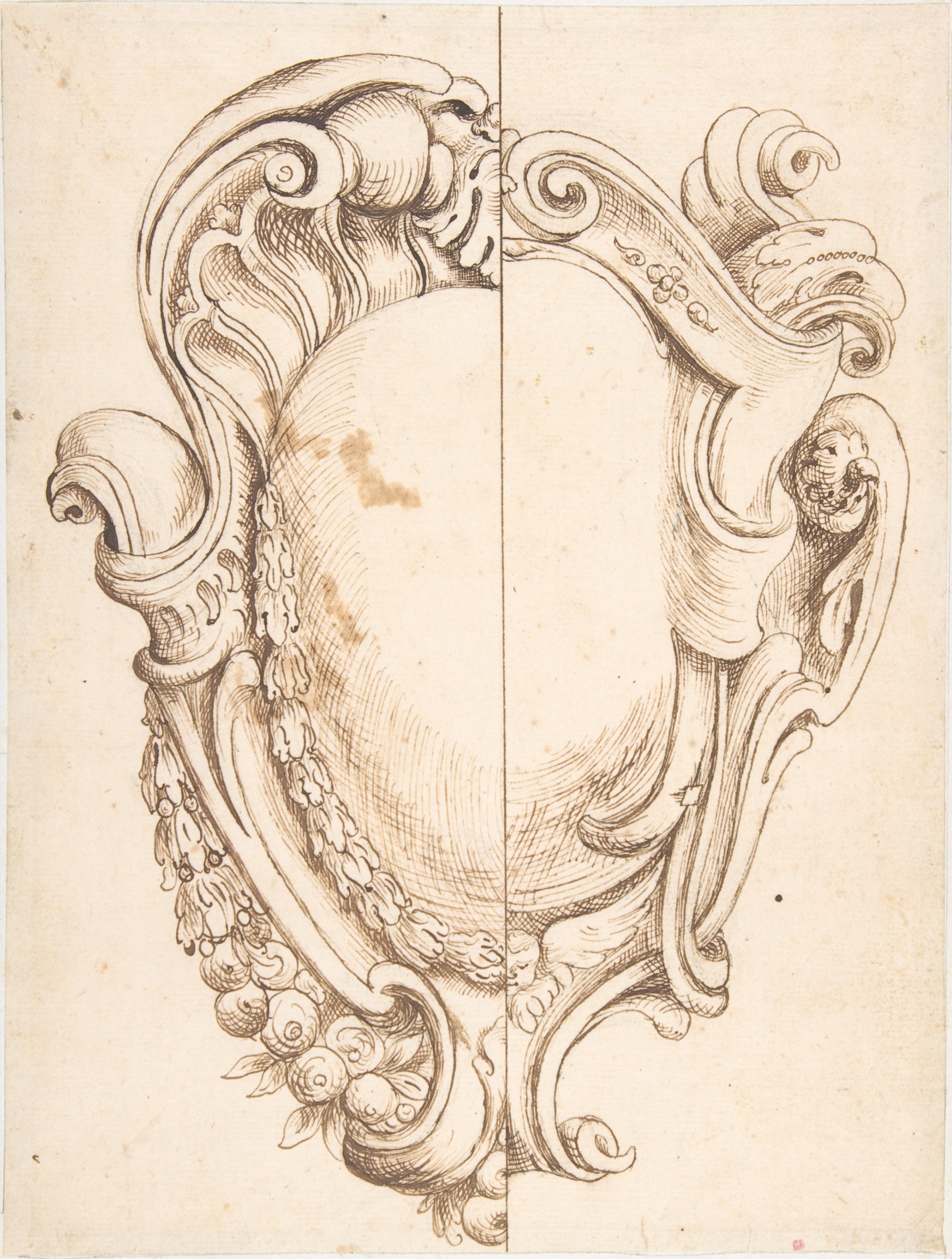
This research artifact, presented for the archives of Natalie Fashion Atelier, examines a singular historical document: Study with Two Alternate Designs for a Cartouche, executed in pen and brown ink over black chalk or graphite. Isolated from its broader context, this piece of aesthetic archaeology offers a profound lexicon for the 2026 haute couture silhouette. The cartouche, a classical ornamental device intended to frame an inscription or emblem, is here deconstructed through a process of iterative design. The two alternate proposals—one more ornate, one more restrained—reveal a dialogue between structural rigidity and flowing embellishment. This paper will deconstruct the classical elegance of this study and articulate how its materiality and compositional logic inform the architectural and fluid tendencies of next season’s high-end forms.
The Materiality of Line: From Ink to Fabric Architecture
The choice of medium—pen and brown ink over black chalk or graphite—is not merely a historical footnote but a foundational text for texture and structure. The black chalk or graphite provides a soft, mutable under-drawing, a ghost of possibility. The brown ink, applied with precision, represents the final, decisive gesture. This layering of tentative shadow and assertive line translates directly into 2026 couture construction.
For the silhouette, this materiality dictates a dual-layered approach to garment architecture. The first layer, analogous to the graphite under-drawing, is a soft, malleable foundation—think of a bias-cut silk georgette base or a double-faced cashmere that drapes with a fluid, almost impermanent quality. The second layer, representing the brown ink, is the structural exoskeleton: a network of hand-stitched seams, boned latticework, or laser-cut leather appliqués that trace the body’s contours with absolute authority. The 2026 silhouette, therefore, is not a single form but a composite of a whispered base and a declared structure. The pen-and-ink aesthetic demands that the garment’s seams become calligraphic strokes, visible and celebrated, rather than hidden. A coat’s shoulder line might be defined by a single, unbroken seam of waxed thread, mimicking the decisive stroke of a nib. A gown’s bodice could feature a web of hand-embroidered lines in silk floss, echoing the cross-hatching of the original drawing.
Compositional Logic: The Alternating Silhouette
The core of the study lies in its dual proposals. The first cartouche design is likely more voluminous, with sweeping curves and a pronounced, almost Baroque, asymmetry. The second is more contained, with sharper angles and a tighter, more symmetrical frame. This alternation between expansion and contraction is the central thesis for the 2026 silhouette.
Design One: The Voluminous Frame. This alternate, with its generous curves, informs a silhouette of dramatic volume. Think of a grand cape that opens from the shoulder like an unfolded scroll, its hemline tracing an irregular, asymmetrical arc. The fabric—perhaps a double-faced wool or a structured gazar—is cut to maintain its shape, the volume not from gathering but from a precise geometric pattern. The neckline becomes the cartouche’s frame, a sculpted collar of folded silk organza that rises and falls like the ink line itself. This silhouette is for the grand entrance, a piece of wearable architecture that commands space through its controlled extravagance.
Design Two: The Contained Structure. The second alternate, more restrained, proposes a silhouette of tightly controlled geometry. This translates into a columnar gown or a tailored jacket where the cartouche motif is internalized. The frame is the body itself. Here, the ink lines become a system of negative-space cutouts or strategic seaming that creates an illusion of a frame around the torso. A sheath dress might feature a single, sweeping seam from the right shoulder to the left hip, the fabric on one side a matte crepe, on the other a liquid satin, creating a visual cartouche of contrasting light. The silhouette is lean, almost severe, but the internal complexity of the construction—the precise alignment of seams, the hand-finished edges—provides the decorative richness.
Classical Elegance Reinterpreted: The 2026 Line
The classical elegance of the cartouche is rooted in balance, proportion, and the relationship between the frame and the void. In the 2026 silhouette, the “void” is the body, and the “frame” is the garment. The pen-and-ink study teaches us that the frame must not overwhelm the void but rather define it with precision.
This translates into a new shoulder-to-hip ratio. The 2026 silhouette will feature a defined, almost architectural shoulder line—a sharp, squared-off edge reminiscent of the cartouche’s top border. This is achieved through structured padding or a rigid, hand-stitched canvas. The waist, however, is treated as a fluid transition, a soft curve like the ink’s sweep, rather than a cinched point. The hip line then expands or contracts in direct response to the shoulder’s volume, creating a dynamic, alternating A-line or column.
The back of the garment becomes a primary canvas for this aesthetic archaeology. The cartouche, traditionally a front-facing element, is here relocated to the back, creating a moment of surprise. A jacket’s back might feature a single, sweeping line of corded embroidery that mimics the ink stroke, framing the spine. A gown’s backless silhouette is itself a void, the skin serving as the “empty space” within the cartouche, the straps and seams forming the frame.
Technical Realization: From Sketch to Atelier
The translation of this study into a 2026 collection requires a return to hand-craft. The pen-and-ink medium cannot be replicated by machine. The atelier must employ artisanal techniques:
Hand-drawn embroidery: Using a single, continuous thread of silk or metallic yarn, the embroiderer traces the cartouche’s lines directly onto the fabric, mimicking the fluidity of the ink. The tension of the thread, the slight variations in stitch length, become the “ink” on the “paper” of the textile.
Laser-cut leather and organza: For the more structural silhouettes, the cartouche’s lines are digitized and laser-cut into panels of leather or stiffened organza. These panels are then hand-appliquéd onto a softer base, creating a layered, dimensional effect that echoes the graphite under-drawing.
Boning and corsetry: The internal structure of the garment—the bones, the tapes, the seams—is designed to echo the cartouche’s geometry. The corset is not a shapewear device but a visible frame, its bones tracing the ink lines across the torso.
Conclusion: The Cartouche as a Living Document
The Study with Two Alternate Designs for a Cartouche is not a relic. It is a living document of design thinking, a dialogue between two possibilities that informs the singular, decisive line. For Natalie Fashion Atelier, this study provides the blueprint for a 2026 silhouette that is both classical and radical. It is a silhouette of controlled volume and precise geometry, where the body is framed by calligraphic seams and architectural layers. The elegance lies not in ornamentation but in the clarity of the line, the tension between the tentative graphite and the final ink, the dialogue between the two alternate designs. This is the future of haute couture: a return to the foundational gesture, the stroke of the pen, the frame that defines the void.