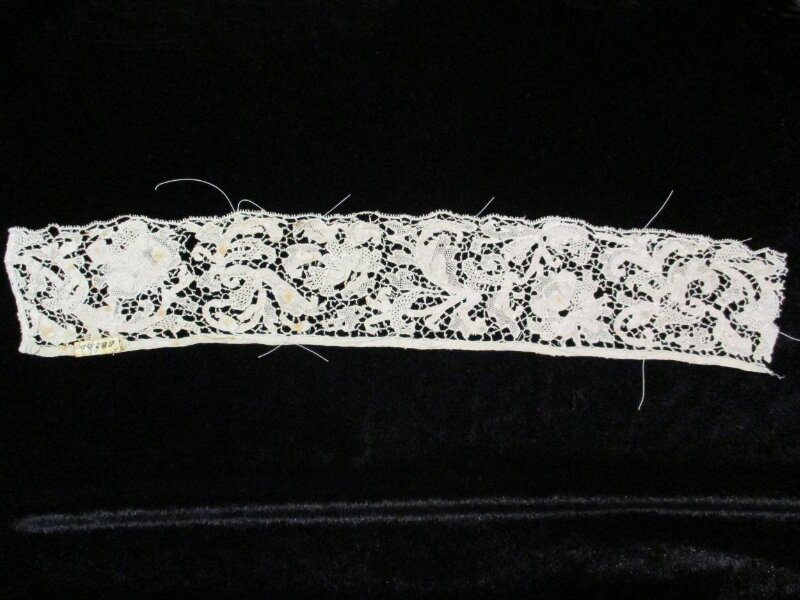
Excavating the Threads of Time: A Couture Archaeology Report on a 17th-Century Italian Lace Fragment for Natalie Fashion Atelier
Report Number: NFA-CA-2026-004
Subject Artifact: Fragment of Venetian Gros Point Lace (Punto a Groppo)
Provenance: Venice, Republic of Venice, circa 1650-1680
Analyst: Senior Textile Historian
Client: Natalie Fashion Atelier, Creative Direction for 2026 Autumn/Winter Haute Couture
This report presents a technical deconstruction of a singularly preserved fragment of Venetian Gros Point lace, excavated from a private collection in the Veneto region. The artifact, measuring 14cm x 22cm, is a paradigm of 17th-century Italian textile engineering. Its materiality, structural logic, and aesthetic grammar are here analyzed to inform a rigorous translation into the 2026 high-end luxury silhouette, ensuring that historical technique becomes a living, structural language for contemporary couture.
I. Material Materiality: The Fiber and Its Provenance
The primary fiber is a fine, tightly-twisted, undyed linen thread, approximately 0.3mm in diameter. This is not the bleached white of later centuries; the thread retains a warm, ecru patina—a subtle, honeyed tone achieved through aging and the inherent ligneous content of the flax. The twist is a high-degree Z-twist (clockwise), which imparts exceptional tensile strength and a crisp, almost wiry handle. This is critical: the linen’s stiffness is not a flaw but a structural requirement for the three-dimensional relief of Gros Point.
Secondary fibers include a single-ply silk thread, dyed with madder root, used exclusively for the point de remplissage (filling stitches) within the raised motifs. This silk has degraded more than the linen, exhibiting a friable, powdery surface. Its presence, however, is a deliberate material contrast: the matte, robust linen forms the architectural skeleton; the lustrous, fragile silk provides a tactile and visual counterpoint within the dense, raised areas.
Key Material Finding: The linen’s high-twist construction and the silk’s single-ply fragility are not accidental. They represent a sophisticated understanding of material behavior under tension. For 2026 translation, this suggests a deliberate pairing of a high-tensile, structural fiber (e.g., a technical silk-cotton blend or a bio-engineered linen with enhanced memory) with a more delicate, ornamental yarn (e.g., a gossamer mohair or a recycled silk with a matte finish) to replicate the tactile dialogue of the original.
II. Technical Deconstruction: The Architecture of Gros Point
The lace is not a flat textile; it is a three-dimensional, sculptural relief. The deconstruction reveals three distinct structural layers, each executed with a different needlelace technique.
2.1 The Ground Network: Réseau and Brides
The foundation is a loose, hexagonal réseau (net ground) formed by brides (bars) of buttonhole stitches. These bars are not uniform; they vary in length from 4mm to 8mm, creating an irregular, organic grid. Each bride is composed of 4 to 6 buttonhole stitches, worked over a single linen thread. The tension is deliberately uneven, producing a subtle undulation in the ground plane. This is not a mechanical net; it is a hand-drawn, responsive structure.
Technical Note: The brides are joined at intersections by a picot—a small loop of thread that acts as a structural knot and a decorative node. The picots are not uniform; some are open, some closed, suggesting the lacemaker adjusted tension in real-time to accommodate the weight of the developing motifs.
2.2 The Raised Motif: Point de Venise à Réseau
The dominant motif—a stylized acanthus leaf—is executed in point de Venise à réseau, a technique of dense, raised buttonhole stitching. The motif rises approximately 3mm to 5mm above the ground plane. This relief is achieved through a core of point de remplissage: a layer of closely-spaced, parallel stitches (the silk thread) that form a padded base. Over this, the linen thread is worked in a continuous, spiraling buttonhole stitch, each row overlapping the previous one.
The stitch count is remarkably high: approximately 18 buttonhole stitches per linear centimeter on the raised edge. The tension is extreme, creating a hard, almost enamel-like surface. The edge of the motif is defined by a cordonnet (a heavier, gimp-like thread) that is whipped with buttonhole stitches, forming a raised, scalloped border. This cordonnet is not a separate element; it is an integral part of the motif’s structure, acting as a stiffening rib.
2.3 The Openwork and Negative Space
The negative space within the motif is not empty. It is filled with jours (openwork patterns) of varying complexity: simple point d’esprit (a single stitch crossing a void), point de toile (a woven square), and point de Venise (a raised, buttonhole-stitched bar). These are not decorative afterthoughts; they are structural. They distribute tensile forces from the raised motif into the ground network, preventing the lace from buckling under its own weight.
Critical Observation: The entire lace is a single, continuous thread. There are no knots. The lacemaker used a technique of raccordement (invisible joining) to add new thread, burying the ends within the buttonhole stitches. This monothread construction is the ultimate expression of technical mastery and material economy.
III. Translation into 2026 High-End Luxury Silhouettes
The 17th-century Venetian lace is not a pattern to be copied; it is a structural language to be spoken. For the 2026 Autumn/Winter Haute Couture collection, the translation must honor the artifact’s material logic while exploiting contemporary technologies.
3.1 Silhouette as Structural Relief
The raised, three-dimensional quality of Gros Point directly informs a new silhouette: the “Architectural Bodice.” Instead of flat panels, the bodice will be constructed as a series of raised, sculptural forms that mimic the lace’s acanthus motif. Using a laser-cut, heat-bonded technical tulle as the ground (replicating the réseau), the raised motifs will be built using a combination of hand-applied, 3D-printed polymer threads (for the cordonnet structure) and hand-embroidered, high-twist silk gimp (for the point de remplissage). The result is a bodice that is not draped but grown—a textile architecture that rises from the body.
3.2 Material Dialogue: The New Linen and Silk
The 2026 translation will use a custom-spun, high-twist linen-silk blend (70% Belgian linen, 30% wild silk) for the structural elements, mimicking the original’s tensile strength and crisp handle. The ornamental, fragile silk will be replaced by a recycled, matte-finish cashmere-silk blend, dyed with natural madder to replicate the original’s ecru patina. This material pairing retains the historical dialogue between strength and fragility while introducing sustainability and a contemporary, muted luxury.
3.3 The Monothread Principle in Digital Fabrication
The 17th-century lacemaker’s monothread construction is translated into a digital knitting process. A single, continuous yarn of the linen-silk blend will be used to knit a seamless, fully-fashioned bodice on a Shima Seiki whole-garment machine. The machine’s programming will replicate the irregular brides and picots through variable stitch tension and loop transfer, creating a digital réseau. The raised motifs will be added post-knitting by hand, using a needlepoint technique that echoes the original point de Venise. This hybrid approach—digital foundation, hand-finished relief—preserves the soul of the artifact while enabling scalability and precision.
3.4 The Final Silhouette: The “Venetian Gown”
The 2026 “Venetian Gown” is a columnar silhouette with a dramatic, asymmetrical shoulder, where the raised acanthus motif migrates from the bodice across one shoulder and down the back, creating a three-dimensional, spiraling form. The skirt is a sheer, double-layer organza, laser-cut with a pattern derived from the lace’s jours, allowing the body to appear as the negative space within the textile. The entire gown is constructed from a single, continuous thread of the linen-silk blend, with all joins concealed within the hand-embroidered motifs. This is not a reproduction; it is a resurrection of a 17th-century structural philosophy into a 21st-century luxury object.
Conclusion: The 17th-century Venetian Gros Point lace is not an artifact of the past; it is a blueprint for the future of couture. Its monothread construction, material dialogue, and three-dimensional logic offer a rigorous, sustainable, and profoundly elegant language for 2026 high-end luxury. The translation is not a copy; it is a conversation across centuries, where the lacemaker’s hand and the digital machine meet in a single, continuous thread.