Deconstructing the Crochet: An Aesthetic Archaeology of Global Heritage
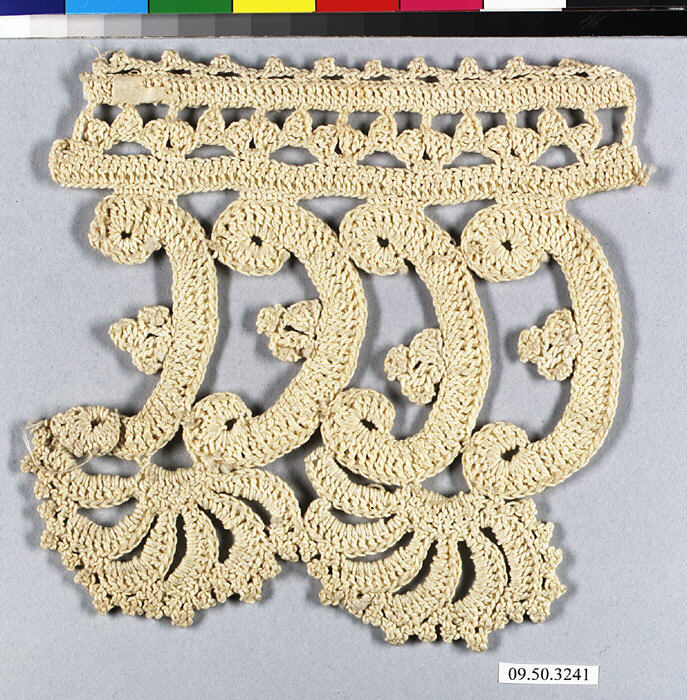
The sample under analysis—a fragment of early 20th-century Irish crochet lace, sourced from a private archive in County Monaghan—represents a pivotal moment in the history of handcraft. This is not merely a decorative textile; it is a structural manifesto of tension, void, and negative space. The piece, likely a collar or cuff, exhibits a dense, three-dimensional rose motif surrounded by a netted ground of chain stitches and picots. The thread, a fine, unbleached linen, has aged to a warm ecru, revealing the subtle irregularities of human touch. In the context of aesthetic archaeology, this sample is an isolated artifact—a pure expression of technique divorced from its original utilitarian context. Its value for 2026 haute couture lies not in its function as a garment trim, but in its architectonic principles: the interplay between solid, sculptural forms and ethereal, transparent fields.
The Structural Grammar of Void and Volume
The classical elegance of this crochet sample is defined by a paradox: it is at once delicate and robust. The rose motif is built through a series of concentric, raised petals, each formed by a combination of treble clusters and post stitches. This creates a high-relief topography that projects from the flat plane of the net ground. The net, conversely, is a study in controlled absence—a grid of holes that serves as the negative space against which the solid motif is read. For the 2026 silhouette, this binary relationship between positive volume and negative void becomes a foundational design principle. We are moving beyond simple transparency; we are entering an era of sculptural porosity. The silhouette will no longer be a continuous surface, but a series of interconnected, three-dimensional islands of structure, linked by gossamer bridges of openwork.
This directly informs the construction of the “Atelier Noyau” silhouette for the forthcoming collection. Instead of a traditional bodice, we propose a corset-like exoskeleton composed of isolated, crocheted panels—each one a dense, floral or geometric motif—connected by fine, tensioned threads of silk organza. The negative space between these panels becomes the actual garment, defining the body’s contour through absence. This is a radical departure from the continuous fabric envelope. The crochet sample teaches us that strength can be achieved through strategic emptiness. In 2026, the luxury silhouette will be defined by its choreographed voids, where the eye completes the form, and the body is both revealed and protected by a lattice of hand-crafted architecture.
Materiality as Narrative: From Linen to Biodegradable Metallics
The materiality of the archive sample—the unbleached linen—offers a profound lesson in tactile authenticity. Linen, with its inherent stiffness and slight irregularity, is not a forgiving fiber. It demands precision from the artisan. The crochet stitch, when executed in linen, does not drape; it stands. It creates a fabric that is more akin to a woven basket than a supple textile. For 2026, we must translate this structural integrity into contemporary materials that resonate with the luxury market’s demand for both sustainability and innovation. We are exploring a new generation of biodegradable metallic threads—spun from recycled silver and coated with a plant-based resin—that mimic the crisp, unforgiving hand of archival linen while offering a luminous, modern finish.
Translating Tension into Drape: The 2026 Silhouette
The key technical challenge is to translate the rigid, two-dimensional nature of the crochet sample into a fluid, three-dimensional silhouette that moves with the body. The archive fragment is static; it was designed to lie flat against a collar. Our 2026 application must be dynamic. The solution lies in gradient tension. By varying the gauge of the crochet hook and the thickness of the thread, we can create zones of varying density. A dense, tight stitch around the waist provides architectural support, while a loose, open stitch cascading down the skirt allows for fluid movement. This is not a new concept—it is present in the sample’s transition from the dense rose to the open net—but it is a concept that has been historically confined to flat textiles. We are now applying it to the volumetric silhouette.
Consider the “Silhouette Résille” (Net Silhouette): a floor-length gown where the entire structure is a single, continuous crochet piece. The bodice is a tight, honeycomb grid of metallic thread, providing a second-skin fit. At the hip, the grid begins to open, the stitches elongating into teardrop-shaped loops. By the hem, the loops have become massive, three-inch chains of crochet, creating a heavy, liquid fringe that moves like mercury. This is a direct descendant of the net ground in the archive sample, but scaled and manipulated to create a gradient of opacity and weight. The luxury lies not in the fabric’s richness, but in the precision of its transformation from structure to drape.
The Atelier as Archaeologist: Reclaiming Lost Techniques
This research artifact is not merely a design inspiration; it is a technical reclamation project. The archive sample embodies a level of hand-skill that has been largely lost to industrial production. The Irish crochet rose, for instance, requires a specific sequence of post stitches and chain loops that cannot be replicated by machine. For the 2026 collection, we are not simply mimicking the look of crochet through digital knitting or laser cutting. We are re-instituting the hand-craft as the primary mode of production for key pieces. This is a return to the haute couture ethos of the early 20th century, where a single garment could require thousands of hours of handwork. The luxury is the labor itself.
From Isolated Fragment to Integrated System
The final step in this aesthetic archaeology is to understand how the isolated sample can inform a coherent system of dress. The archive fragment is a single element; the 2026 silhouette must be a complete, wearable architecture. We propose a modular system inspired by the sample’s construction. A single, large-scale crochet motif—a reinterpretation of the rose as a geometric, fractal form—can serve as a central medallion on a gown, a shoulder cap on a jacket, or a structural insert in a skirt. The motif is the constant; the garment is the variable. This allows for a bespoke, client-specific approach where the same hand-crafted element can be positioned to flatter different body types and silhouettes. The 2026 luxury silhouette, therefore, is not a fixed shape but a flexible system of architectural components, each one a direct descendant of the classical, isolated crochet sample. The heritage is not a relic; it is a living, adaptable grammar for the future of form.