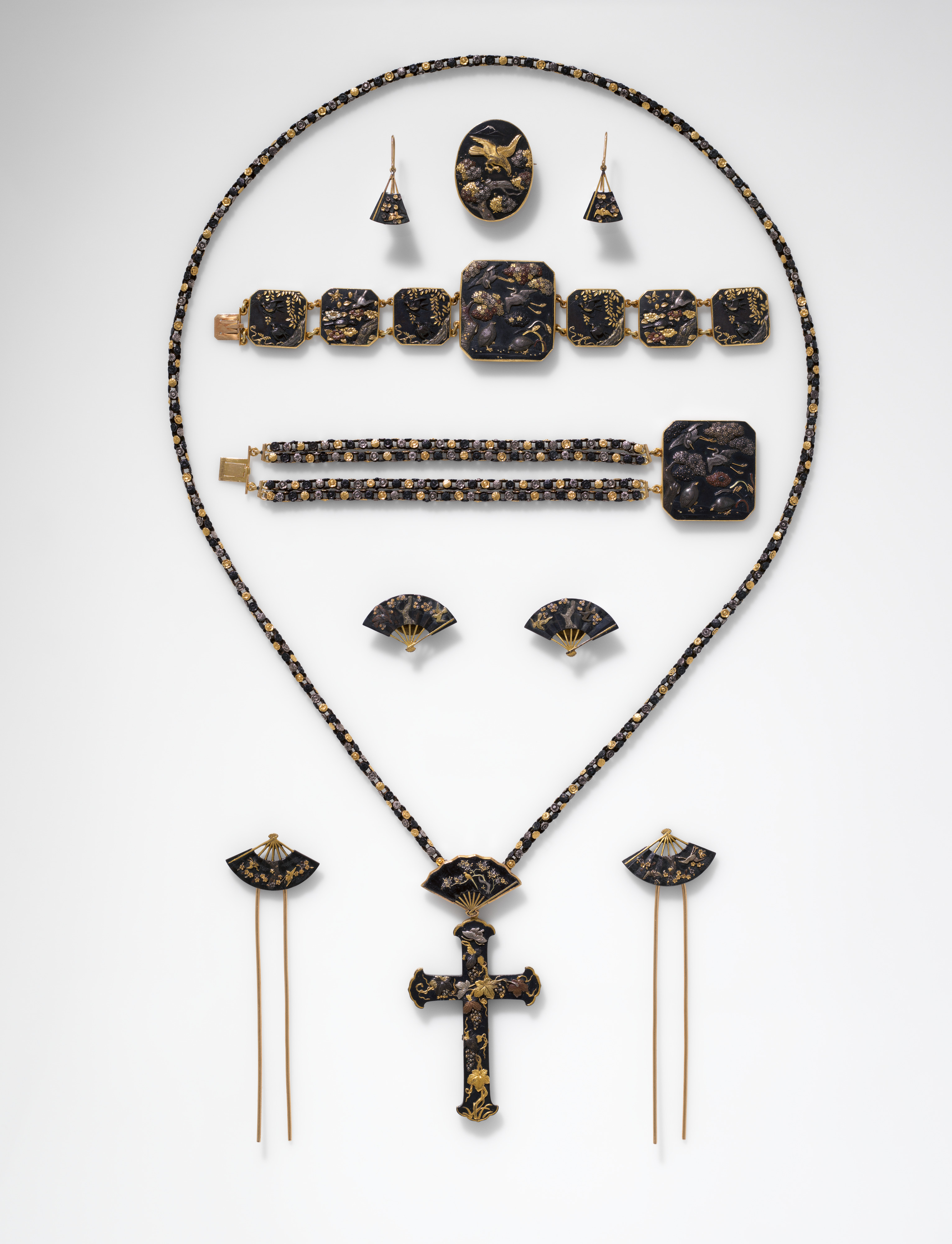
The Eleven-Piece Parure: Aesthetic Archaeology of Shakudo and Gold
Within the hallowed archives of global heritage, the eleven-piece parure stands as a singular artifact of consummate craftsmanship. This ensemble, comprising a tiara, necklace, earrings, brooch, bracelet, and a suite of rings, represents the zenith of 19th-century atelier ambition. For Natalie Fashion Atelier, this parure is not merely a decorative relic; it is a technical lexicon of material alchemy and structural logic. The specific fusion of shakudo—a Japanese alloy of copper and gold, patinated to a deep, almost black-indigo luster—with pure gold creates a dialogue of opacity and brilliance that defies conventional ornamentation. This research paper deconstructs the parure’s classical elegance, isolating its aesthetic archaeology to inform the 2026 haute couture silhouette.
Materiality as Narrative: The Shakudo-Gold Dialectic
The parure’s most radical innovation lies in its material hierarchy. Shakudo, historically reserved for samurai sword fittings and tea ceremony implements, introduces a chromatic gravity that gold alone cannot achieve. Its surface, achieved through a controlled oxidation process in a specific solution of copper acetate and verdigris, yields a non-reflective, velvet-like depth that absorbs ambient light. In contrast, the gold elements—applied as fine wire filigree, granulation, and high-polish plaques—act as luminous accents, creating a visual rhythm of absorption and reflection. This is not a binary of light and dark; it is a gradient of material intelligence.
For the 2026 silhouette, this duality translates into a layered opacity. The designer must consider how a garment’s surface can transition from matte to sheen without relying solely on textile weave. We propose a structural application: a gown’s bodice rendered in a dense, matte silk gazar, mimicking shakudo’s absorptive quality, while the skirt is articulated with gold-lame inserts that catch light only at specific angles. The parure teaches us that material contrast is not decorative but architectural.
Structural Archaeology: The Parure’s Silhouette Logic
The eleven-piece parure operates as a modular system. Each element—the tiara’s arch, the necklace’s collar, the bracelet’s cuff—is designed to be worn in isolation or as a unified composition. This modularity is a proto-deconstructivist concept, predating 20th-century fashion theory by a century. The parure’s structural logic is based on a negative space between components: the neckline is defined by the necklace’s absence of metal at the décolletage, while the earrings create a vertical line that elongates the jaw.
For 2026, this logic informs a silhouette of interrupted lines. Consider a jacket with a detachable collar that mimics the parure’s necklace, or a dress with asymmetric cutouts that echo the negative space between the brooch and bracelet. The parure’s classical elegance is not about symmetry but about balanced tension. The 2026 silhouette must embrace fragmentation as a form of cohesion. A high-waisted pant with a gold-threaded seam that traces the hip, stopping short of the hem, creates a visual echo of the parure’s interrupted arcs.
Chromatic and Textural Translation for 2026
The shakudo-gold parure offers a palette of extremes: the near-black of the alloy and the incandescent yellow of 24-karat gold. This is not a neutral palette but a high-contrast chromatic system. For the 2026 haute couture collection, we translate this into a material vocabulary of oxidized silks and metallic organza. A gown in blackened silk charmeuse, treated with a proprietary dye process to achieve a matte, almost powdery finish, is paired with gold-threaded guipure lace that forms a second skin over the bodice.
The parure’s textural interplay—the smooth, cold shakudo against the warm, granular gold—informs a tactile hierarchy. The 2026 silhouette must offer a sensory experience: a coat with a satin lining that feels cool against the skin, contrasted with a heavy, gold-embroidered collar that provides weight and warmth. The parure teaches that materiality is not seen but felt.
The Parure as a Framework for Silhouette Innovation
The eleven-piece parure’s aesthetic archaeology reveals a hidden geometry. Each piece is proportioned according to a golden ratio of the human form: the tiara’s height equals one-third of the forehead’s length; the necklace’s drop aligns with the collarbone’s apex. This anthropometric precision is the foundation of classical elegance. For 2026, we apply this to silhouette construction: a dress’s waistline is determined not by fashion but by the wearer’s natural waist-to-hip ratio, while the sleeve length is calibrated to the proportion of the upper arm to the torso.
This results in a bespoke silhouette system that rejects standardized sizing. The parure’s influence is most evident in the shoulder line: a structured, slightly raised shoulder, reminiscent of the tiara’s arch, creates a visual anchor for the entire garment. The gold accents are placed at strategic stress points: the shoulder, the hip, the wrist—areas where the body moves and where light catches naturally.
Conclusion: The Parure as a Living Archive
The eleven-piece shakudo-gold parure is not a static artifact but a living archive of design intelligence. Its materiality—the deep, absorptive shakudo and the brilliant gold—offers a chromatic and textural blueprint for the 2026 haute couture silhouette. Its modular structure informs a deconstructivist approach to garment construction, where negative space and interrupted lines create a new form of elegance. Most critically, its anthropometric precision demands a return to bespoke proportion, where the body is not a mannequin but a co-creator of the silhouette.
For Natalie Fashion Atelier, this parure is a technical manifesto. It instructs us to treat material as narrative, structure as dialogue, and silhouette as a living, breathing extension of heritage. The 2026 collection will not mimic the parure but will channel its logic: a logic of contrast, of modularity, and of the profound beauty that emerges when craftsmanship and materiality are allowed to speak in unison.