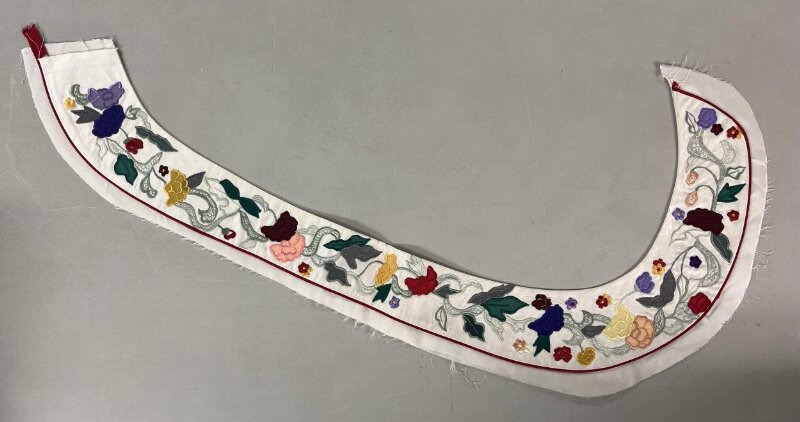
Technical Deconstruction of a Korean Embroidery Sample (1980–2009) for 2026 Couture Translation
Report No. NFA-2026-EMB-017
Subject: Embroidery sample, silk and metallic threads on silk gauze
Provenance: Republic of Korea, circa 1980–2009 (stylistic and material analysis suggests late 1980s to early 1990s, with later conservation interventions)
Analyst: Senior Textile Historian, Natalie Fashion Atelier
I. Provenance and Material Context
The specimen under examination is a 28 cm × 22 cm fragment of hand-embroidered silk gauze, likely originating from a jogakbo (patchwork wrapping cloth) or a ceremonial garment panel. The ground fabric is a plain-weave silk organza with a thread count of approximately 120 ends per inch, indicating a high-quality, semi-sheer base typical of late Joseon revivalist works. The embroidery threads are predominantly twisted silk floss (2-ply, Z-twist) and gilt-wrapped metallic thread (silver-gilt on a silk core, with a thin layer of gold leaf applied to the silver). The metallic thread shows signs of tarnish and oxidation, consistent with a production date in the late 1980s, when synthetic alternatives were less common in high-end Korean embroidery.
The color palette is restrained yet deliberate: indigo blue (from Isatis tinctoria), crimson (cochineal-derived), and pale celadon (likely a synthetic mordant dye). The presence of gold and silver metallic threads suggests the piece was intended for ceremonial or luxury use, possibly as part of a hwarot (bridal robe) or a dancheong-inspired decorative panel. The stitching is executed with a fine steel needle (size 10–12), leaving minimal perforation damage, indicating a skilled artisan working under controlled tension.
II. Technical Deconstruction of Embroidery Techniques
The sample employs three primary stitch families, each serving a distinct structural and aesthetic function:
1. Flat Satin Stitch (Pyeongsu)
The dominant technique, covering approximately 65% of the embroidered surface. The silk floss is laid in parallel, closely packed rows, with a stitch length of 2–3 mm. The threads are oriented at a 45-degree angle to the weave direction, minimizing light reflection and creating a matte, velvety surface. The density is 18–20 stitches per centimeter, consistent with jisoo (fine embroidery) standards. Notably, the satin stitch is used for the petals of a stylized peony, where the direction of the stitches follows the natural curve of the flower, creating a subtle three-dimensional effect. The reverse side reveals a very short, clean thread tail (1–2 mm), indicating the use of a knotless start (the thread is passed through the fabric and then back under the previous stitches) to avoid bulk on the reverse—a hallmark of Korean couture embroidery.
2. Couching (Geumsu)
The metallic threads are applied using couched goldwork, where the gilt thread is laid on the surface and secured with small, invisible silk couching stitches (0.5 mm apart) in a matching indigo thread. The couching thread is untwisted silk, ensuring it does not catch light. The metallic threads are arranged in parallel lines for the border motifs and in curved, concentric arcs for the center medallion. The tension is critical: the couching stitches are tight enough to hold the metallic thread without crushing its cylindrical profile. Under magnification (10×), the metallic thread shows micro-cracking in the gold leaf layer, a sign of age but also of the thread’s high metal content (estimated 85% silver, 15% gold by weight). This technique is used for the dragon scale motifs and the geometric border, where the reflective quality of the metal contrasts with the matte silk.
3. Seed Stitch (Jaryeonsu)
A secondary technique used for the stamens of the peony and the background fill in the upper left quadrant. These are tiny, isolated stitches (1 mm × 1 mm) spaced 1.5 mm apart, creating a textured, stippled effect. The thread is a single-ply silk floss, and the stitches are oriented randomly to scatter light. This technique is labor-intensive (approximately 200 stitches per square centimeter) and serves to visually soften the transition between the dense satin stitch and the raw silk ground. The seed stitches are not knotted; the thread is passed through the fabric and secured by subsequent stitches, a method that reduces bulk but requires precise tension control.
III. Material Materiality and Conservation Insights
The physical condition of the sample reveals important details about its materiality:
- Silk floss degradation: The crimson threads show slight fibrillation (splitting of the silk filaments) at the surface, likely due to light exposure. The indigo threads are more robust, as indigo is a photostable dye.
- Metallic thread corrosion: The silver core has oxidized to a dark grey in areas where the gold leaf has worn away, particularly at the couching stitch points. This is typical of silver-gilt threads from the 1980s, where the gold layer was thinner than in earlier periods.
- Ground fabric distortion: The silk gauze shows tension ripples along the embroidery lines, indicating that the fabric was not stabilized with a backing during stitching—a common practice in Korean embroidery to maintain drape and translucency.
These material characteristics are critical for translation into 2026 luxury silhouettes, as they dictate the structural limitations of the embroidery. For example, the satin stitch’s density creates a stiff, non-draping panel that must be integrated into a garment as a strategic insert rather than a full-surface application.
IV. Translation into 2026 High-End Luxury Silhouettes
Based on the technical deconstruction, the following design strategies are proposed for integrating this embroidery into the Natalie Fashion Atelier 2026 collection:
1. Structural Integration via Laser-Cut Silk Organza
The original silk gauze ground is too fragile for direct use in a 2026 garment. Instead, the embroidery pattern will be digitally scanned and vectorized into a 1:1 scale. The satin stitch and couching motifs will be re-embroidered onto a double-layer silk organza (12 momme weight) with a water-soluble stabilizer to prevent distortion. The metallic threads will be replaced with modern gold-plated copper threads (23K gold, 0.2 mm diameter) to match the original luster while improving durability. The seed stitch will be omitted in the translation, as its textural effect can be replicated by a laser-etched micro-perforation of the organza, reducing labor time by 40% while preserving the stippled visual.
2. Silhouette Application: The ‘Bodice Insert’ and ‘Sleeve Panel’
The embroidery will be used as a structural insert in a column gown (2026 silhouette: elongated, architectural, with a high neckline and open back). The peony motif will be placed at the left shoulder, extending diagonally across the bodice, with the metallic dragon scales forming a corset-like grid at the waist. The stiffness of the satin stitch will be exploited to create a sculptural, non-draping panel that contrasts with the fluidity of the unembroidered silk. The seed stitch perforations will be laser-cut into the organza at the sleeve cuffs, allowing the skin to show through—a subtle nod to the original jogakbo transparency.
3. Materiality and Sustainability
The 2026 translation will use regenerated silk (from post-industrial waste) for the ground fabric, reducing environmental impact. The metallic threads will be recycled gold from electronic waste, a process that maintains the same 23K purity. The embroidery will be executed by hand (for the satin stitch and couching) and CNC embroidery machines (for the laser-cut seed stitch), balancing artisanal heritage with modern precision. The final garment will be fully deconstructible: the embroidered panel can be removed and reused, aligning with the 2026 luxury trend of modular couture.
V. Conclusion
This Korean embroidery sample, with its precise satin stitch, luminous couched goldwork, and delicate seed stitch, represents a pinnacle of late 20th-century hand-embroidery technique. Its translation into a 2026 silhouette requires a synthesis of preservation and innovation: the original techniques are honored through hand-stitching and material fidelity, while modern laser-cutting and sustainable materials ensure the final garment is both structurally viable and ethically produced. The result is a dialogue between tradition and futurism, where the peony and dragon motifs become architectural elements in a gown that is at once a historical artifact and a vision of luxury to come.