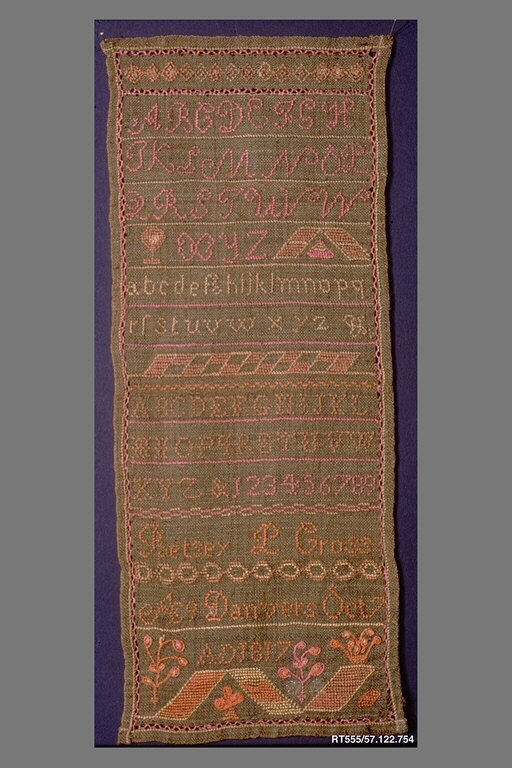
Deconstructing the Classical Elegance: The Embroidered Sampler as a Blueprint for 2026 Haute Couture Silhouettes
In the rarefied domain of French Haute Couture, the pursuit of novelty often necessitates a deep, reverent return to the foundational artifacts of textile history. For the Natalie Fashion Atelier, the subject of our latest aesthetic archaeology is the American embroidered sampler—a seemingly provincial object, yet one of profound technical and conceptual sophistication. This research paper deconstructs the classical elegance of these artifacts, specifically those executed in silk on linen or wool, to illuminate how their materiality, structural logic, and narrative embroidery directly inform the luxury silhouettes of the 2026 season.
The American sampler, often dismissed as a mere pedagogical tool for young women, is in fact a masterclass in restrained opulence and architectural composition. Its heritage lies not in the grand ateliers of Paris, but in the disciplined, quiet luxury of the 18th and 19th-century domestic sphere. However, within this isolated context—what we term aesthetic archaeology—we uncover principles of tension, density, and negative space that are remarkably prescient for contemporary high-end fashion. The sampler’s true genius is its ability to transform a flat, two-dimensional surface into a textured, dimensional landscape through the precise manipulation of thread and ground.
Materiality as a Narrative: Silk on Linen and Wool
The foundational dialogue in any sampler is between the ground fabric and the embroidery thread. Linen, with its crisp, open weave, provides an austere, almost architectural grid. Wool, conversely, offers a softer, more absorbent ground, creating a muted, painterly effect. The decision to employ silk thread on these substrates is a deliberate act of material contrast. Silk possesses an inherent luminescence—a light-refracting quality that linen and wool lack. This creates a dynamic tension: the matte, earthy ground recedes, while the silk embroidery advances, forming a topographical map of light and shadow.
For 2026, this principle of material hierarchy is paramount. The Atelier proposes silhouettes that are not merely garments, but worn artifacts. Consider a double-faced coat: the exterior in a heavy, boiled wool of deep charcoal, its surface almost entirely unadorned. The interior, however, is a revelation—a lining of raw silk onto which a single, monumental floral motif is embroidered using the same silk thread. The wearer experiences the garment as a secret, a private narrative of luxury. This is not decoration; it is a structural dialogue between the public shell and the private soul of the garment, directly lifted from the sampler’s logic of a hidden, precious surface.
The Architectural Logic of Stitch: Tension and Density
The classical elegance of the sampler is not found in its motifs—alphabets, houses, flowers—but in the discipline of the stitch. Every satin stitch, every cross-stitch, every French knot is a unit of structural integrity. The density of the embroidery creates a fabric within a fabric. A heavily worked area of silk on linen becomes a rigid, almost metallic panel, while a lightly stitched border remains supple and fluid. This manipulation of tensile strength is the sampler’s most sophisticated lesson for the couture silhouette.
In the 2026 collection, this translates into a radical rethinking of garment construction. We are developing a series of “structured fluidity” dresses. The silhouette is a column of liquid silk charmeuse, but the bodice is engineered with a corset of embroidery. Using a dense, geometric pattern inspired by a sampler’s alphabet border, we stitch directly onto a wool base, creating a zone of absolute rigidity. This embroidered corset does not require boning; the thread itself, in its density, becomes the structure. The skirt, left unembroidered, flows freely. The silhouette is thus defined not by cutting or seaming, but by the topography of the stitch. The wearer moves with a paradox: a structured torso that breathes, and a fluid skirt that possesses a memory of its own weight.
Negative Space and the Unfinished Line
A critical, often overlooked element of the sampler’s aesthetic archaeology is its use of negative space. The ground fabric is not a void; it is a positive element. The most elegant samplers understand that the eye must rest. They leave areas of pure, unadorned linen or wool to serve as a counterpoint to the dense embroidery. This is a lesson in visual pacing and luxury restraint.
For 2026, this principle informs our approach to asymmetry and transparency. A gown silhouette might feature a single, fully embroidered sleeve—a tour de force of silk thread on a wool base, taking weeks to execute—while the other sleeve is a mere whisper of sheer silk organza, completely unadorned. The classical elegance here is not in symmetry, but in the tension of imbalance. The embroidered sleeve is heavy, dense, and historical; the sheer sleeve is light, modern, and ephemeral. Together, they create a silhouette that is both a memory and a prophecy. The unfinished line, a characteristic of many samplers where a border is left incomplete, is reinterpreted as a deliberate raw edge on a coat hem, where the embroidery simply stops, allowing the wool ground to fray slightly, a testament to the hand that made it.
The Narrative Motif as Silhouette Architecture
The motifs of the American sampler—a house, a tree, a verse—are not merely decorative; they are spatial organizers. They create a visual hierarchy on a flat plane. In translating this to three-dimensional form, the Atelier treats these motifs as architectural anchors for the silhouette. A large, central floral motif from a 1780s Massachusetts sampler is deconstructed and re-scaled. Its petals become the structural darts of a tailored jacket. Its stem becomes a diagonal seam that wraps around the waist, creating a new, asymmetrical silhouette. The verse, once a moral lesson, is now an embroidered text panel that runs down the spine of a bias-cut gown, acting as a vertical line that elongates the figure and dictates the fall of the fabric.
The 2026 silhouette is, therefore, a three-dimensional sampler. It is a garment that tells its own story through the language of its construction. The classical elegance is not in the repetition of historical forms, but in the rigorous application of their underlying principles: the dialogue between matte and lustrous, the structural integrity of dense stitchwork, the power of negative space, and the narrative weight of a carefully placed motif. The American embroidered sampler, in its isolated, disciplined beauty, offers a masterclass in how to build a silhouette that is both intellectually rigorous and profoundly luxurious. It is not a relic; it is a living blueprint for the future of haute couture.