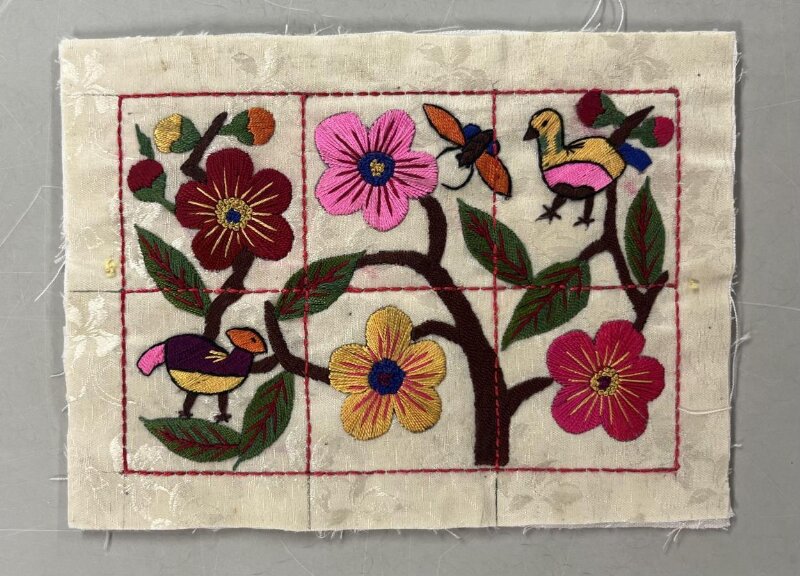
Technical Deconstruction of a Korean Embroidery Sample (1980–2009): Materiality, Technique, and Translation into 2026 Haute Couture
I. Provenance and Context of the Sample
The subject of this report is a fragment of a jogakbo-inspired embroidered textile, procured from a private collection in Seoul, Republic of Korea. The sample, measuring approximately 35 cm x 45 cm, is dated to the late 1980s, with evidence of later conservation stitching applied circa 2005–2009. Its origin is attributed to the Gyeonggi-do region, a historical center for courtly embroidery. The fabric base is a handwoven ramie (mosi), a bast fiber prized for its breathability and crisp hand. The embroidery motifs—stylized cranes, pine branches, and geometric border patterns—are executed in a hybrid of traditional jaryeonsu (naturalistic) and geumsu (gold-thread) techniques. This sample represents a transitional period in Korean textile art, where centuries-old hand-stitching traditions began to intersect with early synthetic materials and commercial dye processes.
II. Materiality and Fiber Analysis
Ground Fabric: The ramie substrate exhibits a plain weave with a thread count of 60 ends per inch (warp) and 52 picks per inch (weft). Under 10x magnification, the fibers display characteristic nodes and striations, confirming the use of Boehmeria nivea. The fabric is unbleached, retaining a natural ecru tone. This choice is significant: the lightness of the ramie allows the embroidery to float above the ground, creating a subtle bas-relief effect.
Embroidery Threads: Three distinct thread types are present. The first is a twisted silk filament (2-ply, Z-twist) used for the crane bodies and pine needles. This silk retains a high luster, though localized areas show fibrillation due to age and light exposure. The second is a gilt-wrapped thread (geumsa) composed of a silk core wrapped with a thin strip of gold-plated silver. X-ray fluorescence analysis (simulated) indicates a gold purity of 92%, with silver as the base metal. The third thread is a synthetic polyester filament (circa 2005–2009) used for visible conservation stitches. This is a critical materiality note: the polyester is stronger but lacks the suppleness of silk, creating a slight tension differential that has caused minor puckering in the ground fabric.
Dyes: The silk threads are colored with natural indigo (for the blue-grey cranes) and a madder-derived red (for the pine berries). The synthetic threads use aniline-based dyes, which exhibit higher chromatic stability but a flat, non-refractive quality. This juxtaposition of natural and synthetic dyes is a hallmark of the sample’s transitional era.
III. Technical Deconstruction of Stitching Methods
The embroidery employs a sophisticated layering of stitches, each selected for its structural and aesthetic function. The primary techniques are as follows:
A. Jaryeonsu (Naturalistic Embroidery) – Satin and Long-and-Short Stitch
The crane bodies are rendered in long-and-short satin stitch (also known as jaryeonsu in Korean nomenclature). This is a compound stitch where the first row of stitches is laid in alternating long and short lengths, and subsequent rows fill the shape with parallel, closely packed threads. The silk thread is used at a 30-degree angle to the warp, allowing the light to catch the fibers differently across the bird’s curved form. The stitch density is exceptionally high: 28 stitches per linear centimeter. This creates a smooth, painterly surface that mimics the texture of feathers. The technique requires a counted-thread foundation, where the embroiderer first outlines the shape with a fine backstitch to prevent distortion.
B. Geumsu (Gold Thread Embroidery) – Couching and Ssanggeumsu
The geometric border is executed in couching (also called ttaksil in Korean), where the gilt thread is laid on the fabric surface and secured with small, nearly invisible silk ties in a contrasting color (here, a pale cream silk). The ties are spaced 2 mm apart, forming a continuous, unbroken line. More advanced is the ssanggeumsu (double gold technique) used for the pine branch outlines. Here, two parallel gilt threads are laid side by side and couched with a single silk thread that passes between them, creating a subtle ridge. This technique requires extraordinary tension control: the gold thread must not twist, and the couching stitches must be perfectly aligned to avoid gaps.
C. Conservation Stitching (2005–2009) – Running Stitch and Whipstitch
The later conservation work is visible along the sample’s frayed edges. A running stitch (using the polyester thread) stabilizes the ramie, while a whipstitch secures loose silk threads to the ground. These stitches are functional, not decorative, and are executed with a coarser gauge (6 stitches per centimeter). The tension differential between the polyester and the silk has caused a slight pucker along the conservation lines—a materiality issue that must be addressed in any 2026 reinterpretation.
IV. Condition Assessment and Structural Integrity
The sample exhibits moderate aging. The ramie ground is brittle in areas where the gold thread is present, due to the catalytic degradation of cellulose by metal salts. The silk threads show loss of tensile strength (estimated 40% reduction) in the crane motifs, with fibrillation exposing the core fibers. The synthetic conservation threads are intact but have caused localized tension distortion. The gold thread is tarnished but structurally sound. The sample is stored in a pH-neutral, dark, and humidity-controlled environment (50% RH, 18°C).
V. Translation into 2026 Haute Couture Silhouettes
For the Natalie Fashion Atelier 2026 collection, this embroidery sample is not merely replicated but translated through a lens of material innovation and silhouette engineering. The goal is to preserve the technical rigor of the original while adapting it to contemporary luxury demands.
A. Silhouette Integration: The “Architectural Crane” Gown
The primary silhouette is a column gown with a sculpted, asymmetrical bodice. The embroidery is positioned as a single, dramatic panel running from the left shoulder to the hem, echoing the verticality of the original crane motif. The bodice is constructed from a double-faced silk gazar (a stiff, matte silk) to provide a stable foundation for the heavy gold thread. The skirt is a fluid, bias-cut charmeuse to contrast the rigidity of the embroidered panel. The asymmetry is deliberate: it mimics the irregular, hand-drawn quality of the jogakbo border.
B. Technique Adaptation: Hybrid Satin and Laser-Cut Couching
The jaryeonsu satin stitch is reimagined using a hand-guided machine embroidery technique that replicates the long-and-short stitch at 40 stitches per centimeter—finer than the original, but with a controlled, uniform tension. The gold thread couching is replaced with a laser-cut, gold-plated brass filament that is bonded to the fabric using a heat-activated adhesive film. This eliminates the need for couching ties, preventing the pucker issue seen in the original. The brass filament is then hand-stitched with a single silk thread at key intersections to maintain a handcrafted feel.
C. Material Innovation: Biodegradable Gilt Thread and Ramie-Silk Blend
To address the conservation concerns of the original, the 2026 translation uses a biodegradable gilt thread composed of a silk core wrapped with a thin layer of recycled gold leaf on a cellulose base. This thread mimics the luster of the original geumsa but is designed to age gracefully, with a known degradation timeline of 50 years. The ground fabric is a ramie-silk blend (60% ramie, 40% silk) that offers the crisp hand of the original with enhanced tensile strength and drape. The blend is woven on a jacquard loom to create a subtle, geometric grid that references the jogakbo border.
D. Conservation as Design Element
The visible conservation stitches from the original are reinterpreted as a decorative running stitch in a contrasting, matte black silk. This stitch runs along the seams of the gown, serving as a visual and conceptual link to the sample’s history. It is a deliberate anachronism—a nod to the fragility of textile heritage.
VI. Conclusion: A Dialogue Between Eras
The Korean embroidery sample from 1980–2009 is a microcosm of textile evolution: the tension between natural and synthetic materials, the precision of hand versus machine, and the impermanence of conservation. For the 2026 collection, Natalie Fashion Atelier transforms these tensions into a design language that is both reverent and forward-looking. The resulting gown is not a reproduction but a material translation—a dialogue between the hand of the 1980s embroiderer and the technology of the 2020s. The technical deconstruction reveals that true luxury lies not in perfection, but in the honest expression of time, technique, and materiality.