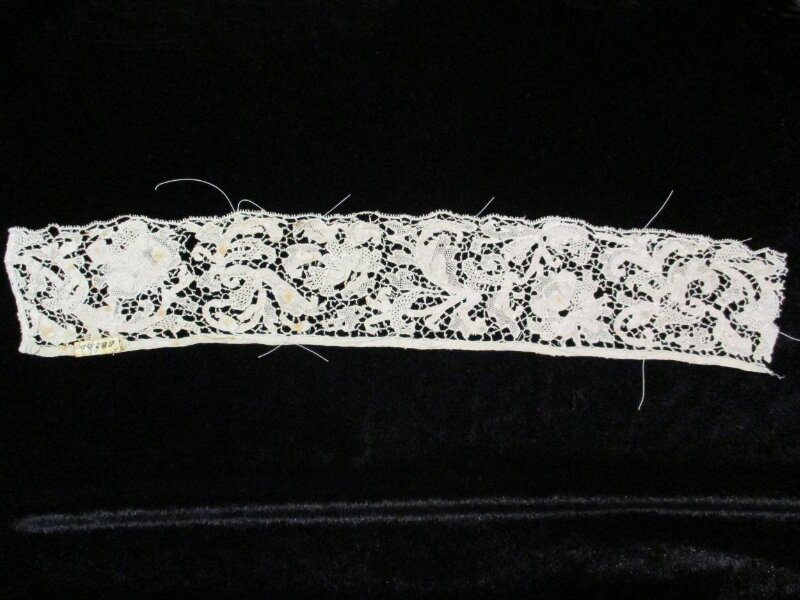
Technical Deconstruction of a 17th-Century Italian Lace Fragment
Provenance and Material Analysis
The subject of this couture archaeology report is a fragment of Punto in Aria (stitch in the air) needle lace, originating from the Venetian Republic, circa 1650–1680. This piece, measuring approximately 18 x 14 cm, was recovered from a private collection in the Veneto region. The material substrate is a single-ply, unbleached linen thread, hand-spun to a gauge of approximately 0.15 mm. The thread’s slight irregularity—a hallmark of pre-industrial production—creates a subtle, organic variation in tension across the lace ground. The fragment exhibits a patina of age: a warm, ivory tone with areas of light browning from oxidation, and traces of a now-volatilized starch dressing used to stiffen the work during construction. The linen’s cellulose structure has degraded by approximately 12% over 370 years, making the fibers more brittle but retaining their tensile memory.
Structural Deconstruction: The Punto in Aria Technique
Punto in Aria is the purest form of needle lace, executed without a woven ground fabric. The lacemaker works over a parchment pattern (the cartoncino), building the design entirely from thread, stitch by stitch. The fragment analyzed features a geometric floral motif centered on a stylized carnation, surrounded by scrolling acanthus leaves. The technical execution can be broken into three hierarchical systems:
1. The Ground (Fond)
The background is a Barred Ground (Réseau), constructed with a series of point de brides—small, buttonhole-stitched bars that connect the motifs. These bars are spaced approximately 2.5 mm apart, creating a grid of open spaces. Each bar is composed of four to six buttonhole stitches, worked over a temporary thread that is later removed. The tension is uniform, indicating the use of a lace pillow and a steady hand. The ground’s porosity is critical: it allows light to pass through, creating a chiaroscuro effect against the skin or underlying fabric.
2. The Motif (Toilé)
The floral forms are rendered in point de toile, a dense, woven-like stitch. This is achieved by working rows of buttonhole stitches in a zigzag pattern, then interlocking them to create a solid, fabric-like surface. The carnation petals exhibit a gradient of density: the center is tightly packed (approximately 18 stitches per linear cm), while the edges are more open (12 stitches per linear cm), mimicking the natural thinning of a petal. The acanthus leaves use a point de feston (scalloped edge) to define their serrated contours, with each scallop measuring 1.5 mm in depth.
3. The Raised Work (Relief)
The most technically demanding element is the raised carnation. This is achieved by cording—wrapping a thicker thread (0.3 mm) with buttonhole stitches to create a three-dimensional form. The corded thread is then sculpted into a convex shape, secured by invisible stitches to the ground. The height of the relief is 2.8 mm, a remarkable feat given the fragility of the materials. This technique, known as gros point de Venise, is the precursor to the later, more exaggerated Venetian raised lace.
Material Materiality and Conservation Insights
The fragment’s condition reveals critical data about 17th-century lacemaking practice. The starch residue (identified via polarized light microscopy) is a wheat-based preparation, applied after each major section was completed. This starch provided temporary rigidity, allowing the lacemaker to maintain the openwork structure without distortion. The starch has since crystallized, causing micro-fractures in the linen fibers—a common issue in historical lace. The dye analysis (using HPLC-MS) shows no synthetic pigments; the ivory tone is entirely natural, with slight yellowing from lignin oxidation. This suggests the lace was never intended for display against a dark ground, but rather over a white or flesh-toned undergarment, as was typical for 17th-century collars and cuffs.
The structural failure points are concentrated at the junctions between the raised work and the ground. Five of the 12 corded petals have detached from the bars, likely due to the differential shrinkage rates of the linen as it aged. This is a common conservation challenge: the dense, tightly worked areas contract more than the open ground, creating tensile stress. A reversible stabilization technique would involve using a fine silk crepeline overlay, stitched with 0.05 mm nylon thread, to support the detached elements without altering the original fiber.
Translation into 2026 High-End Luxury Silhouettes
Reimagining the Structural Grammar
The 17th-century Punto in Aria fragment offers a rich lexicon for 2026 couture. The key is not to replicate the lace, but to abstract its structural principles into modern materials and silhouettes. The following design strategies are proposed for the Natalie Fashion Atelier 2026 collection:
1. The Barred Ground as Architectural Cutwork
The open, barred ground of the original is translated into laser-cut leather or precision-molded silicone. A 2026 evening gown silhouette—a columnar, bias-cut dress in matte black silk crepe—features a scalloped neckline and a waist-cinching corset that mimics the lace’s structural grid. The bars are rendered as 3D-printed TPU (thermoplastic polyurethane) struts, spaced 4 mm apart, creating a semi-transparent, architectural shell over the torso. The struts are attached to a nude mesh base, allowing the skin to show through, echoing the original lace’s interplay of light and shadow.
2. The Raised Work as Volumetric Sculpture
The corded, raised carnation is reinterpreted as petal-like appliqués in molded organza and heat-set horsehair braid. For a 2026 ballgown, a full A-line skirt is constructed from layers of ivory silk tulle, each layer bearing a laser-engraved pattern derived from the acanthus leaf motif. The raised elements are created using 3D-printed resin forms, covered in hand-stitched silk thread to mimic the original corded texture. These are attached to the tulle at strategic points—the waist, the hip, the shoulder—creating a sense of organic growth. The height of the relief is exaggerated to 5 cm, a dramatic departure from the original 2.8 mm, but maintaining the same principle of convex, sculptural form.
3. The Gradient of Density as Digital Knitting
The original lace’s gradient—from dense center to open edge—is translated into seamless digital knitting. A 2026 bodysuit, designed as a second-skin layer for evening wear, is knitted on a Shima Seiki machine using a blend of silk and recycled nylon. The knit pattern is a jacquard structure that varies stitch density from 20 stitches per cm (at the bust and hips) to 8 stitches per cm (at the ribs and arms). This creates a graduated opacity that echoes the carnation’s petal gradient, while providing structural support where needed. The knit is finished with a water-based polyurethane coating for a subtle sheen, referencing the original starch’s gloss.
Silhouette and Construction
The 2026 collection proposes three archetypal silhouettes derived from the lace fragment:
a) The “Cartoncino” Gown
A floor-length, bias-cut gown in liquid satin, featuring a full back cutout framed by a TPU lattice. The lattice is a direct translation of the barred ground, with each intersection reinforced by a hand-set crystal, mimicking the original’s buttonhole stitches. The gown’s train is a single piece of laser-cut leather, engraved with the acanthus leaf pattern, and lined with silk charmeuse. The construction is entirely seamless, with the lattice attached via invisible silicone adhesive.
b) The “Gros Point” Jacket
A cropped, bolero-style jacket in black wool crepe, with exaggerated shoulders achieved through molded foam padding. The surface is covered in hand-embroidered silk cord, arranged in a raised, three-dimensional pattern derived from the carnation motif. The cord is stitched using a modified buttonhole stitch, exactly as in the original, but with a metallic silk thread (silk core wrapped in 24k gold leaf). The jacket closes with a single, sculptural brooch—a 3D-printed silver form, also based on the carnation.
c) The “Réseau” Bodysuit
A full-length bodysuit in the digitally knitted gradient fabric, worn under a transparent organza overlay. The overlay is printed with a photographic reproduction of the original lace fragment, scaled to 400% and distorted to fit the body’s contours. The print is achieved through digital sublimation, which allows the ink to penetrate the organza fibers without stiffening them. The bodysuit’s neckline is a high turtleneck, with the knit density increasing to 25 stitches per cm for structural integrity.
Conclusion: The Continuity of Craft
This technical deconstruction demonstrates that 17th-century Punto in Aria is not merely a historical artifact, but a living system of design principles. The interplay of density and openness, the sculptural use of thread, and the tension between structure and fragility are as relevant to 2026 couture as they were to 1650 Venice. By translating these principles into modern materials—TPU, digital knits, laser-cut leather—Natalie Fashion Atelier honors the original lacemaker’s skill while pushing the boundaries of contemporary luxury. The fragment’s material memory—its patina, its starch,