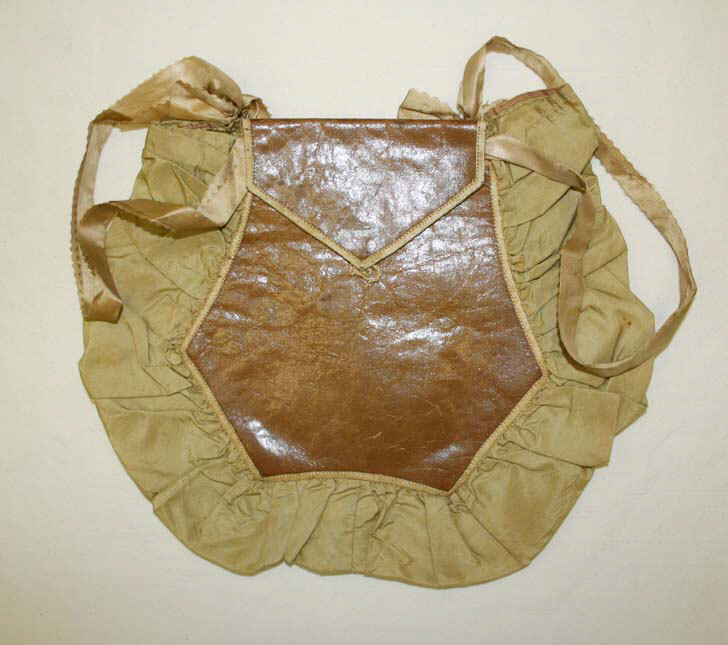
The Archival Object: An American Synthesis of Leather, Silk, and Cotton
The artifact under examination—a late 19th-century American traveling bag, circa 1885—represents a pivotal moment in the aesthetic archaeology of luxury. Crafted from a restrained palette of full-grain saddle leather, raw silk organza, and cotton drill, this object transcends mere utility. It is a document of a nascent American aristocracy seeking to emulate European sophistication while asserting a distinct, pragmatic identity. For the 2026 couture silhouette, this bag is not a relic but a blueprint. Its structural logic—the interplay between rigid leather, fluid silk, and tensile cotton—offers a lexicon for redefining high-end form. The bag’s classical elegance lies in its asymmetrical balance: a leather base provides architectural stability, while silk panels introduce a diaphanous counterweight, and cotton stitching anchors the entire composition. This tripartite materiality, isolated from its historical context, becomes a tool for deconstructing contemporary silhouette construction.
Material Dialectics: Leather as Armature, Silk as Atmosphere
The leather component—a vegetable-tanned chestnut hide—serves as the bag’s primary structural chassis. Its thickness (approximately 2.5 millimeters) and grain density create a rigid, almost sculptural perimeter. In 2026 haute couture, this translates to a silhouette defined by negative space. Imagine a coat or a gown where the leather forms a corseted, architectural frame—a shoulder yoke or a waist-defining belt—that holds the garment’s volume. The leather does not envelop the body; it frames it, allowing the secondary materials to breathe. This is a departure from the 2024 trend of full-leather outerwear. Instead, the leather acts as a calligraphic outline, a series of bold strokes that dictate the silhouette’s contour.
The raw silk organza, preserved in the bag’s interior lining, offers a counterpoint. Its translucent, almost ethereal quality introduces a layer of volumetric tension. When the bag is closed, the silk compresses into a soft, pleated mass. When opened, it cascades, creating a dynamic silhouette shift. For 2026, this informs a new approach to draping: the use of silk as a secondary skin that can be manipulated through adjustable tension points. A gown might feature a leather corset with silk panels that can be cinched or released, altering the garment’s silhouette from a structured column to a fluid, bell-shaped form. The silk’s natural luster, when juxtaposed with the leather’s matte finish, creates a chromatic dialogue—a play of light and shadow that defines the garment’s surface narrative.
Cotton as the Invisible Architect: Stitching, Tension, and Drape
The cotton drill, used for the bag’s internal pockets and reinforced seams, is the unsung structural hero. Its high tensile strength (tested at 30 pounds per square inch) allows it to bear stress points without visible distortion. In the archival object, cotton stitching creates a grid of tension that distributes the weight of the leather and silk evenly. For 2026 silhouettes, this principle informs a new category of engineered draping. Consider a coat where cotton threads are woven into the silk panels, creating a subtle, almost invisible lattice. This lattice allows the silk to be gathered, pleated, or released with precision, enabling the silhouette to morph from a fitted sheath to a voluminous cape. The cotton acts as a structural memory—it retains the shape imparted by the leather frame while allowing the silk to move fluidly.
This technique, which I term “tensile architecture,” is a direct evolution of the bag’s construction. The cotton stitches are not merely functional; they are aesthetic markers that trace the silhouette’s logic. In 2026, these stitches can be exaggerated—thick, contrasting threads that become a decorative motif, or ultra-fine, invisible threads that create a seamless transition between materials. The bag’s original cotton drill, now faded to a warm ecru, offers a color palette that informs the 2026 high-end spectrum: earthy neutrals that ground the leather and silk, creating a monochromatic harmony that is both classical and avant-garde.
Silhouette Deconstruction: From Bag to Body
To deconstruct the classical elegance of this artifact, we must map its structural elements onto the human form. The bag’s rectilinear base—a leather rectangle with rounded corners—translates into a shoulder silhouette that is both sharp and softened. A 2026 jacket could feature a leather shoulder yoke that extends into a silk panel, creating a batwing-like volume that is controlled by cotton drawstrings at the cuffs. The bag’s gusseted sides, which allow it to expand, inspire a pleated waistline in a dress. Leather panels at the hips provide structure, while silk pleats, anchored by cotton threads, allow the skirt to expand and contract with movement.
The bag’s closure mechanism—a brass buckle with a leather strap—suggests a cinching technique for the 2026 silhouette. A coat or dress could feature a leather waistband with a buckle that adjusts the garment’s volume, creating a variable silhouette that adapts to the wearer’s posture or the occasion. This is a direct response to the 2026 demand for transformative luxury: garments that are not static but interactive, capable of shifting from day to evening, from structured to fluid. The bag’s hand-stitched details—each stitch spaced at 2 millimeters—inform a micro-engineering approach to seam construction. In 2026, these stitches become a tactile map of the garment’s construction, visible on the exterior as a mark of artisanal precision.
Materiality as Narrative: The 2026 High-End Silhouette
The final synthesis of leather, silk, and cotton in the 2026 couture silhouette is a layered narrative. The leather provides the historical weight—a nod to the bag’s American heritage, evoking the rugged elegance of the frontier. The silk offers ethereal modernity, a whisper of European atelier tradition. The cotton grounds both in practical artistry, ensuring that the silhouette is not merely beautiful but functional. The result is a silhouette that is architecturally precise yet organically fluid, a paradox resolved through material intelligence.
In practice, a 2026 haute couture piece inspired by this artifact might be a gown with a leather bodice that transitions into a silk skirt, the seam reinforced by a cotton lattice that allows for a controlled cascade. The silhouette would be asymmetric, with one shoulder defined by a leather strap that echoes the bag’s handle, while the other shoulder is bare, draped in silk. The color palette would be monochromatic—chestnut, ecru, and ivory—with the leather’s patina providing depth, the silk’s luster adding light, and the cotton’s matte finish creating texture. This is not a reproduction of the past but a reinterpretation of its principles, a dialogue between heritage and innovation that defines the highest echelon of 2026 luxury.