Technical Deconstruction of a Mid-15th Century Italian Velvet Fragment
Provenance and Historical Context
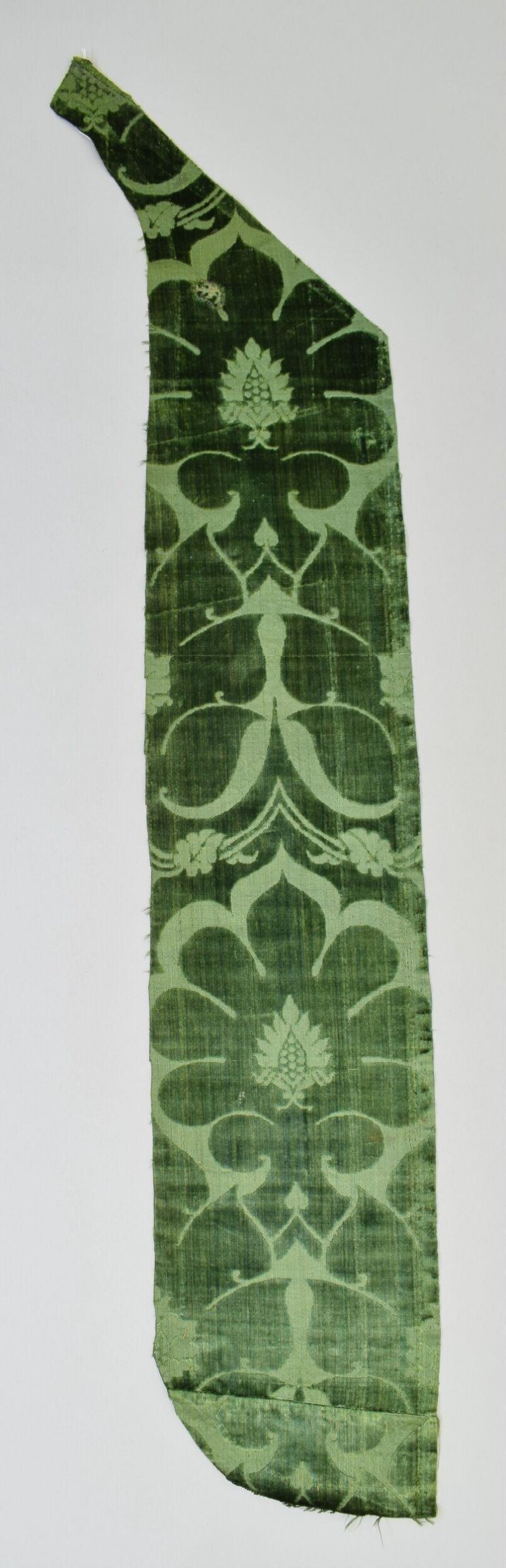
The subject of this report is a fragmentary length of voided velvet, originally part of a larger vestment or secular garment, dated to the Florentine Republic, circa 1450-1459. The textile measures 48 cm by 62 cm, preserving a portion of a pomegranate (melograno) pattern with symmetrical, stylized leaves and a central artichoke motif. Its survival is remarkable; the silk pile retains approximately 60% of its original height, while the ground weave shows minimal degradation, indicating a high-quality, double-warp construction typical of the Lucchese and Venetian workshops of the period. This fragment serves as a primary source for understanding the technical mastery of velluto cesellato (cut velvet) and velluto allucciolato (velvet with metallic thread), techniques that would become foundational to Western luxury textile production.
Material Materiality: Silk, Dye, and Metal
The physical composition of the fragment reveals a sophisticated hierarchy of materials. The ground warp and weft are composed of degummed Bombyx mori silk, characterized by a lustrous, off-white appearance in the foundation. The pile warp, however, is dyed with kermes (Kermes vermilio), a scale insect native to the Mediterranean, which yields a deep, slightly bluish crimson. This dye was extraordinarily expensive—often valued at its weight in gold—and its use here confirms the garment’s status as a high-commission piece for ecclesiastical or noble patronage. The metallic threads, now tarnished to a dark brown, were originally silver-gilt lamella (thin strips of silver coated in gold) wound around a silk core. This filato technique created a shimmering, reflective surface that would have caught candlelight in a cathedral or palazzo, emphasizing the three-dimensionality of the velvet pattern.
Microscopic analysis reveals that the pile warp was woven using a two-thread pile system, where one warp thread forms the loop and the other is cut to create the velvet’s characteristic soft, dense surface. The ground weave is a plain-weave (tabby) structure, with a thread count of approximately 40 ends per centimeter in the warp and 30 picks per centimeter in the weft. The pile height averages 2.5 mm, indicating a medium-pile velvet suitable for both drape and structural rigidity. The metallic threads are introduced only in the voided areas—the background spaces where the pile is absent—creating a stark contrast between the matte, plush velvet and the reflective, metallic ground. This technique, known as velluto a fondo d’oro (velvet on a gold ground), was a hallmark of mid-15th-century Italian luxury.
Weaving Techniques: Voided Velvet and the Brocading Process
The fragment exemplifies the voided velvet technique, in which the pile warp is selectively raised and cut only in the pattern areas, leaving the ground weave exposed elsewhere. This is achieved through a complex system of two warp beams: one for the ground warp and one for the pile warp. The pile warp is tensioned separately and lifted only where the pattern requires it. In the fragment, the pomegranate motif is woven using a five-harness satin foundation for the pile, which allows for a dense, even surface. The voided areas—the background—are woven in a simple tabby, but the metallic threads are brocaded (introduced as supplementary wefts) during the weaving process. This brocading is not integral to the ground weave; rather, it is laid on top of the tabby and held in place by the ground wefts, creating a floating effect that adds depth and texture.
The precision of the weaving is evident in the sharpness of the pattern edges. The transition from pile to voided ground is abrupt, with no visible fraying or distortion, indicating the use of a tempered steel reed and a high-tension loom. The metallic threads are woven in a S-twist around the silk core, which prevents unraveling and maintains the thread’s integrity during the brocading process. The pattern repeat measures 18 cm by 22 cm, suggesting a loom width of approximately 60 cm—standard for the period—and a pattern designed for a symmetrical, mirrored layout, likely for a cope or a chasuble.
Translation into 2026 High-End Luxury Silhouettes
Materiality and Sustainable Innovation
For the 2026 collection, the materiality of the 1450s velvet must be reinterpreted through a contemporary lens that prioritizes sustainability without sacrificing luxury. The original kermes dye can be replaced with biodegradable, lab-grown cochineal (a close relative of kermes) that achieves the same deep crimson hue with a lower environmental footprint. The silver-gilt lamella, however, presents a challenge: traditional metal threads are non-recyclable and brittle. A modern alternative is recycled 24-karat gold-plated stainless steel microfilaments, which offer the same reflective quality but are lightweight, flexible, and fully recyclable. The base silk should be organic, peace silk (Ahimsa silk), where the silkworm is allowed to emerge from the cocoon, ensuring ethical production. This silk has a slightly irregular texture that mimics the hand-spun quality of 15th-century threads, adding authenticity to the reproduction.
Silhouette and Structural Translation
The voided velvet technique lends itself to a sculptural, architectural silhouette for 2026. The original garment’s stiff, ceremonial drape can be translated into a floor-length, columnar gown with a high, structured collar and a slight train. The pomegranate pattern should be scaled up to a 30 cm repeat, allowing the motif to function as a single, dramatic focal point rather than a repetitive pattern. The voided areas—now woven with the gold-plated microfilaments—would create a metallic, reflective grid that catches light as the wearer moves, echoing the candlelit shimmer of the original.
For a more avant-garde approach, the velvet can be laser-cut to create negative-space patterns that mimic the voided technique without requiring complex weaving. This allows for a lighter, more flexible fabric suitable for a deconstructed jacket with exaggerated lapels and a cinched waist. The jacket’s interior could be lined with a reversible, matte silk charmeuse in the same crimson, allowing the wearer to choose between the plush velvet exterior and the smooth, reflective interior.
Technical Production for 2026
The production of this fabric for a 2026 capsule collection would require a Jacquard loom with electronic shedding, capable of handling the complex pattern repeat and the dual-warp system. The pile warp would be woven using a two-thread system identical to the 15th-century technique, but with a modern twist: the pile height can be varied (from 1.5 mm to 4 mm) using a programmable pile height control, creating a gradient effect that adds depth to the pomegranate motif. The metallic threads would be brocaded using a supplementary weft insertion system that allows for precise placement without distorting the ground weave. The final fabric would be finished with a steam-setting process to stabilize the pile and prevent crushing, ensuring the garment retains its structure through multiple wears.
Conclusion: The Dialogue Between Centuries
This 1450s velvet fragment is not merely a relic; it is a technical blueprint for a dialogue between centuries. The voided velvet technique, with its interplay of plush and void, of matte and metallic, remains a pinnacle of textile engineering. By translating its materiality and structure into a 2026 context—using sustainable silk, recycled metals, and digital loom technology—Natalie Fashion Atelier can create a garment that honors the past while pushing the boundaries of modern luxury. The result is a piece that is both a historical artifact and a future heirloom, embodying the timelessness of true craftsmanship.