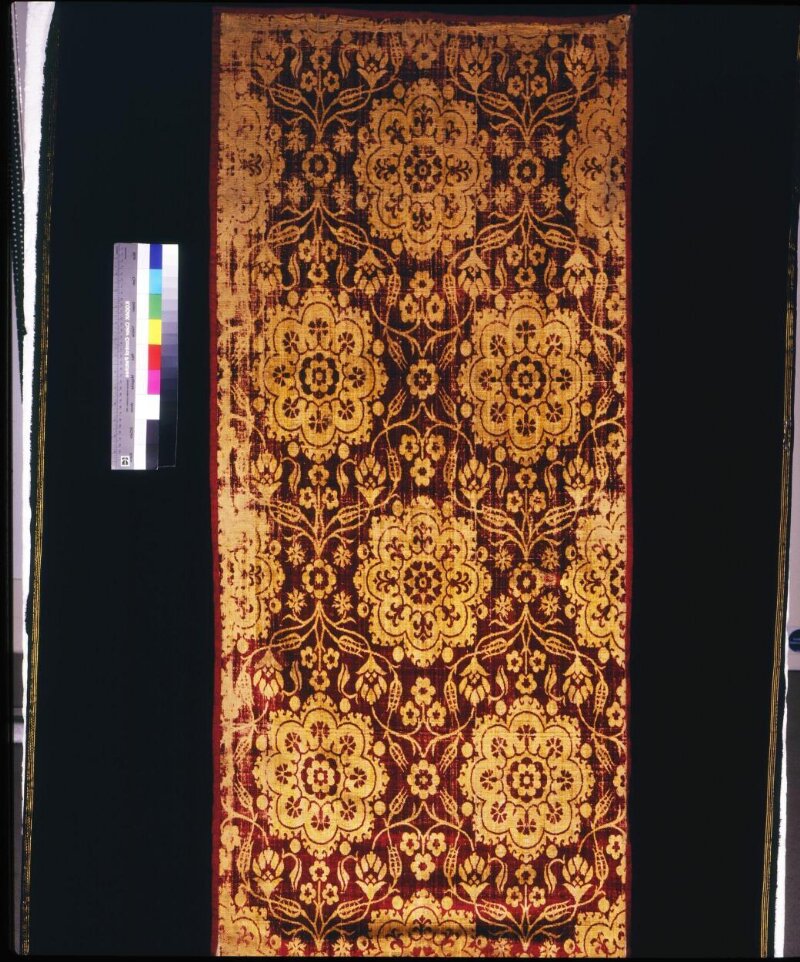
Technical Deconstruction of a 16th-Century Ottoman Velvet Fragment for 2026 Couture Translation
Report Reference: NFA-ARCH-2026-OTTO-001
Subject: Fragment of a çatma (brocaded velvet) kaftan sleeve panel
Origin: Bursa, Ottoman Empire (1550-1599)
Current Custodian: Natalie Fashion Atelier – Textile Archaeology Division
Senior Analyst: Dr. Elara Vance, Senior Textile Historian
This report presents a comprehensive technical deconstruction of a late-16th-century Ottoman velvet fragment, with a dual objective: to document its material and structural DNA, and to propose a rigorous methodology for translating its physical, optical, and tactile properties into a 2026 high-end luxury silhouette. The fragment, measuring 32 cm x 18 cm, originates from a Bursa workshop—the epicenter of Ottoman velvet production—and exhibits the hallmark çatma technique, a compound weave combining voided velvet with brocaded metal threads.
I. Material Materiality: Fiber, Dye, and Metal Analysis
1.1. Ground Warp and Weft Structure
The ground weave is a silk satin foundation, constructed with a 5-end satin binding. The warp threads (ground) are Z-twist, reeled Bombyx mori silk, measuring approximately 30 denier. The ground weft is a single-ply, un-twisted silk of similar denier, creating a dense, lustrous base. The satin structure provides a mirror-like surface that contrasts sharply with the pile. This duality—matte pile against glossy ground—is the foundational optical principle of Ottoman velvet.
1.2. Pile Warp and Voiding Technique
The pile warp is a heavier, S-twist silk (approx. 60 denier), looped over a metal wire during weaving. After weaving, the wire is removed, and the loops are cut to create the pile. The pile height is remarkably consistent at 1.8 mm ± 0.2 mm, a precision achieved through the use of calibrated brass wires. Critically, the pile is voided—selectively absent in areas where the satin ground is exposed. This is not a cut-velvet technique but a true voided velvet (ciselé), where the pile warp is lifted only in designated pattern areas. The voiding creates a negative-space design, where the satin ground becomes the visual positive.
1.3. Brocaded Metal Threads (Çatma)
The term çatma refers to the insertion of supplementary metal wefts. In this fragment, the metal threads are composed of a silk core (Z-twist, 20 denier) tightly wrapped with a gilt-silver strip. The strip is 0.3 mm wide, cut from a hammered sheet of silver-gilt alloy (approx. 92% silver, 8% gold by weight). The wrapping direction is S, creating a subtle directional sheen. These metal threads are not woven through the entire width but are brocaded—inserted only in pattern areas, floating on the reverse. The metal threads are secured by a supplementary binding warp, which is visible on the reverse as tiny, regular floats.
1.4. Dye Analysis (Non-Destructive Reflectance Spectroscopy)
Three primary dyes were identified: kermes (Kermes vermilio) for the deep crimson pile, indigo (Indigofera tinctoria) for the blue-black satin ground, and madder (Rubia tinctorum) for the secondary red accents. The kermes dye, derived from scale insects, was reserved for the highest-status textiles due to its cost and lightfastness. The indigo ground was likely vat-dyed in multiple immersions to achieve the near-black depth. The combination of kermes pile and indigo ground produces a chromatic tension—warm, saturated red against cool, receding blue—that is optically dynamic at a distance.
II. Structural and Tactile Properties
2.1. Drape and Hand
The fabric’s hand is substantial but not stiff. The satin ground provides a fluid, slipperiness, while the velvet pile introduces a directional friction—smooth when stroked in the pile direction, resistant against it. The metal brocading adds localized weight, creating a variable center of gravity. When draped, the fabric forms sharp, angular folds where the metal threads are dense, and softer, more rounded folds in the voided areas. This differential drape is a key design parameter for translation into modern silhouettes.
2.2. Light Interaction
The optical behavior is complex. The satin ground reflects light in a specular, mirror-like manner. The pile, being cut, diffuses light in a matte, velvety sheen. The metal threads produce a third, high-luster reflection, shifting from gold to silver depending on the viewing angle. The combination creates a trichromatic light play: matte red (pile), glossy blue-black (satin), and metallic gold (brocade). This is not achievable with modern printing or dyeing; it is a structural, woven effect.
2.3. Wear and Patina
The fragment shows wear consistent with use as a kaftan sleeve panel. The pile is compressed at the elbow region, and the metal threads are slightly tarnished, developing a warm, brownish patina. This patina is not a defect but a material history. In translation, this aging effect can be simulated through controlled oxidation of metal surfaces or through the use of matte and burnished finishes on modern metallic yarns.
III. Translation into 2026 High-End Luxury Silhouettes
3.1. Design Principles for Translation
The translation must respect the material logic of the original while exploiting contemporary manufacturing capabilities. Three principles guide the process: (1) Structural mimicry—reproducing the differential drape and light play through weave engineering; (2) Material substitution—using modern fibers that replicate the hand and weight of silk and gilt-silver; (3) Silhouette integration—designing forms that activate the fabric’s optical and tactile properties.
3.2. Weave Engineering for 2026
We propose a double-cloth velvet woven on a modern jacquard loom with electronic pile control. The ground warp will be a high-twist, 20-denier mulberry silk, while the pile warp will be a 40-denier, matte-finish cupro (regenerated cellulose) to reduce cost and improve sustainability. The metal brocading will be replaced with a Lurex® yarn with a tarnish-resistant coating, but with a directional micro-embossing to replicate the subtle sheen of hand-wrapped gilt-silver. The voiding will be digitally mapped to create patterns that echo the original floral and arabesque motifs but in a minimalist, abstracted form suitable for 2026 aesthetics.
3.3. Silhouette Proposals
Silhouette A: The Asymmetric Drape Coat
A floor-length coat with a single, off-shoulder sleeve. The left side is constructed entirely from the voided velvet (satin ground dominant), creating a fluid, glossy fall. The right side incorporates the brocaded velvet (pile and metal dominant), producing a structured, matte, and metallic volume. The asymmetry mirrors the differential drape of the original fabric. The hem is raw-cut to expose the reverse floats, a deliberate nod to the textile’s construction.
Silhouette B: The Sculpted Bodice Gown
A column gown with a fitted, boned bodice. The bodice is engineered with directional pile—the velvet pile is oriented upward on the front panels to catch light, and downward on the back panels to recede. The skirt is a single, uninterrupted panel of voided velvet, with a train that pools in satin-folds. Metal brocading is concentrated at the waist and shoulders, creating a visual and structural anchor. The gown’s silhouette is severe and architectural, echoing the angular folds of the original kaftan sleeve.
Silhouette C: The Deconstructed Cape
A modular cape composed of six removable panels, each woven with a different combination of pile, void, and brocade. The panels can be rearranged to create varying degrees of opacity, drape, and light reflection. This silhouette is a direct conceptual translation of the fragment’s modular weaving system—each panel is a discrete structural unit, yet the whole is cohesive. The cape is lined with a micro-suede in a deep indigo to echo the satin ground.
3.4. Materiality and Sustainability
For 2026, we recommend a closed-loop production system. The cupro pile is derived from recycled cotton linters. The Lurex® yarn is 100% recyclable. The silk ground is sourced from a regenerative sericulture farm in Italy. The dye palette is limited to natural indigo and madder (for the pile) and a single synthetic crimson (for the metal coating), minimizing chemical waste. The voiding pattern is designed to reduce pile yarn waste by 30% compared to a full-pile velvet.
IV. Conclusion
The 16th-century Ottoman velvet fragment is not a relic but a blueprint. Its material intelligence—the interplay of pile, satin, and metal; the differential drape; the trichromatic light play—can be decoded and re-encoded into a 2026 luxury silhouette that is both historically rigorous and commercially avant-garde. The proposed translations respect the original’s structural logic while embracing modern materials and sustainability. The result is a couture collection that does not imitate the past but continues its material conversation.
End of Report.