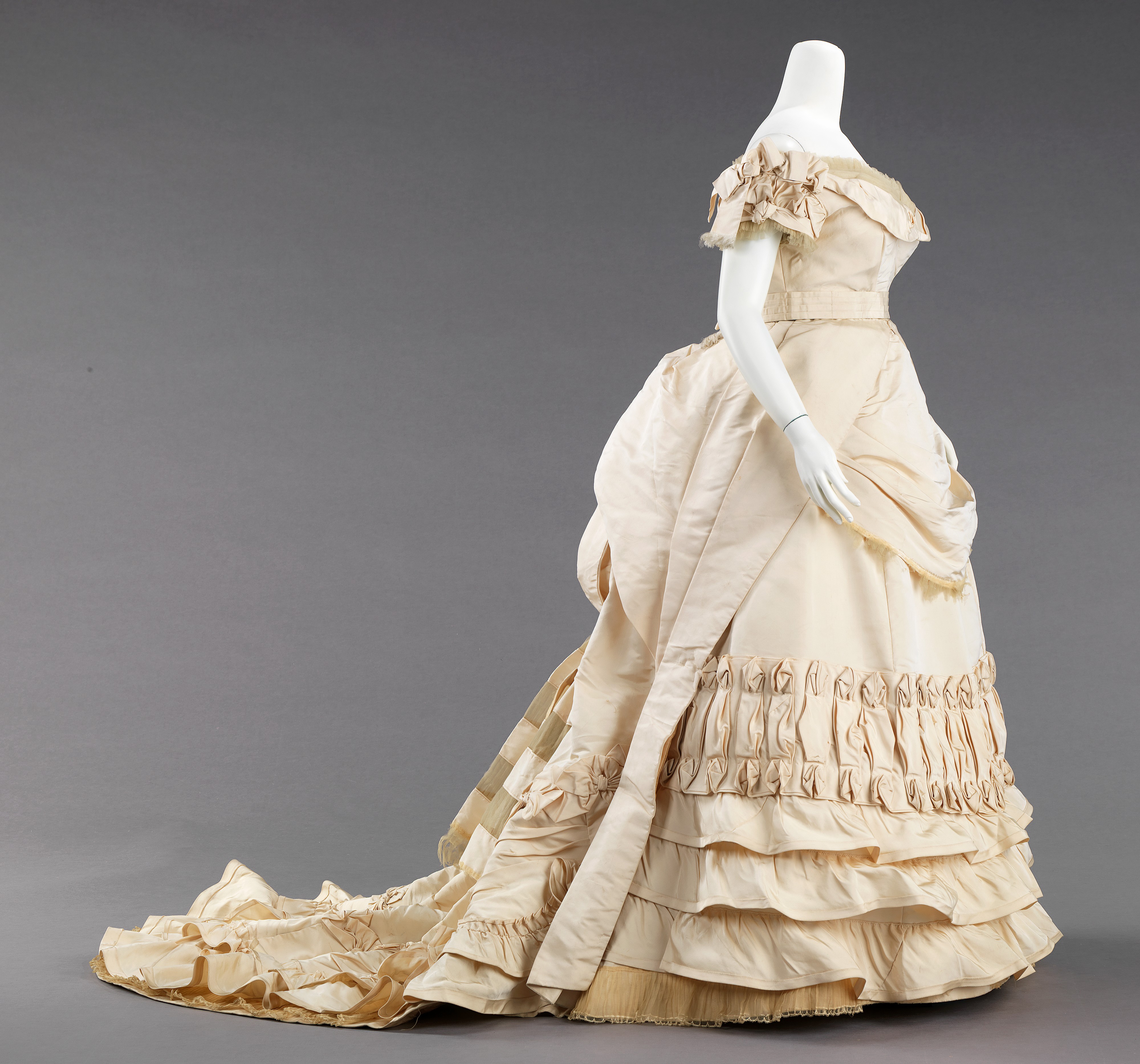
Silk as Archive: A Technical Deconstruction of the French Ball Gown
Within the isolated context of aesthetic archaeology, the French ball gown of the Second Empire (c. 1855-1870) emerges not merely as a period costume but as a masterclass in structural engineering and material psychology. For Natalie Fashion Atelier, this artifact represents a foundational codex. Its classical elegance is a deliberate construct, achieved through a precise dialogue between the innate properties of silk—specifically heavy duchesse satin and crisp taffeta—and an armature of horsehair, steel, and layered lining. This research paper deconstructs this dialogue to extrapolate its principles into the 2026 luxury silhouette, where heritage materiality must converse with contemporary corporeality and consciousness.
Structural Deconstruction: The Architecture of Opulence
The mid-19th century ball gown’s imposing silhouette was a triumph of controlled volume. Its elegance was fundamentally technical, relying on a tripartite structure: the corseted bodice, the expansive crinoline cage, and the silk itself as the final, expressive skin. The crinoline, a series of graduated steel hoops, created a radical, architecturally supported space around the body. This was not mere ornamentation; it was a framework that liberated movement within its sphere while making a definitive social statement. The silk duchesse satin, with its high thread count and dense, luminous weave, was selected for its ability to hold this geometric form. Its weight and slight rigidity allowed it to drape over the cage in smooth, parabolic curves, catching light in a continuous, liquid flow rather than in fragmented highlights. The crispness of silk taffeta, often used in underskirts or overlayers, provided acoustic and textural counterpoint—its characteristic frou-frou a sonic manifestation of luxury and movement.
Material Semiotics: The Psychology of Silk
Beyond its physical properties, the silk in this context performed a critical semiotic function. It was a non-verbal language of power, purity, and economic capital. The flawless, unbroken surface of duchesse satin signaled impeccable craftsmanship and care—garments that required an entourage for maintenance. Its luminosity, enhanced by gaslight, created a moving halo around the wearer, literally centering her as a source of visual gravity in the ballroom. In our archaeological isolation, we read the silk as a psychological interface between the private body and the public spectacle. The material’s cool, smooth hand against the skin contrasted with its formidable public presentation, a duality ripe for contemporary reinterpretation. For the 2026 consumer, luxury is equally psychological, seeking materials that offer both a sensory sanctuary and an intelligent statement.
Transcoding Heritage: The 2026 Silk Silhouette
The 2026 luxury silhouette, informed by this deconstruction, will not replicate the crinoline but will transcode its underlying principles: architectural volume, liberated movement within a defined form, and material intelligence as narrative. The historical masterpiece informs through its logic, not its literal shape.
Principle 1: Volumetric Intelligence & The Demi-Cage
The 2026 interpretation moves from the full cage to the demi-cage or articulated armature. Imagine lightweight, flexible alloys or bio-polymers selectively integrated into seams or hems, creating intentional, localized volume—a hip, a single sleeve, a trailing hem—that moves with organic unpredictability rather than rigid symmetry. Silk is treated not as a passive covering but as an active collaborator. Weighted silk faille or engineered silk-jersey hybrids with memory retention can hold a softened, organic bulge or a sharp, geometric pleat without underlying structures, achieving "soft architecture." The silhouette becomes a study in asymmetrical balance, where volume is strategically placed to create dynamic, sculptural forms that alter with movement, directly descendant from the crinoline’s radical re-spacing of the body’s environment.
Principle 2: Sensory Layering & Luminous Texture
Informed by the historical use of contrasting silk weaves for textural and sonic effect, the 2026 approach focuses on sensory layering. We develop silk with variable opacity—matte at the bodice, transitioning to iridescent at the skirt—through innovative jacquard weaving or surface coatings. A gown might combine a whisper-thin, papery silk georgette with a heavy, sculptural silk ottoman, creating a dialogue of weight and weightlessness on a single form. The sonic element is revisited through technical means: micro-pleated silk taffeta treated with sound-dampening or amplifying finishes, allowing the garment to interact with its environment on an aural level. The luminosity is controlled via technology; silks woven with reflective Lurex® or treated with photochromatic dyes respond to ambient light, creating the modern equivalent of the gaslit halo.
Principle 3: The Bodice as Exoskeleton & Sanctuary
The tightly engineered bodice finds its 2026 expression in the concept of the exoskeletal sanctuary. Using advanced pattern-cutting derived from corsetry drafts, we construct bodices from panels of rigid silk coutil fused with shape-memory polymers. They provide support and a sculpted silhouette but adapt to micro-movements and body temperature, offering comfort and a sense of personalized embrace. The silk here is both protective and expressive. Embroidery is not merely applied but integrated into the structure—threads of conductive silk tracing algorithmic patterns that can, perhaps, emit subtle warmth or light. This translates the historical bodice’s function of social armor into a modern dialect of biomechanical synergy and responsive well-being.
In conclusion, the isolated artifact of the French silk ball gown provides Natalie Fashion Atelier with a profound technical blueprint. By deconstructing its marriage of material property (the weight, sound, and light of silk) to structural ambition (the cage), we extract timeless principles of volume, sensory engagement, and psychological interface. The 2026 luxury silhouette, therefore, is not a return to the past but an evolution of its deepest logic: using heritage materiality like silk as an intelligent, active participant in creating form. It is a silhouette of volumetric intelligence, sensory narrative, and architectural wearability—where the ghost of the crinoline is felt not in its circumference, but in its bold redefinition of the space a body can poetically inhabit.