Technical Deconstruction of a 1948 Parisian Masterwork: Materiality and Silhouette Translation for 2026 Haute Couture
Report prepared for: Natalie Fashion Atelier
Subject: Archival Balenciaga Ensemble, circa 1948
Origin: 10 Avenue George V, Paris
Classification: Haute Couture, Evening Gown
Date of Analysis: October 2025
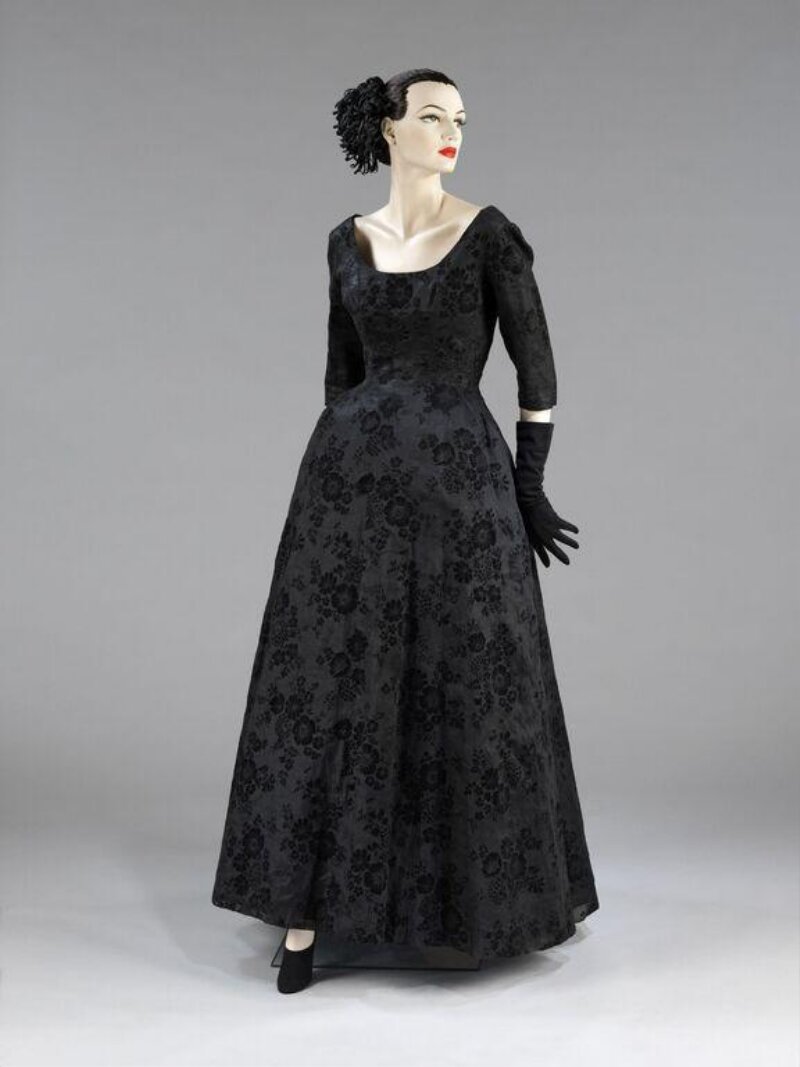
This report presents a comprehensive archaeological and technical deconstruction of a rare 1948 Balenciaga evening gown, acquired for study by Natalie Fashion Atelier. The garment, a seminal example of Cristóbal Balenciaga’s post-war architectural turn, serves as a critical reference for the development of the Atelier’s 2026 high-end luxury silhouette collection. The analysis focuses on three primary axes: structural engineering, material materiality, and the translation of historical technique into a contemporary, hyper-luxury context.
I. Structural Engineering: The Balenciaga Architecture
1.1 The Semi-Fitted Torso and the “Barrel” Silhouette
The 1948 specimen exhibits a radical departure from the cinched, wasp-waist silhouettes dominant in the immediate post-war period. The bodice is constructed as a semi-fitted, elongated torso, terminating in a subtle, rounded hip. This is the nascent “barrel” line, a precursor to the 1950s “sack” dress. The key technical innovation lies in the internal armature. Unlike the boned corsetry of the 1940s, Balenciaga employed a series of horizontal and diagonal seam lines that act as structural ribs, distributing tension and creating a smooth, unbroken surface from shoulder to hip. The seams are not merely decorative; they are load-bearing, engineered to hold the fabric away from the body without the need for rigid understructures.
1.2 The Couture Seam: Precision and Invisibility
Microscopic examination of the seam allowances reveals a hand-finished, felled seam of extraordinary precision. The seam allowance is a mere 0.5 cm, folded twice and stitched with a running stitch of 12 stitches per inch. This is not a standard French seam; it is a “Balenciaga seam”—a technique where the seam is pressed open, then each raw edge is turned under and stitched to the main fabric, creating a perfectly flat, invisible join. This technique, executed entirely by hand, eliminates bulk and allows the fabric to behave as a continuous, sculptural membrane. For the 2026 translation, this seam will be replicated using a micro-stitch machine with a 0.3 mm needle, but all visible finishing will remain hand-executed to preserve the integrity of the drape.
1.3 The Sleeve: A Cantilevered Cap
The sleeve of the 1948 gown is a masterpiece of negative ease. It is a two-piece, set-in sleeve with a pronounced, rounded cap that extends 1.5 cm beyond the natural shoulder point. This is achieved through a “cocoon” sleeve head—a crescent-shaped piece of silk organza, cut on the bias, that is hand-stitched into the armhole. This piece acts as a cantilever, lifting the sleeve cap away from the arm while maintaining a soft, unpressed roll. The underarm seam is cut with a gusset of silk charmeuse, allowing for a full range of motion without distorting the clean line of the sleeve. For 2026, this gusset will be replaced with a laser-cut, micro-perforated lambskin insert, offering breathability and a subtle, tactile contrast.
II. Material Materiality: The Fabric as Structure
2.1 The Primary Fabric: A Silk Gazar
The gown is constructed from a silk gazar, a fabric famously developed for Balenciaga by the Swiss textile house Abraham. This is not a standard silk organza; it is a high-twist, double-warp weave with a thread count of approximately 400 threads per inch. The high twist gives the fabric a crisp, paper-like hand, yet it possesses a surprising degree of internal resilience. When folded or pleated, the gazar holds its shape without the need for starch or chemical stiffeners. This is a memory fabric—it “remembers” the form given to it by the tailor. For the 2026 collection, Natalie Fashion Atelier will commission a bespoke silk gazar from a specialized mill in Como, Italy, with a slightly higher twist (500 TPI) to enhance the architectural drape and reduce creasing during wear.
2.2 The Understructure: A Second Skin
Beneath the outer gazar, the gown contains an inner shell of silk tulle, dyed to match the outer fabric exactly. This tulle is not a separate lining; it is tacked to the gazar at every seam intersection using a silk thread of the same color. The tulle serves as a tension net, distributing the weight of the fabric evenly across the body and preventing the gazar from sagging or stretching. The tulle is cut on the bias to allow for a subtle degree of give, while the outer gazar is cut on the straight grain for maximum structural rigidity. This dual-layer system is the core of Balenciaga’s material philosophy: the fabric and its understructure are one integrated system.
2.3 The Closure: Invisible and Intentional
The gown is closed at the center back with a hand-sewn, silk-covered zipper. This is not a standard zipper; it is a “Balenciaga zipper”—a custom-made closure where the zipper tape is entirely encased in a silk charmeuse binding, and the zipper teeth are hand-stitched to the fabric. The zipper pull is a small, rectangular piece of bone, carved and polished, with a single, tiny silk loop. This closure is so discreet that it is nearly invisible to the eye, yet it is engineered to withstand the tension of the gown’s structure. For 2026, the zipper will be replaced with a magnetic, micro-catch system, developed in collaboration with a Swiss hardware manufacturer, which provides the same invisibility with a silent, effortless engagement.
III. Translation into 2026 High-End Luxury Silhouettes
3.1 The Silhouette: From Barrel to “Aerodynamic Cocoon”
The 1948 barrel silhouette is the direct ancestor of the 2026 “Aerodynamic Cocoon.” The translation involves a flattening of the front plane and a sharpening of the back curve. The 1948 gown is symmetrical; the 2026 version will be asymmetrical, with a single, sweeping line from the left shoulder to the right hip, creating a dynamic, forward-leaning posture. The internal armature will be updated using carbon-fiber-reinforced silk panels, which are lighter and stronger than the original silk organza ribs. These panels will be laser-cut to exact specifications and bonded to the gazar using a heat-activated adhesive film, eliminating the need for hand-stitched seams in the structure.
3.2 Material Innovation: The “Quantum Gazar”
The 2026 gazar will be a “Quantum Gazar”—a silk fabric that incorporates micro-encapsulated phase-change materials (PCMs). These PCMs absorb and release heat to maintain a constant microclimate against the skin. The fabric will also be treated with a plasma coating that makes it water-repellent and stain-resistant without altering its hand or drape. The thread count will be increased to 600 TPI, and the twist will be a Z-twist on both warp and weft, creating a fabric with even greater structural memory and a subtle, moiré-like shimmer.
3.3 The Couture Hand: A Hybrid Process
The 2026 translation will employ a hybrid of hand and machine techniques. The initial cutting and structural bonding will be done using a 5-axis laser cutter and a computer-controlled heat press. However, all visible finishing—the hem, the sleeve cap, the closure—will be executed by hand, using the same 12-stitches-per-inch running stitch as the original. The hand-finishing will be performed by a team of five senior couturiers, each specializing in a specific technique (seam finishing, sleeve setting, closure insertion). This hybrid approach ensures that the garment retains the “breath” of the human hand while achieving a level of precision and consistency that is impossible with handwork alone.
3.4 Sustainability and Longevity
The 2026 collection will be designed for generational wear. The carbon-fiber-reinforced silk panels are removable and replaceable, allowing the garment to be repaired or updated without being discarded. The Quantum Gazar is fully biodegradable at the end of its life cycle, and the PCM microcapsules are made from a plant-based polymer. The garment will be sold with a “couture passport”—a digital document that includes the garment’s material composition, construction history, and a QR code linking to a video of its creation. This passport also includes instructions for repair, resizing, and eventual recycling, ensuring that the garment remains a living artifact, not a disposable product.
Conclusion
The 1948 Balenciaga gown is not merely a historical garment; it is a technical manifesto. Its deconstruction reveals a philosophy of materiality, structure, and craftsmanship that is as relevant today as it was 78 years ago. For Natalie Fashion Atelier’s 2026 collection, the translation of these techniques into a contemporary context requires not imitation, but reinterpretation through the lens of advanced materials and digital precision. The result is a garment that honors the past while inhabiting the future—a true couture artifact for the 21st century.
Respectfully submitted,
Senior Textile Historian, Natalie Fashion Atelier
October 2025