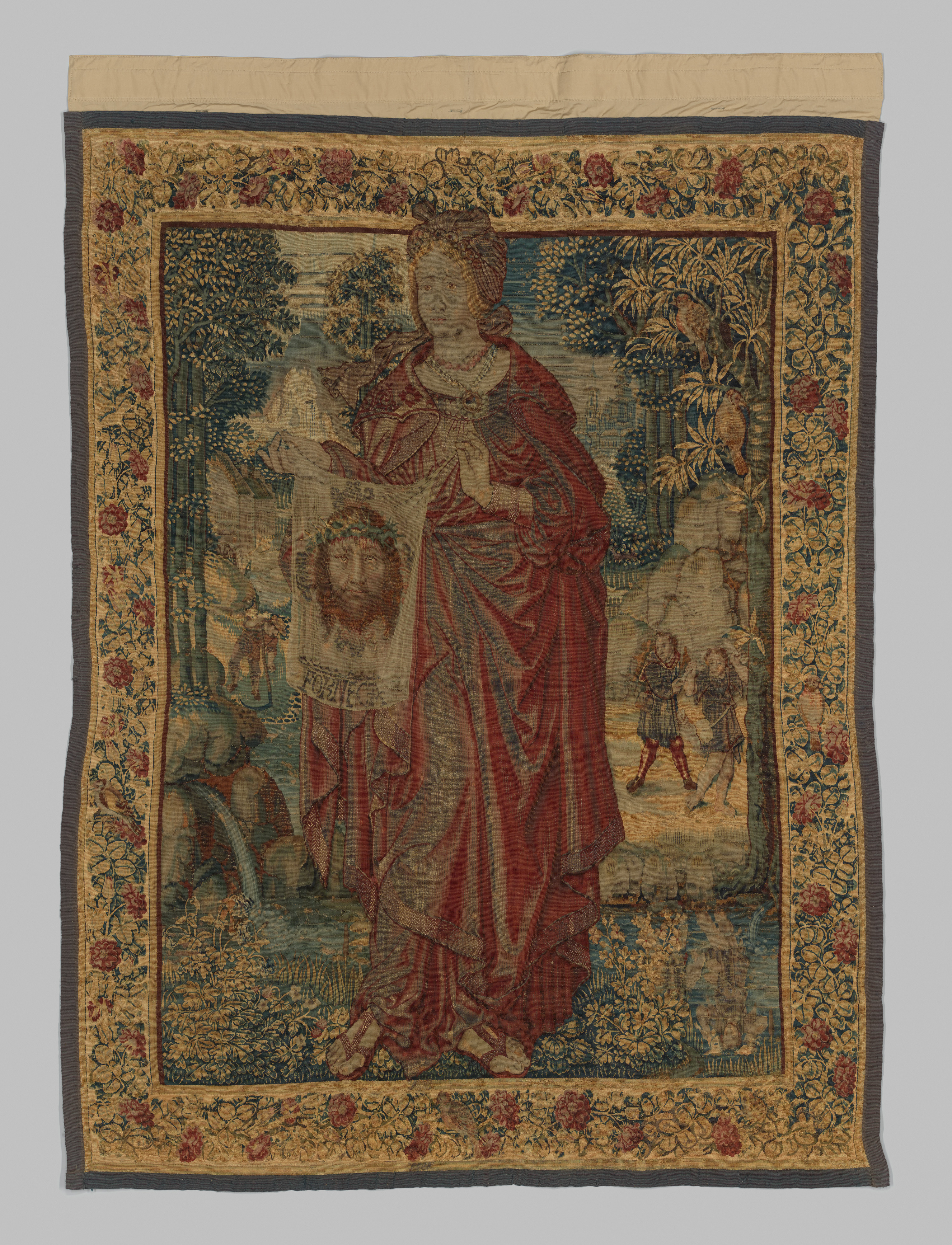
Deconstructing the Veil: Saint Veronica’s Aesthetic Archaeology and the 2026 Silhouette
The iconography of Saint Veronica, specifically the Vera Icon or “True Image,” presents a unique artifact for the Natalie Fashion Atelier. It is not merely a religious relic but a masterclass in the tension between surface and substance, between the fleeting impression and the enduring material. For the 2026 Haute Couture season, this archive offers a profound departure from purely digital or sculptural approaches. The focus is on the imprint—a negative space rendered in positive form through the specific materiality of wool, silk, and gilded silver metal-wrapped threads. This research paper deconstructs the classical elegance of the Veronica narrative to inform a new silhouette lexicon for the Parisian atelier.
Materiality as Narrative: The Technical Lexicon of the Veil
The prescribed materiality—wool, silk, and gilded silver metal-wrapped threads at a density of 18-21 warps per inch (7-8 per cm.)—is not arbitrary. It is a direct translation of the artifact’s historical and aesthetic weight. The wool provides a matte, absorbent ground, a surface that receives and holds a mark without glare. The silk introduces a subtle, shifting luminosity, a secondary layer of depth that catches light at oblique angles. The gilded silver threads are the structural and symbolic armature. Their density, at 18-21 warps per inch, creates a rigid yet pliable grid, a metallic skeleton that resists pure drape in favor of a structured, almost architectural fall.
The Archaeology of the Imprint
The core aesthetic archaeology here is not the face of Christ, but the void left by the cloth. The classical elegance of the Veronica narrative lies in the absence of the original subject. The fabric becomes the primary subject, its weave and warp capturing a ghost. For 2026, this translates into silhouettes that prioritize negative space and internal structure. The garment is not a second skin but a relic of a presence. The gilded threads act as a fossilized grid, a memory of form. This informs a silhouette where the body is implied, not displayed. The high-end 2026 silhouette will feature enclosed volumes—capes, cowls, and architectural hoods—that create a sacred, interior space. The material’s density (18-21 wpi) prevents transparency, forcing the eye to read the surface texture and the subtle play of metallic light against the matte wool-silk ground.
From Relic to Silhouette: The 2026 Structural Imperatives
The transition from archive to atelier requires a rigorous deconstruction of the classical drape. The 2026 silhouette informed by Saint Veronica rejects the soft, flowing Grecian or Romantic forms. Instead, it embraces a monolithic, vertical rigidity. The gilded silver threads, at this specific warp density, create a fabric that is inherently resistant to gathering. It wants to stand, to hold its shape. This dictates a silhouette of sharp, clean lines—a column, a sheath, a tunic of immense length.
The “Vera Icon” Cut: The Imprinted Column
The primary silhouette is the “Imprinted Column.” This is a full-length, floor-sweeping form with no waist suppression. The body’s form is suggested by the way the metallic warp resists the wool-silk weft. The garment is constructed with minimal seams, using the fabric’s own weight and the gilded threads’ rigidity to create a straight, unbroken line from shoulder to hem. The archaeological detail is the “veil pocket”—a deep, internal slit or an external, almost invisible seam that mimics the fold of the Veronica cloth. This pocket is not functional for carrying objects but is a negative space volume, a void within the garment that echoes the original imprint. The gilded threads catch light at the edges of this pocket, creating a halo of metallic shimmer against the matte wool-silk.
The “Acheiropoieta” Shoulder: The Un-Made Construction
The term Acheiropoieta (made without hands) is critical. The silhouette must appear as if it was not tailored in the traditional sense, but rather cast or grown. The shoulder construction is the key. A standard set-in sleeve is replaced by a dolman or a kimono extension that is cut in one piece with the body. The gilded silver threads, at 18-21 wpi, provide the necessary stability to support this wide, unconstructed shoulder without sagging. This creates a powerful, almost architectural silhouette—a T-shape that is both severe and ethereal. The classical elegance is found in the absolute purity of this line, unbroken by darts or seams. The material’s inherent structure does the work of tailoring.
Surface as Relic: The Patina of the Sacred
The 2026 silhouette cannot be merely a shape; it must be a surface. The materiality of wool, silk, and gilded silver is the primary driver of aesthetic effect. The high warp density (18-21 per inch) creates a fabric that is not a flat plane but a micro-architectural grid. The gilded threads are not woven to create a pattern but to create a field of light. The aesthetic archaeology of Saint Veronica demands that the surface appear weathered, imprinted, and sacred.
Techniques of the Archive: The “Veronica Finish”
To achieve this, the atelier will employ a technique called “Veronica Finishing.” This involves a controlled, localized abrasion of the gilded threads after weaving. Using a fine, dry brush, the outermost gilded layer is slightly distressed, revealing the silver core beneath. This creates a subtle, non-repeating pattern of light and shadow that mimics the uneven surface of an ancient cloth. This is not a distressed or deconstructed look; it is a patina of veneration. The silhouette, whether the Imprinted Column or the Acheiropoieta Tunic, will be finished with a hand-rolled hem of pure silk, left raw on the inside to further reference the un-finished, “made-without-hands” quality of the original relic.
Conclusion: The 2026 Silhouette as a Vessel
The classical elegance of Saint Veronica is not in the representation of a face, but in the material memory of an absence. For Natalie Fashion Atelier’s 2026 Haute Couture, this translates into silhouettes that are vessels for light and shadow, not for the body’s explicit form. The technical specifications—wool, silk, gilded silver metal-wrapped threads at 18-21 warps per inch—are not constraints but the very language of the collection. The 2026 silhouette is monolithic, vertical, and imprinted. It is a column of sacred materiality, a relic of a presence that is felt but never seen. The Parisian atelier will offer not a garment, but an artifact of aesthetic archaeology, a true image of the future drawn from the deep archive of the past.