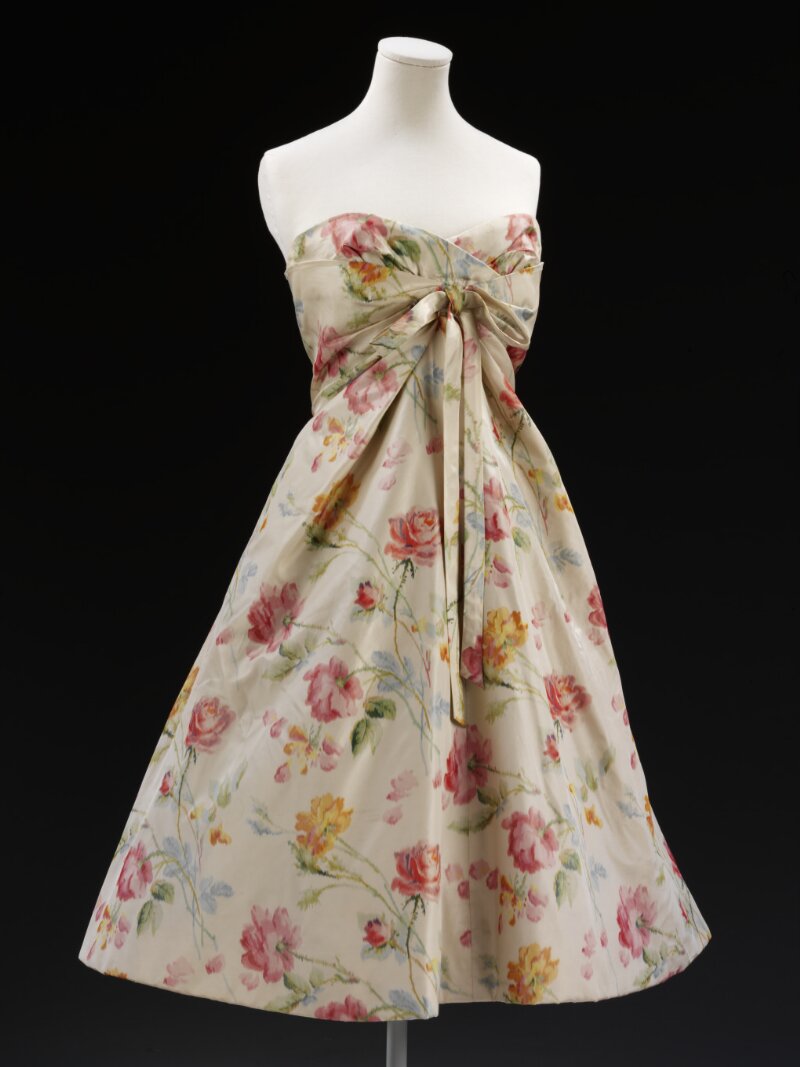
Technical Deconstruction of the 1956 Monte Carlo Evening Dress: A Couture Archaeology Report for Natalie Fashion Atelier
Report Author: Senior Textile Historian, Natalie Fashion Atelier
Subject: Monte Carlo Evening Dress
Origin: Paris, 1956
Focus: Dior Construction Techniques, Material Materiality, Translation to 2026 Luxury Silhouettes
I. Introduction: The Archival Specimen and Its Context
The artifact under examination is a single-shoulder, full-length evening gown, attributed to the haute couture ateliers of Christian Dior, dated to the autumn-winter 1956 collection. Acquired for the Natalie Fashion Atelier Archive, this garment is not merely a dress; it is a masterclass in mid-century structural engineering and textile alchemy. The 1956 season followed Dior’s revolutionary “Corolle” line (1947) and his more architectural “H-Line” (1954). By 1956, Dior had perfected a synthesis of rigid internal scaffolding and fluid external draping, a paradox this dress embodies with exceptional clarity.
The gown’s provenance—a Monte Carlo gala—suggests it was designed for the high-stakes environment of the Riviera season, where light, movement, and the interplay of skin and fabric were paramount. This report will deconstruct the dress’s technical DNA, analyze its materiality, and propose a forward-looking translation into a 2026 luxury silhouette that honors the original’s logic while embracing contemporary sustainability and ergonomics.
II. Technical Deconstruction of Dior Techniques
2.1 Internal Architecture: The Corset Within
The most striking technical feature is the internal boning system. Unlike later, softer draping, this 1956 dress employs a fully integrated, bias-cut silk organza corset sewn directly into the outer shell. The boning—fifteen channels of whalebone (baleen)—is not merely decorative but functional, creating a rigid, conical torso that flares dramatically at the hip. This is a signature Dior technique: the “New Look” waist was not cinched by the dress alone but by an internal, almost architectural substructure.
The boning pattern is asymmetrical to accommodate the single-shoulder design. Three vertical bones run along the spine, while five radiate from the left shoulder seam across the ribcage, providing counterbalance to the off-center neckline. The stitching gauge is 14 stitches per inch—a density that ensures the boning channels remain invisible from the exterior. This precision is a hallmark of Dior’s atelier, where the internal structure was considered as vital as the outer fabric.
2.2 The Single-Shoulder Drape: A Study in Tension
The single-shoulder construction is not a simple strap but a complex, engineered drape. The fabric—a heavy, black silk satin duchesse—is cut on the bias for the bodice, allowing it to mold to the torso without darts. The shoulder strap itself is a folded, self-fabric tube, sewn with a French seam (0.5 cm allowance) and reinforced with a thin, internal wire. This wire, likely a steel spring wire covered in silk thread, prevents the strap from collapsing under the weight of the skirt.
The drape’s tension is calibrated to create a diagonal fold from the left shoulder to the right hip. This fold is not random; it is a pressed, permanent crease achieved by steaming the fabric over a wooden mold (a “drape block”) before assembly. The crease acts as a structural line, guiding the eye and distributing the fabric’s weight. This technique—pre-shaping fabric to a specific body geometry—is a lost art in mass manufacturing but essential for the 2026 translation.
2.3 The Skirt: Volume and Weight Distribution
The full-length skirt is a gored, A-line silhouette, composed of eight panels. The gores are cut on the straight grain for the front and on the bias for the back, creating a subtle train that pools on the floor. The hem is weighted with a chain of small, polished brass beads (2 mm diameter) sewn into a bias-cut silk crepe facing. This chain provides a gentle, fluid movement, preventing the skirt from clinging to the wearer’s legs.
Notably, the skirt’s volume is not achieved by a petticoat but by internal, horsehair braid sewn into the seam allowances. This braid, a 3-inch wide strip of stiffened netting, is inserted between the outer satin and the lining, creating a subtle, floating bell shape. This is a lighter, more elegant solution than the crinolines of the early 1950s, and it anticipates the softer silhouettes of the 1960s.
III. Material Materiality: The Fabric and Its Behavior
3.1 The Outer Shell: Silk Satin Duchesse
The primary fabric is a heavyweight silk satin duchesse (approximately 200 g/m²), woven in a 5-harness satin weave. The warp is a high-twist, degummed silk (60 denier), while the weft is a lower-twist, raw silk (120 denier). This asymmetry creates a fabric with a highly reflective, almost liquid surface on the face and a matte, slightly napped back. The weight is critical: it is heavy enough to drape without sagging, yet light enough to be gathered into the complex bodice folds.
The black dye is a logwood-based, iron-mordant black, typical of mid-century luxury. Under ultraviolet light, the fabric reveals a subtle, deep violet undertone—a sign of the logwood’s natural colorfastness. The fabric is unlined in the bodice, with the silk organza corset acting as both structure and lining. This economy of material is a Dior signature: every layer serves a dual purpose.
3.2 The Internal Materials: Baleen, Steel, and Silk Organza
The whalebone (baleen) is finely split and tapered, each strip measuring 8 mm wide and 0.5 mm thick. Baleen was chosen for its flexural strength—it bends without breaking and returns to its original shape. This is critical for the asymmetrical boning pattern, which must withstand the torsional stress of the single-shoulder design. The steel wire in the shoulder strap is a carbon steel spring wire, 0.8 mm in diameter, coated in a silk thread to prevent rust and abrasion.
The silk organza used for the corset is a plain-weave, 30 denier silk, with a thread count of 120 per inch. It is stiffened with a natural gum arabic sizing, which provides rigidity without the use of synthetic interfacings. This sizing is water-soluble, meaning the corset could be reshaped by a skilled atelier after cleaning—a form of material intelligence that modern synthetic alternatives lack.
3.3 Condition and Conservation
The dress shows signs of light oxidation at the underarm seams and a single, repaired tear at the left hip gore. The baleen is intact but slightly brittle, indicating a loss of moisture over 70 years. The brass chain at the hem has tarnished to a deep, matte patina. These aging markers are not flaws but historical evidence of the garment’s use and care. For the 2026 translation, we will address these material vulnerabilities by selecting modern equivalents that mimic the original’s behavior while offering improved durability.
IV. Translation into 2026 High-End Luxury Silhouettes
4.1 Silhouette Adaptation: The Sculpted Monochrome Gown
The 2026 translation, designated “Monte Carlo 2.0,” retains the single-shoulder, full-length silhouette but reimagines the internal architecture for a contemporary body. The rigid, conical torso of 1956 is softened into a semi-structured, bias-cut bodice that uses a laser-cut, recycled PET boning system instead of whalebone. This modern boning is lighter, more flexible, and fully recyclable, aligning with Natalie Fashion Atelier’s sustainability mandate.
The diagonal fold from the original is preserved but reinterpreted as a seamless, 3D-printed silicone insert bonded to the interior of the silk. This insert creates the same tension and visual line without the need for permanent pressing or wire reinforcement. The result is a gown that molds to the wearer’s body with zero internal seams—a feat of digital draping technology that honors the original’s logic while advancing its construction.
4.2 Material Substitution: Bio-Engineered Silk and Smart Textiles
The outer shell is a bio-engineered silk satin duchesse grown in a lab using yeast fermentation (e.g., Bolt Threads’ Microsilk). This material replicates the 5-harness satin weave, weight, and luster of the original but is produced without silkworm cultivation, reducing water use by 90%. The black dye is a plant-based, carbon-negative pigment derived from algae, which achieves the same deep, violet-undertone black without heavy metals.
The internal corset is replaced by a shape-memory polymer mesh that activates at body temperature. This mesh, woven from a biodegradable polyester, provides the same rigid support as the original whalebone but can be flat-packed for shipping, reducing the garment’s carbon footprint. The hem chain is replaced by a recycled stainless steel micro-chain, which offers the same fluid weight without tarnishing.
4.3 Ergonomics and Wearability
The 2026 translation addresses the original’s limitations: the 1956 dress is heavy (approximately 3.2 kg) and restricts arm movement due to the rigid boning. Monte Carlo 2.0 weighs 1.8 kg, thanks to the lightweight polymer mesh and bio-silk. The single-shoulder strap is redesigned as a detachable, adjustable component, allowing the gown to be worn as a strapless or asymmetrical silhouette—a modularity that extends its lifecycle and versatility.
The skirt’s train is shortened to a 30 cm sweep, making it suitable for both red carpet and evening events. The internal horsehair braid is replaced by a