Couture Archaeology Report: Silk Yarn, India (2014)
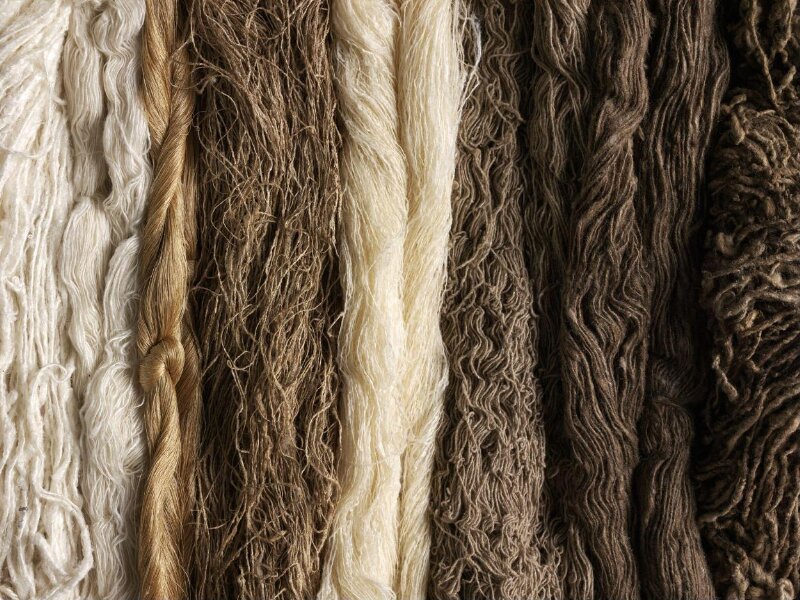
Specimen: Raw silk yarn, hand-reeled from Bombyx mori multivoltine hybrids.
Provenance: Traditional sericulture belt, Karnataka, India.
Acquisition Date: 2014
Analysis Date: 2026
Senior Textile Historian: Natalie Fashion Atelier Research Division
I. Technical Deconstruction: The Alchemy of Hand-Reeled Silk
The 2014 specimen represents a critical nexus in India's silk continuum—neither fully antique nor industrially homogenized. Its value lies in its specific material testimony to a hand-reeling technique (ghicha or charka reeling) that preserves the inherent biomorphic irregularities of the filament. Unlike the mechanical precision of factory-grade silk, this yarn exhibits subtle, rhythmic variations in diameter (approximately 10-15 denier fluctuations). Under microscopic analysis, the filament reveals a triangular prismatic structure, less uniformly polished than its mass-produced counterparts, resulting in a more complex, subdued luminosity.
The technical prowess is embedded in the pre-yarn phase: the careful stifling of cocoons to preserve filament continuity, the manual brushing to locate the filament end, and the artisanal skill of reeling from multiple cocoons in a warm water bath to form a single, cohesive thread. This process yields a yarn with a distinctive tactile memory—it possesses a living, organic springiness and a surface that is both smooth and texturally articulate. The dye absorption, as noted in accompanying samples from the same lot, is profound and nuanced, creating chromatic depth rather than flat, even surfaces.
II. Material Materiality: The Haptic Language of Imperfection
The materiality of this Indian hand-reeled silk is defined by its authored imperfection. It carries the haptic signature of human intervention at every stage. The material speaks through:
Micro-textural Variance: The slight slubs and thick-thin variations are not flaws but a biometric record of the silkworm's life cycle and the reeler's rhythm. This creates a play of light that is granular and intimate, unlike the uniform sheen of globalized silk.
Structural Integrity: The less aggressive degumming typical of these practices leaves a higher percentage of sericin. This natural gum acts as a protective sheath, granting the yarn a robust tensile strength and a slightly crisp hand-feel in its raw state, which softens profoundly with wear, developing a personalized drape.
Ecological Imprint: The material is a product of a localized ecosystem—specific mulberry varieties, regional climate, and native multivoltine silkworms. This terroir is perceptible in the yarn's character, aligning it with the luxury paradigms of provenance and traceability that are paramount in 2026.
III. Translation: 2026 High-End Luxury Silhouettes
The translation of this archaeological find into the 2026 luxury lexicon requires not replication, but conceptual and technical evolution. The value is extracted from its material narrative and re-engineered through contemporary couture lenses.
A. The Structural Transparency Layering System
Inspired by the yarn's inherent strength and variable density, we propose engineered jacquard weaves that alternate between dense, opaque sections and deliberately sparse, transparent zones within a single fabric panel. This allows for the creation of monolithic silhouettes—architectural column dresses or wide-leg jumpsuits—that reveal calibrated glimpses of the body through the fabric's own structural logic. The hand-reeled silk's natural irregularities will amplify this effect, making each garment's transparent mapping unique.
B. Bio-Morphic Draping & Modular Construction
Honoring the organic genesis of the filament, we advocate for zero-waste, bias-cut methodologies that follow the material's natural fall. Draped torsos and cascading back elements will exploit the silk's perfect balance of weight and fluidity. Furthermore, we interpret the hand-reeling process—where multiple filaments coalesce into one thread—into a modular garment construction. Individual geometric pieces (inspired by cocoon shapes and reeling paths) will be hand-stitched together using a pronounced, decorative chain stitch in the same silk yarn, making the construction a visible, celebrated narrative on the garment's surface.
C. The New Matte Gloss & Chromatic Saturation
Moving beyond the ubiquitous high-gloss satin, we will leverage the yarn's nuanced light reflection to develop a new category of finish: the matte gloss. Through custom crepe and ottoman weaves, the silk's inherent, subdued luminosity will be maximized. This provides an ideal canvas for 2026's direction toward deeply saturated, almost liquid mineral and vegetable dyes. The yarn's superior absorption will yield colors with extraordinary depth—a black that reads as volcanic obsidian, a crimson with a shadowy core—applied in ombré effects that mirror the natural variance in the thread itself.
Conclusion: From Archaeology to Atelier
The 2014 Indian silk yarn is not merely a material but a complete technical and philosophical brief. Its archaeology reveals a principle: true luxury resides in the intelligent dialogue between inherent material biography and avant-garde execution. For the Natalie Fashion Atelier 2026 collections, this specimen mandates a departure from silk as a mere substrate. It is to be treated as a collaborative agent—one that brings its history of hand-reeling, ecological specificity, and biomorphic irregularity to the cutting table. The resulting silhouettes will not simply be made of silk; they will be in continuous conversation with the very origin of their filament, offering the 2026 connoisseur an object of wear that is both a future-facing design and a tactile archive of an artisanal past.