Deconstructing the Lacquer Aesthetic: The Writing Box as a Blueprint for 2026 Haute Couture
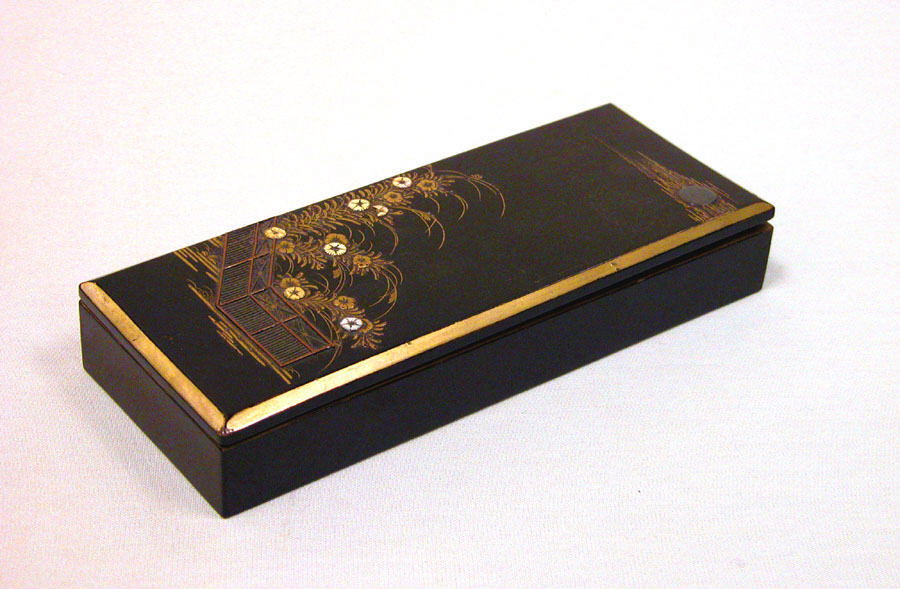
The artifact under examination—a Japanese Writing Box with Design of Wild Pink by Fence—represents a pinnacle of aesthetic archaeology within the Natalie Fashion Atelier archive. Executed in gold maki-e with inlays of ivory and mother-of-pearl on black lacquer, this piece is not merely a functional object from the Edo period; it is a masterclass in spatial tension, material hierarchy, and the orchestration of light. For the 2026 luxury silhouette, this artifact offers a radical departure from digital-era maximalism. It proposes a return to controlled opulence, where the narrative is embedded in the surface treatment and the negative space is as potent as the embellishment.
Materiality as Structural Language: The Lacquer Principle
The foundational material of the writing box is black lacquer, a surface that absorbs light to create an infinite depth. In the context of 2026 haute couture, this translates to a silhouette that prioritizes matte, absorbent foundations. We are not speaking of simple black fabric, but of textiles engineered to replicate the lacquer’s density. Think of a double-faced cashmere treated with a micro-sanded finish, or a silk gazar woven with a carbon-fiber core to achieve a static, non-reflective black. This base becomes the void against which all other elements are articulated.
The gold maki-e technique—sprinkling gold dust onto wet lacquer—is not a flat application. It is a three-dimensional topography. For the 2026 silhouette, this informs a new approach to surface architecture. Instead of embroidery that sits on the fabric, we propose integrated metallurgy. Gold thread is not stitched; it is fused, layered, and polished into the textile substrate. The result is a garment that changes character with the movement of the wearer, catching light in a manner analogous to the maki-e’s granular sparkle. The silhouette itself must accommodate this: a lean, columnar dress that acts as a canvas, with the gold application concentrated along the spine or the hemline, creating a directional luminosity.
Inlays of Ivory and Mother-of-Pearl: The Principle of Strategic Disruption
The ivory and mother-of-pearl inlays in the writing box are not scattered; they are precisely placed to create a visual rhythm. The wild pink flowers and the fence are rendered in these materials, creating a stark contrast of opacity and translucency against the black lacquer. For the 2026 silhouette, this dictates a new grammar for cut-out and insert techniques.
We must deconstruct the classical elegance of the fence motif. The fence is a structural frame, a grid of interruption. In a couture gown, this translates to a corseted bodice where panels of matte black crepe are separated by inlaid strips of polished mother-of-pearl. These inserts are not mere decoration; they function as architectural ribs, dictating the garment’s shape and the flow of the eye. The ivory, with its warm, creamy opacity, is reserved for the floral appliqués that seem to grow from the seams. The technique is one of negative space construction: the garment is defined as much by what is removed (the gaps between the fence slats) as by what is present.
This approach directly informs the 2026 silhouette’s emphasis on deconstructed tailoring. A jacket, for instance, might have its sleeves attached only at the shoulder and the cuff, with a gap of air and a single mother-of-pearl strut connecting the two. The body becomes the lacquer; the inlay becomes the garment’s skeleton.
The Wild Pink by the Fence: Narrative Through Asymmetry
The specific design—wild pink by a fence—is a study in controlled asymmetry. The flowers are not perfectly centered; they grow organically against the rigid fence. This tension between the natural and the geometric is the core of the artifact’s aesthetic archaeology. For the 2026 silhouette, this translates to a dialogue between structure and drape.
We propose a gown where the left side is a rigid, architectural column (the fence), constructed from a lacquer-like faille with vertical seams and a high, closed neckline. The right side is a cascade of fluid, pink-dyed silk organza (the wild pink), draped in an organic, asymmetrical sweep from the shoulder to the floor. The two sides are connected by a single, continuous line of gold maki-e embroidery that traces the path of the fence, then breaks into a scatter of mother-of-pearl petals. The silhouette is not balanced; it is resolved through the tension of its opposing forces.
The color palette is dictated by the artifact: the absolute black of the lacquer, the warm white of the ivory, the iridescent white of the mother-of-pearl, and the soft, dusty pink of the wild flowers. This is a monochromatic study with a single chromatic accent. The 2026 luxury client does not seek color; she seeks textural depth and tonal nuance. The pink is not a color; it is a memory of a color, achieved through a wash of silk gazar or a layer of tulle over a black base.
Construction Methodology: The Atelier’s 2026 Protocol
To translate this artifact into a wearable silhouette, the Natalie Fashion Atelier will employ a three-phase construction protocol:
Phase One: The Lacquer Base. The primary fabric is a custom-woven, double-sided satin with a matte finish. It is treated with a micro-ceramic coating to achieve the depth and weight of lacquer. The silhouette is a floor-length, columnar dress with a built-in corset of molded thermoplastic polymer, covered in the satin. This provides the rigid, absorbent foundation.
Phase Two: The Maki-e Application. Using a laser-guided embroidery machine with a hand-finished overlay, gold-plated metallic thread is applied in a pattern of fine, overlapping circles, mimicking the sprinkling of gold dust. The application is concentrated on the left shoulder and cascades down the back, creating a luminous waterfall effect. The thread is then burnished by hand to achieve a polished, non-fraying edge.
Phase Three: The Inlay Integration. Panels of the dress are cut away and replaced with hand-carved mother-of-pearl segments, set into the fabric using a micro-silicone adhesive that allows for flexibility. The ivory (simulated through a high-density, matte-finish resin) is used for floral appliqués that are attached at the hip and the hem, creating a visual anchor. The fence motif is rendered as a series of vertical, pearl-inlaid strips that run from the waist to the hem, spaced two centimeters apart, allowing the skin to show through as the ultimate negative space.
Conclusion: The 2026 Silhouette as a Lacquered Object
The Writing Box with Design of Wild Pink by Fence is not a source of direct inspiration; it is a technical and philosophical blueprint. For the 2026 season, the Natalie Fashion Atelier will not produce a dress that looks like a writing box. We will produce a silhouette that operates like one. It will be a study in surface density, material hierarchy, and the power of the void. The gold maki-e will not be decoration; it will be a structural element. The mother-of-pearl will not be an accent; it will be a frame. The black lacquer will not be a color; it will be an atmosphere.
This is the aesthetic archaeology of the future: a rigorous deconstruction of the past to build a silhouette that is at once ancient and impossibly new. The 2026 luxury client will wear this garment not as a statement, but as a portable artifact—a piece of history re-engineered for the present, where every seam, every inlay, and every particle of gold dust is a deliberate act of controlled elegance.