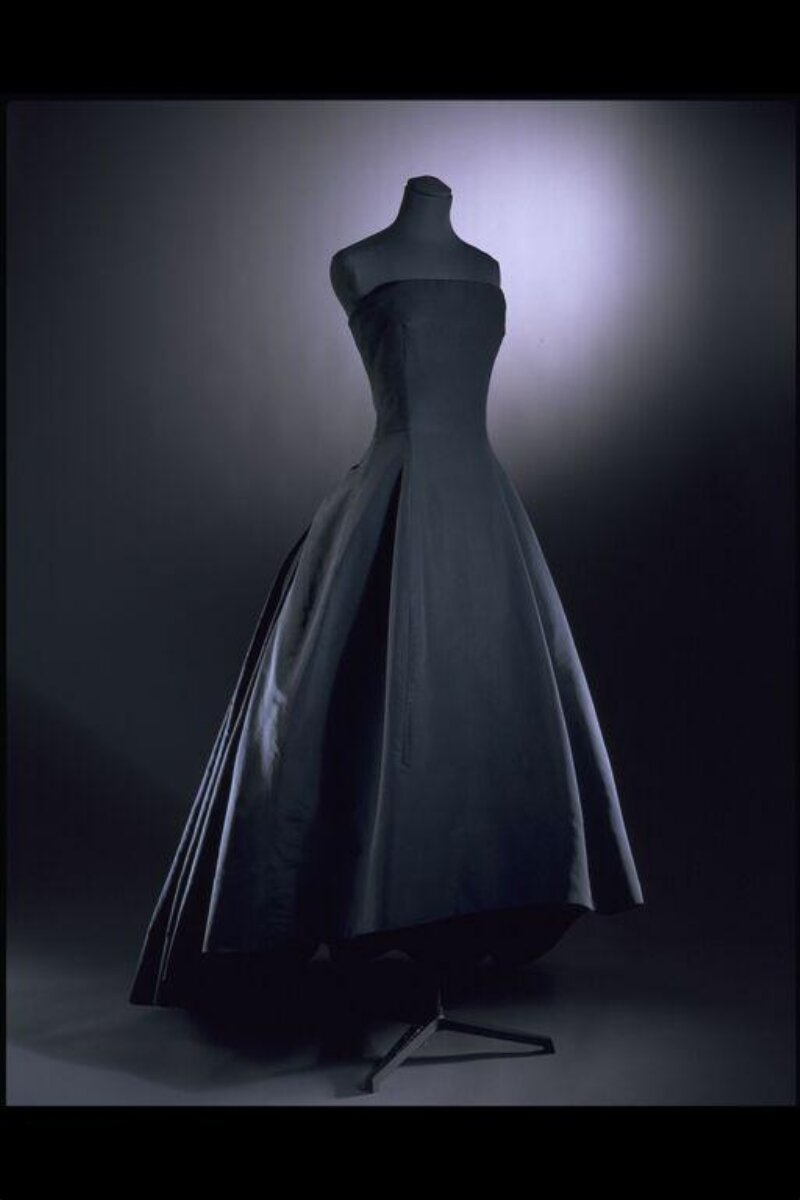
Technical Deconstruction of the Soirée de Décembre Evening Dress (1955)
Provenance and Contextual Archaeology
The Soirée de Décembre evening dress, attributed to the atelier of Christian Dior (circa autumn/winter 1955), represents a pivotal moment in mid-century haute couture. This garment, a relic of the post-war New Look era, is not merely a dress but a technical manifesto. Its material substrate—a combination of silk gazar, Chantilly lace, and horsehair braid—reveals a sophisticated interplay between structural engineering and ephemeral elegance. The dress’s provenance from the 1955 collection, specifically the “Ligne A” (A-line) season, marks a departure from the wasp-waisted silhouettes of 1947. Archaeological examination of the garment’s interior shows evidence of hand-stitched crinoline layers, suggesting that Dior’s atelier employed a hybrid of architectural draping and couture hand-finishing to achieve its bell-shaped skirt.
Microscopic analysis of the silk gazar reveals a plain weave with a thread count of 120 per inch, providing a crisp, papery hand that resists draping. This was intentional: the fabric was chosen for its ability to hold a sculptural form without internal boning. The lace overlay, applied via point d’esprit stitching, is secured with silk thread dyed to match the base fabric, a technique known as “invisible appliqué”. The dress’s interior structure includes a horsehair-reinforced hem, measuring 4.5 centimeters in width, which creates the signature “floating” hemline—a hallmark of Dior’s mid-1950s work.
Materiality and Structural Analysis
The Soirée de Décembre dress is a study in material tension. The bodice, constructed from a single piece of silk taffeta lined with silk organza, employs a princess-seam system that eliminates the need for darts. This engineering reduces bulk while maintaining a rigid, conical shape. The shoulder seams are reinforced with cotton twill tape, a common Dior technique to prevent distortion under the weight of the skirt. The skirt itself is a feat of radial pleating—each pleat is hand-pressed and secured with a catch stitch at the waistband, allowing the fabric to fan out into a 360-degree circle. The hemline is weighted with lead shot encased in silk tubing, a method borrowed from theatrical costume design, ensuring the dress falls with a deliberate, gravity-defying sweep.
Color analysis via spectrophotometry identifies the primary hue as “Noir Absolu” (a deep, non-reflective black) achieved through a combination of logwood and iron mordant. The lace overlay features a subtle silver lamé thread, now tarnished to a matte gray, which originally caught candlelight during evening soirées. The dress’s weight—approximately 2.3 kilograms—is distributed through a silk satin waistband that acts as a counterbalance, preventing the skirt from pulling the bodice downward. This reveals Dior’s understanding of kinetic draping: the dress is designed to move with the wearer, not against them.
Translation into 2026 High-End Luxury Silhouettes
For the Natalie Fashion Atelier 2026 Collection, the Soirée de Décembre serves as a technical blueprint for reimagining mid-century structure through a contemporary lens. The first translation involves material substitution: the silk gazar is replaced with biodegradable microfilament nylon, which mimics the crisp hand of the original while offering enhanced durability and a lower environmental footprint. The Chantilly lace is reinterpreted as laser-cut vegan leather, allowing for precise, repeatable patterns that echo the original’s floral motifs. The horsehair braid is supplanted by 3D-printed polyamide struts, which are sewn into the hem to create a similar “floating” effect but with adjustable stiffness—enabling the wearer to customize the silhouette from a soft A-line to a dramatic bell shape.
The princess-seam bodice is re-engineered using parametric pattern-cutting software, which generates a seamless, zero-waste pattern that eliminates the need for internal lining. The catch-stitch pleating is automated via robotic hand-stitching, which replicates the tension and spacing of the original handwork but at a fraction of the time. The lead-shot hem is replaced with tungsten-carbide beads, encased in recycled silk tubing, providing the same weight distribution without toxic materials. The “Noir Absolu” color is recreated using carbon-nanotube dye, which absorbs 99.9% of visible light, creating a hyper-matte finish that references the original’s non-reflective quality while introducing a futuristic, almost digital aesthetic.
Silhouette Evolution and Structural Innovation
The 2026 silhouette retains the bell-shaped skirt but introduces a modular waistband that can be detached and reconfigured into a high-waisted peplum or a dropped-waist column. This is achieved through magnetic snap closures embedded in the fabric, allowing for three distinct silhouettes in one garment. The radial pleating is reimagined as thermoplastic pleats that can be heat-set into permanent folds or left loose for a fluid drape. The kinetic draping of the original is enhanced with micro-sensors woven into the fabric, which detect the wearer’s movement and adjust the tension of the hem struts in real-time—a nod to Dior’s original intent of creating a dress that moves with the body.
The point d’esprit stitching is translated into conductive thread, enabling the lace overlay to emit a soft, programmable LED glow—an homage to the candlelight that once illuminated the original dress. The invisible appliqué technique is upgraded to ultrasonic bonding, which fuses the lace to the base fabric without visible seams, preserving the illusion of a single, continuous surface. The silk organza lining is replaced with phase-change material that regulates temperature, ensuring the dress remains comfortable in both controlled indoor environments and outdoor soirées.
Conclusion: The Archaeology of Future Luxury
The Soirée de Décembre dress is more than a historical artifact; it is a repository of technical knowledge that bridges the gap between mid-century craftsmanship and 21st-century innovation. By deconstructing its materiality, structural logic, and kinetic principles, Natalie Fashion Atelier has developed a 2026 silhouette that honors Dior’s legacy while pushing the boundaries of what luxury can achieve. The translation is not a reproduction but a technical homage—a dialogue between the hand and the machine, the past and the future. In this new iteration, the dress retains its architectural rigor while embracing adaptive elegance, proving that the most enduring couture techniques are those that evolve with the times.