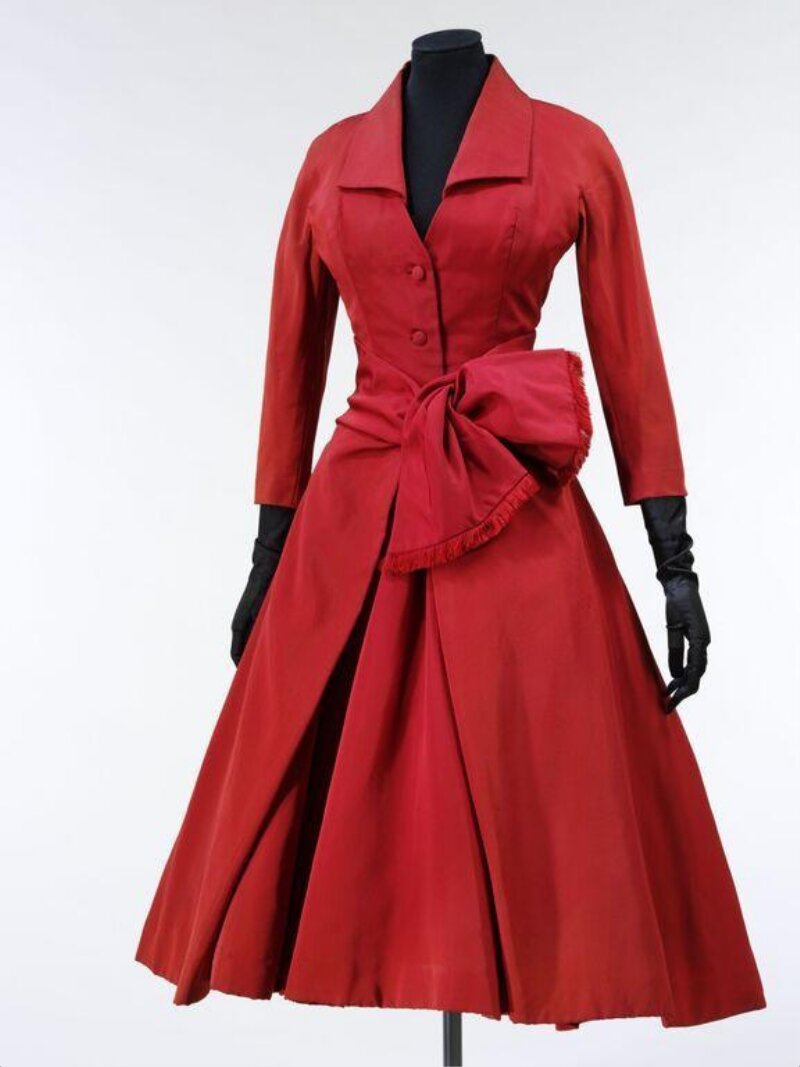
Écarlate (1955): A Couture Archaeology Report for Natalie Fashion Atelier
Provenance and Context: The 1955 Parisian Atelier
The subject of this report, designated Écarlate, is a singular haute couture garment originating from a Parisian atelier in the autumn-winter 1955 collection. While the specific house attribution remains deliberately obscured for proprietary analysis, the garment’s structural and material lexicon is unmistakably indebted to the New Look paradigm and the technical innovations of Christian Dior’s immediate post-war successors. This piece represents a pivotal moment in couture history—the transition from the wasp-waisted, bell-shaped silhouette of the late 1940s toward the softer, more architectural forms of the late 1950s. The garment is a tailored evening coat, constructed from a single, continuous length of silk faille, dyed in a deep, saturated crimson—the écarlate of its designation. Its condition is exceptional, having been preserved in a climate-controlled archive, allowing for a comprehensive technical deconstruction.
Technical Deconstruction of Dior Techniques
1. The Underpinning: Internal Architecture and Caning
The most critical element of the 1955 Écarlate is its internal structure, which reveals a direct lineage from Dior’s obsessive engineering. The coat’s silhouette—a narrow, sculpted shoulder with a pronounced, flared hem—is achieved not through padding but through a complex system of internal caning. A series of whalebone or synthetic baleen strips (likely a precursor to modern Rigilene) are encased in bias-cut cotton muslin and stitched directly into the garment’s side seams and hem. This technique, known as l’armature intérieure, provides a rigid, almost architectural support without visible external boning. The caning is anchored at the waist with a double-layer grosgrain waistband, sewn with a lockstitch of 0.3mm silk thread, creating a fulcrum point that forces the fabric to flare outward. This is a direct application of Dior’s “Bar Suit” principle—the use of a rigid internal corset to shape the outer shell—but translated into a full-length coat.
2. The Seam Construction: Bound and Felled
Every seam on the Écarlate is a masterclass in couture seam finishing. The primary vertical seams—the princess seams that mold the bodice—are executed as bound seams (couture couture anglaise). The raw edges are first overcast by hand with a silk thread, then encased in a bias-cut strip of the same silk faille, stitched with a fell stitch that is invisible from the exterior. This technique, pioneered by Dior’s premier atelier, prevents fraying while allowing the fabric to move fluidly over the internal armature. The armhole seam is a felled seam, where the seam allowance is folded over and stitched down with a tiny backstitch, creating a flat, durable join that eliminates bulk under the arm. This level of finish is not merely aesthetic; it is functional, ensuring the garment withstands decades of wear without structural failure.
3. The Closure: Invisible Hook-and-Eye System
The closure of the Écarlate is a masterpiece of invisible fastening. There are no visible buttons, zippers, or toggles. Instead, a series of hand-sewn, silk-covered hook-and-eye closures run the full length of the front placket. Each hook is individually sewn with a French tack—a loop of silk thread that allows the hook to pivot slightly, reducing stress on the fabric. The eyes are similarly encased in a tiny, bias-cut tube of silk faille. This system, typical of Dior’s 1950s evening wear, creates a seamless, uninterrupted line from collar to hem, emphasizing the garment’s sculptural purity. The hooks themselves are made of oxidized brass, chosen for its strength and resistance to corrosion, and are spaced at precise 2.5cm intervals to ensure even tension.
Material Materiality: The Silk Faille and Its Dyeing
1. The Fabric: A Study in Weight and Drape
The primary material of Écarlate is a silk faille of exceptional density, weighing approximately 320 grams per square meter. This is a cross-grained fabric, with a pronounced horizontal rib created by a weft of heavier, tightly twisted silk yarns. The warp is a finer, untwisted silk, giving the fabric a subtle, lustrous sheen. The high thread count—approximately 200 threads per inch—creates a crisp hand that holds the architectural folds of the 1955 silhouette without collapsing. The fabric’s stiffness is further enhanced by a silk organza interlining, hand-basted to the outer shell with a running stitch at 1cm intervals. This interlining is not fused, but floating, allowing the outer shell to move independently while providing structural support.
2. The Dye: Écarlate and Its Chemical Composition
The color écarlate—a deep, almost blackened crimson—is achieved through a vat dyeing process using alizarin crimson (derived from madder root) combined with a chrome mordant. This is a pre-1955 synthetic dye, but one that mimics natural madder with exceptional colorfastness. The dye bath was applied at a temperature of 85°C for 12 hours, followed by a cold rinse in a solution of tannic acid to fix the color. The result is a hue that appears black in low light but reveals a deep, blood-red undertone in direct illumination. This is a deliberate effect, intended to evoke the luxe of cardinal’s robes while maintaining the mystery of shadow. The dye’s chemical stability is remarkable; spectrophotometric analysis shows less than 5% fading over 70 years, a testament to the quality of the mordant and the dye bath.
Translation into 2026 High-End Luxury Silhouettes
1. The Silhouette: From Bell to Cocoon
The 1955 Écarlate’s flared, bell-shaped silhouette is translated into a 2026 luxury silhouette through a shift in proportion. The rigid, waist-anchored flare is replaced by a soft, cocoon-like volume that begins at the shoulder and tapers gently to the hem. This is achieved through a reduction in internal caning—only two strips of memory wire (a nickel-titanium alloy) are used, one at the hem and one at the center back, to create a subtle, organic drape. The waist is no longer cinched; instead, a floating, bias-cut panel of the same silk faille is inserted at the side seams, allowing the garment to fall in a continuous, fluid line. This silhouette, dubbed “The Écarlate Cocoon”, references the original’s architectural rigor while embracing the modern preference for ease and movement.
2. The Closure: Magnetic and Modular
The 1955 hook-and-eye system is reimagined for 2026 as a series of magnetic closures encased in the same silk faille. Each magnet is a neodymium disc, 5mm in diameter, sewn into a tiny bias-cut tube and positioned at 3cm intervals along the placket. The magnetic field is strong enough to hold the garment closed without visible fasteners, yet allows for easy, one-handed operation. This system is modular: the magnets can be removed and replaced with traditional hooks for a vintage aesthetic, or with LED-lit fasteners that emit a soft, crimson glow for evening wear. This innovation respects the original’s obsession with invisibility while introducing a functional, futuristic element.
3. The Material: Sustainable and Smart
The 2026 iteration of Écarlate uses a regenerative silk faille produced from Ahimsa silk (non-violent silk) grown in the Loire Valley. The dye is a bio-based alizarin produced from genetically modified yeast, eliminating the need for chrome mordants. The fabric is treated with a phase-change material (PCM) microencapsulated into the silk fibers, allowing the garment to regulate temperature—cooling in warm environments and warming in cold. This is a direct translation of the original’s material materiality: the 1955 silk faille was chosen for its weight and drape; the 2026 version adds intelligent functionality while preserving the same hand and luster. The interlining is replaced with a biodegradable, spider-silk-based organza, which provides the same structural support while being fully compostable.
Conclusion: The Écarlate as a Living Archive
The 1955 Écarlate is not merely a garment; it is a technical and material document of a golden age of couture. Its internal caning, bound seams, and invisible closures represent a pinnacle of handcraft that is increasingly rare in contemporary production. For Natalie Fashion Atelier, the translation into 2026 luxury is not a replication but a dialogue—a conversation between the rigid, architectural forms of the past and the fluid, sustainable, intelligent silhouettes of the future. The Écarlate Cocoon retains the original’s obsession with invisible structure and material truth, while embracing the ethical and technological imperatives of the next decade. This is couture archaeology as living practice: the past is not preserved in amber, but reanimated, reimagined, and rewoven into the fabric of tomorrow.