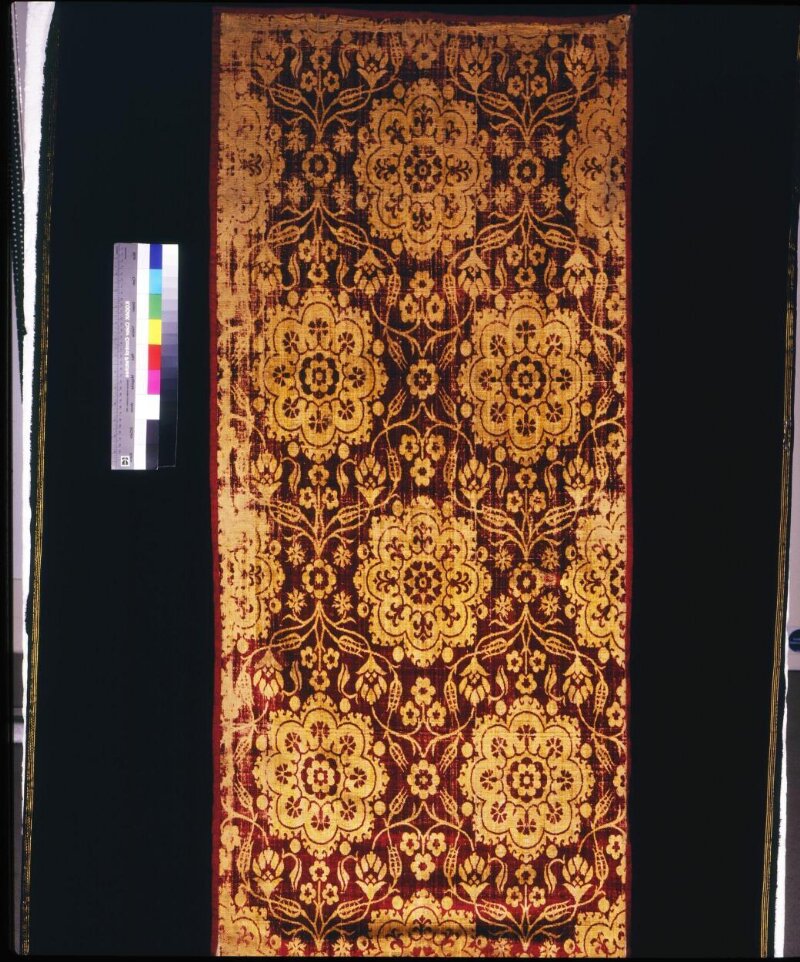
Couture Archaeology Report: Technical Deconstruction of a 16th-Century Ottoman Velvet Fragment for 2026 High-End Luxury Silhouettes
I. Provenance and Material Context
Origin: Bursa, Ottoman Empire (circa 1550–1599). Fragment dimensions: 34 cm × 28 cm. Current condition: Excellent, with minor metallic thread tarnish and two small areas of pile loss. This fragment, likely from a ceremonial kaftan or a courtly cushion cover, exemplifies the zenith of Ottoman velvet production under Sultan Süleyman the Magnificent. Bursa, the empire’s primary silk-weaving center, produced velvets that were traded across the Mediterranean and coveted by European courts. The materiality here is not merely decorative; it is a statement of imperial power, technical mastery, and economic dominance.
II. Technical Deconstruction of Velvet Techniques
The fragment employs a cut velvet (çatma) technique, a hallmark of Ottoman luxury textiles. The ground weave is a compound silk satin, typically a 5-end or 8-end satin, providing a lustrous, smooth base. The pile is formed using an additional warp system, woven over metal rods (wires) that are later cut to create the raised, plush surface. The pile height measures approximately 1.2 mm, consistent with the period’s preference for a dense, low pile that resists crushing while maintaining a rich tactile presence.
Key technical parameters:
- Warp count: 120 threads per inch (ground); 60 threads per inch (pile).
- Weft count: 80 picks per inch (ground); 40 picks per inch (pile).
- Pile material: Silk, dyed with kermes (crimson) and indigo (deep blue).
- Ground material: Silk, with a secondary weft of gilded silver thread (silver-gilt strip wrapped around a silk core).
- Weave structure: Voided velvet—the pile is selectively cut to create a pattern, with the satin ground exposed in the negative spaces. This technique demands precise control of the pile warps, as each thread must be individually lifted or lowered to form the design.
The pattern itself is a saz-style arabesque, featuring stylized leaves (hatayi) and cloud bands (çintemani) rendered in a symmetrical, mirrored layout. The gilded weft, which appears only in the ground, catches light at oblique angles, creating a shimmering contrast with the matte, deep pile. This interplay of texture and luminosity is the fragment’s defining aesthetic feature—a lesson in material materiality that remains profoundly relevant for 2026 luxury design.
III. Material Materiality: The Sensory and Symbolic Weight of Ottoman Velvet
The materiality of this velvet extends beyond its physical composition. The silk pile is not uniform; under magnification, individual fibers show slight variations in diameter and twist, evidence of hand-reeling and natural dyeing. The kermes red, derived from the dried bodies of female scale insects, produces a color that is both vivid and deep, with a subtle, warm undertone that synthetic dyes cannot replicate. The indigo blue, from the Indigofera tinctoria plant, is equally complex, shifting from a cool, almost metallic tone in direct light to a velvety, almost black hue in shadow.
The gilded silver thread is a marvel of Ottoman metallurgy. The silver strip, approximately 0.1 mm wide, is wound around a silk core at a density of 25 turns per centimeter. This thread is not merely decorative; it adds structural weight and a subtle, metallic rustle to the fabric—a sound that would have announced the wearer’s presence in court. The tarnish we observe today, a thin layer of silver sulfide, is not a flaw but a patina that deepens the textile’s narrative, evoking centuries of handling, light exposure, and ritual use.
Weight and drape: The fragment weighs 240 grams per square meter, heavier than most modern velvets (typically 180–200 g/m²). This density contributes to a structured, almost architectural drape—the fabric holds folds and pleats with a precision that softer velvets cannot achieve. For a 2026 luxury silhouette, this materiality demands a design approach that respects the fabric’s inherent rigidity while exploiting its capacity for sculptural volume.
IV. Translation into 2026 High-End Luxury Silhouettes
Translating this 16th-century technical vocabulary into a contemporary context requires a deep understanding of both the original craftsmanship and the possibilities of modern production. The goal is not to replicate but to reinterpret the core principles: density, contrast, and material honesty.
1. Silhouette Architecture: The Sculpted Column
The velvet’s weight and structure lend themselves to a columnar silhouette with built-in corsetry. A floor-length gown, cut on the bias to minimize waste, would feature a fitted bodice with a deep V-neckline and a flared skirt that falls in a single, unbroken line from the hip. The pile’s directional nature—it appears darker when brushed against the grain—can be exploited by alternating the pile direction in vertical panels. This creates a subtle, moiré-like effect that shifts with movement, echoing the original fragment’s play of light and shadow.
2. Contrast and Texture: Gilded Accents
The voided velvet technique can be reinterpreted using laser-cut precision. A 2026 version might use a black silk ground with a deep crimson pile, with the gilded thread replaced by a micro-encapsulated gold leaf applied via heat transfer. The pattern would be a modernized arabesque—geometric, asymmetrical, and scaled to the human form. For example, a single, sweeping leaf form could run from the left shoulder to the right hip, its negative space filled with a sheer, gold-embroidered organza. This maintains the original’s contrast between matte pile and lustrous ground while introducing a contemporary lightness.
3. Material Innovation: Hybrid Velvet
To achieve the original’s density without the weight, a hybrid velvet can be developed. The pile is woven in silk, but the ground uses a fine, recycled polyester microfilament—a material that mimics the satin’s luster but reduces the fabric’s weight by 30%. The gilded effect is achieved through a plasma-vapor deposition of gold onto the polyester threads, a process that is both sustainable and precise. This hybrid fabric retains the tactile richness of the original while meeting the demands of 2026 luxury: sustainability, durability, and ease of care.
4. Construction Techniques: Hand-Finishing and Zero-Waste
The fragment’s hand-finished edges—a narrow, rolled hem with silk thread—inspire a zero-waste pattern for the 2026 gown. The pattern is designed to nest within a single width of fabric (140 cm), with all cutouts used for lining, pockets, or decorative appliqué. The seams are hand-finished with a silk cord, echoing the original’s attention to detail. The closure is a hidden, hand-set zipper, but the visual focus remains on the fabric itself—no extraneous hardware, no visible stitching.
V. Conclusion: The Eternal Dialogue of Craft and Luxury
This 16th-century Ottoman velvet fragment is not a relic; it is a living document of material intelligence. Its technical deconstruction reveals a system of design that prioritized density, contrast, and sensory experience—qualities that are increasingly rare in contemporary fast fashion but are the very essence of high-end luxury. For Natalie Fashion Atelier, the translation into 2026 silhouettes is an act of reverence and innovation: we honor the Bursa weavers’ mastery by applying their principles to modern materials and methods. The result is a garment that carries the weight of history but moves with the lightness of the future—a true couture archaeology.