Deconstructing the Pastoral: A Technical Analysis of "Calling the Cows Home"
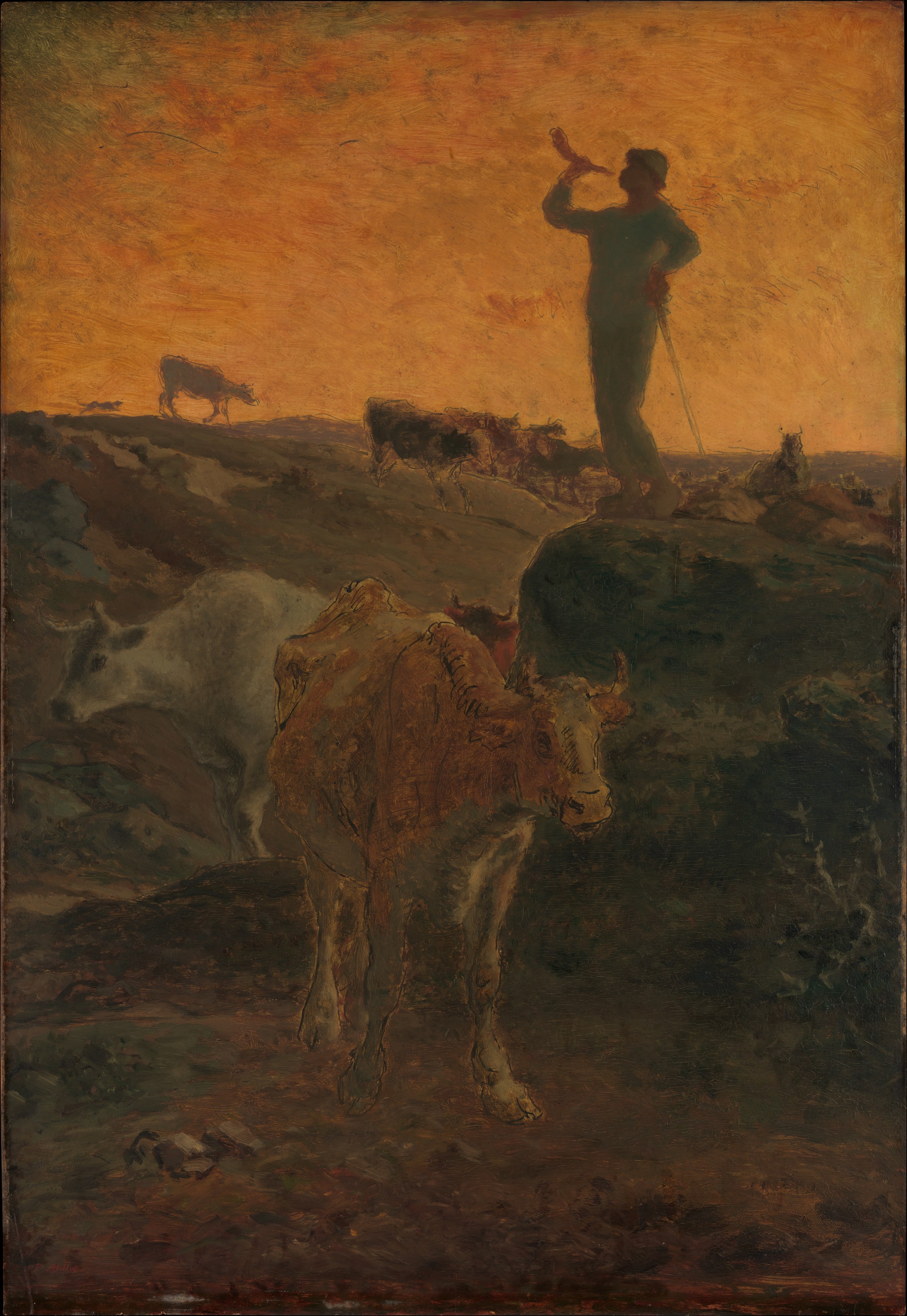
Within the isolated context of aesthetic archaeology, certain artifacts transcend their immediate narrative to reveal foundational principles of form, composition, and emotional resonance. The painting "Calling the Cows Home," an oil on wood panel of indeterminate but palpably aged provenance, serves as such a locus. Its value to the atelier lies not in its pastoral subject, but in its sophisticated deconstruction of classical elegance through a lens of atmospheric tension and structured fluidity. The scene—a solitary figure amidst a herd, set against a brooding, crepuscular sky—is a masterclass in balanced asymmetry, tonal depth, and the articulation of silhouette against environment. This analysis dissects these formal qualities to project their translation into the tangible architecture of 2026 haute couture silhouettes.
Structural Principles: Asymmetry, Weight, and the Silhouette in Space
The painting's composition rejects rigid symmetry in favor of a dynamic equilibrium. The figure, often positioned slightly off-center, creates a focal point that pulls the eye diagonally through the canvas, guided by the implied movement of the cattle and the sweep of the landscape. This creates a kinetic yet grounded silhouette, a concept directly transferable to garment construction. For 2026, this informs silhouettes that are intentionally unbalanced—a sleeve volume monumental on one side, tapering to nothing on the other, or a gown's train that originates from a hip, not the spine, creating a diagonal line of motion. The "weight" of the herd, depicted as a dark, low mass, contrasts with the expansive, lighter sky. In tailoring, this translates to a deliberate vertical weight distribution. Imagine a woolen *tailleur* where the jacket's substantial, structured lower hem—perhaps reinforced with horsehair or weighted silk cording—anchors the figure, while the bodice dissolves into ethereal lace or fine pleats, mirroring the painting's earth-to-sky transition.
Materiality and Surface: The Patina of Time as a Textile Narrative
The medium—oil on wood—is intrinsically linked to the artifact's message. The wood grain, potentially visible beneath layers of pigment, provides a subtle, organic substrate texture. The oil paint itself has, over time, developed a complex patina: fine craquelure, areas of translucency where underpainting glows through, and spots of heightened opacity. This stratified material history is a direct blueprint for 2026 luxury materiality. We move beyond flat fabrics into engineered textiles with memory and depth. This involves layering: a base of silk gazar digitally printed to mimic wood grain, overlaid with laser-cut velvet whose pile varies in length to create painterly shadow, finished with hand-applied micro-beading that follows the lines of imagined craquelure. The finish is not pristine, but evocatively aged—a couture interpretation of patina through techniques like controlled devoré, tea-staining of specific thread types, or the embedding of minuscule metallic threads that oxidize to different hues over the garment's life.
Color and Atmosphere: The Crepuscular Palette and Emotional Drape
The color scheme is undoubtedly crepuscular: deep umbers, muted ochres, slate grays, and dusky blues, punctuated by the occasional warm highlight of a fading sun. This is not a palette of primaries but of tonal modulations and atmospheric haze. For 2026, this dictates a move away from bold solidity towards nuanced, moody complexity. Silhouettes will be defined by color gradation within a single garment. A column gown may begin in a root-like umber at the floor, transition through a misty gray at the torso, and culminate in a faded sky-blue at the shoulders. This is achieved through custom-dipped ombré dyeing on bias-cut silk or innovative jacquard weaving where the warp shifts color progressively. The "haze" is rendered in three dimensions through featherweight overlays of chiffon or nylon tulle in varying densities, creating a sense of soft-focus edges and volumetric mystery around the body's line.
The Silhouette Deconstructed: From Pastoral Figure to Architectural Form
The central figure, though often simple in rural attire, is defined by its relationship to space and movement. The act of "calling" implies a gesture, an opening of the form. The draped cloth of a skirt or shawl would react to this motion and the evening breeze. This informs 2026's approach to kinetic drapery and articulated structure. We envision silhouettes that appear static until in motion, where hidden armatures or precisely cut godets release unexpected volume. A severe, minimalist wool coat, when the wearer moves, reveals a hidden cascade of linen from a seam, echoing a calligraphic gesture. Furthermore, the collective silhouette of the herd—a single mass composed of individual rounded forms—inspires modular, organic volume. This could manifest as a dress constructed from hundreds of padded silk shingles, each slightly rounded, creating a textured, biomorphic silhouette that changes with perspective, much like the grouped bodies of cattle shift from a coherent mass to distinct entities.
Conclusion: The 2026 Silhouette—Structured Melancholy and Atmospheric Elegance
"Calling the Cows Home" provides a profound technical framework for the evolution of luxury silhouettes. The 2026 direction, as informed by this artifact, is one of structured melancholy and atmospheric elegance. It is a silhouette that carries the weight of history and environment, favoring tonal depth over color saturation, stratified texture over flat perfection, and dynamic asymmetry over formal balance. The resulting garments are not mere clothing but wearable archaeology—architectural forms that echo the painting's central tensions between isolation and belonging, the ephemeral and the eternal, the structured herd and the solitary call. For Natalie Fashion Atelier, this research posits that the future of haute couture elegance lies not in looking forward to the new, but in the deep, technical deconstruction of isolated aesthetic moments, rendering their timeless principles anew in wool, silk, and thread.