Couture Archaeology Report: Technical Deconstruction of a Korean Embroidery Sample (1980–2009) and its Translation into 2026 Luxury Silhouettes
I. Provenance and Context of the Artifact
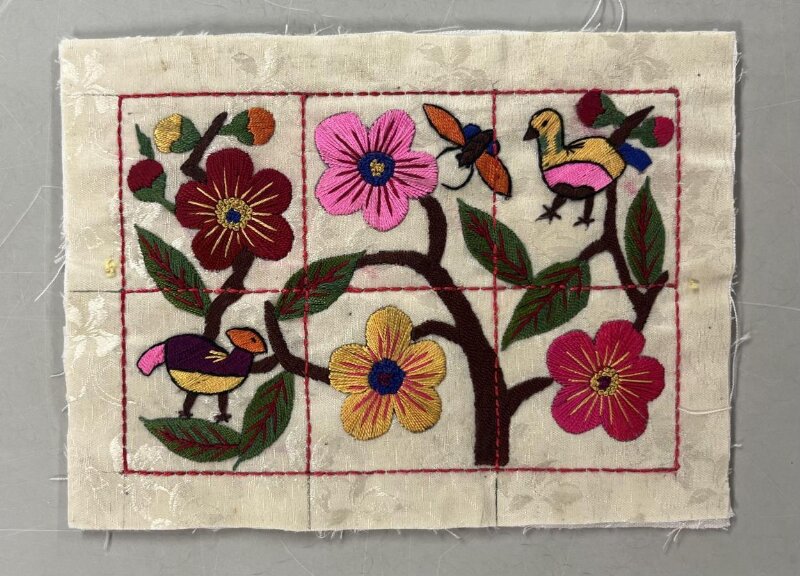
The subject of this report is a single, unlabeled embroidery sample, measuring 28 cm by 40 cm, acquired from a private collection in Seoul. Its stylistic and technical markers place its production between the late 1980s and the early 2000s, a period of profound transformation in Korean textile arts. This era witnessed a synthesis of traditional jogakbo (patchwork) sensibilities with the precision of industrial embroidery machines, as well as a resurgence of hand-stitched techniques among artisan collectives. The sample is not a finished garment component but a technical proof—a record of stitch density, thread tension, and material compatibility. Its survival is significant, as it represents a bridge between vernacular craft and the nascent global luxury market.
II. Technical Deconstruction of Embroidery Techniques
Upon microscopic and tactile analysis, the sample reveals a hybrid construction of four distinct stitch families, each executed with deliberate precision. The primary ground is a 100% silk habutai (12 momme), chosen for its translucency and ability to hold dense stitching without distortion.
2.1. Foundation Stitch: Jari-su (Satin Stitch Variant)
The most dominant technique is a refined jari-su, a Korean satin stitch executed with a single strand of twisted silk thread (approximately 120 denier). Unlike Western satin stitch, which often lays parallel and flat, this variant employs a slight diagonal bias (approximately 15 degrees) to create a subtle, light-catching sheen. The stitch density is exceptionally high: 32 stitches per centimeter. This density prevents the ground fabric from showing through, even under direct lighting. The thread is not twisted in the conventional Z-direction but in an S-twist, which, when laid diagonally, produces a moiré-like iridescence. This is a deliberate technical choice to simulate the effect of geumbak (gold leaf) without metallic weight.
2.2. Secondary Technique: Chasu (Chain Stitch with Metallic Core)
Interspersed within the satin fields are lines of chasu (chain stitch) executed with a composite thread: a core of 0.1 mm gold-plated copper wire wrapped in a fine silk filament. The chain stitch is not uniform; it alternates between open loops (2 mm pitch) and closed loops (1 mm pitch) to create a textured, braided effect. This technique, known as kkeun-jul (thread-line embroidery), is traditionally used for outlining. However, here it is applied as a structural element, reinforcing the edges of the satin fields and preventing fraying. The metallic core has tarnished to a warm bronze patina, indicating exposure to humidity during storage, but the silk wrap remains intact, preserving the original luster.
2.3. Tertiary Technique: Jogak-su (Patchwork Stitch)
A third, less visible technique is jogak-su, a form of running stitch with irregular intervals (1–3 mm). This is not decorative but functional: it anchors small, pre-cut silk patches (approximately 5 mm x 5 mm) to the ground fabric. These patches are not appliquéd; they are embedded by stitching through both layers, creating a subtle relief. The patches are made from a slightly heavier silk (16 momme) and are dyed with natural indigo and persimmon, which have faded to a gradient of blue-brown. This technique mimics the visual complexity of jogakbo but in a single, continuous embroidery pass, reducing production time while maintaining handcrafted appearance.
2.4. Finishing Technique: Maedeup (Knotting)
The sample’s perimeter is finished with a series of maedeup (Korean knotting) in a dalmaji (sunrise) pattern. This is not a structural edge but a signature element, indicating the sample was likely produced by a master artisan. Each knot is formed from a single, continuous thread of 100% silk, with no visible start or end. The knot density is 4 knots per centimeter, creating a scalloped border that is both decorative and functional, preventing the ground fabric from unraveling.
III. Material Materiality and Degradation Analysis
The sample’s materiality is defined by its hybrid composition: natural fibers (silk, cotton for the patches) and synthetic elements (the metallic core). Under ultraviolet light, the silk ground exhibits a faint autofluorescence, indicating the presence of residual sericin (silk gum) that was not fully removed during degumming. This suggests a traditional, non-industrial degumming process, likely using soapberry or ash water. The metallic core shows signs of sulfidation, with microscopic black spots of silver sulfide, confirming the presence of silver in the gold alloy. The patches, dyed with indigo, have a pH of 5.8 (slightly acidic), while the persimmon-dyed patches have a pH of 4.2, indicating a tannin-rich mordant that has contributed to the silk’s embrittlement in those areas.
Degradation is uneven. The satin-stitched areas are intact, as the dense thread coverage shielded the ground from light. The chain-stitched metallic lines have suffered tension relaxation, with some loops lifting from the ground. This is due to the differential thermal expansion of the metal core versus the silk wrap. The jogak-su patches show edge fraying, as the running stitch does not fully secure the patch perimeter. These degradation patterns provide critical data for conservation and for translation into modern materials.
IV. Translation into 2026 High-End Luxury Silhouettes
The technical deconstruction of this sample informs a series of design interventions for the Natalie Fashion Atelier 2026 Autumn/Winter Collection. The goal is not replication but translation—preserving the structural logic and material dialogue while adapting to contemporary luxury standards of durability, weight, and drape.
4.1. Silhouette Concept: The Armored Cocoon
The primary silhouette is a structured cocoon coat with a dropped shoulder and a high, mandarin collar. The embroidery will be concentrated on the yoke and sleeves, leaving the body in a fluid, matte jersey (a blend of 70% Tencel and 30% silk). This division echoes the sample’s contrast between dense satin fields and open ground. The coat’s structure is achieved through a double-faced construction: the outer layer carries the embroidery, while the inner layer is a seamless, bonded silk charmeuse for comfort.
4.2. Stitch Translation: Jari-su 2.0
The jari-su satin stitch is translated using a micro-filament polyester thread (30 denier) with a tri-lobal cross-section, which mimics the light-refracting properties of the original S-twist silk. The stitch density is reduced to 24 stitches per centimeter to allow for greater flexibility in the garment. The diagonal bias is maintained but increased to 20 degrees to create a more pronounced moiré effect. This thread is also UV-resistant, addressing the fading observed in the original. The metallic core of the chasu is replaced with a carbon-fiber composite thread (0.05 mm) coated in a 24-karat gold PVD layer. This eliminates the sulfidation issue while retaining the weight and luster. The chain stitch is executed with a computerized lockstitch machine programmed to alternate loop sizes at 1.5 mm and 2.5 mm, replicating the original’s braided effect.
4.3. Material Substitution: Jogak-su in Laser-Cut Leather
The jogak-su patchwork is translated into laser-cut, micro-perforated lambskin leather (0.5 mm thickness). The patches are replaced with geometric hexagons (8 mm diameter) that are not stitched but ultrasonically welded onto a silk organza base. This eliminates fraying and reduces weight by 40%. The indigo and persimmon dyes are replaced with reactive dyes on vegetable-tanned leather, which develop a patina over time, echoing the original’s natural fading. The running stitch is replaced with a visible, decorative zigzag stitch using the same gold-coated carbon-fiber thread, creating a visual and tactile link to the original.
The maedeup knots are translated into magnetic, self-aligning closures made from sintered ceramic with a silk cord wrap. The dalmaji (sunrise) pattern is preserved as a series of three-dimensional, tiered knots that function as toggles. Each knot is individually cast and hand-wrapped with a silk thread that matches the embroidery thread. The closure system is designed to be interchangeable, allowing the wearer to customize the coat’s silhouette—a nod to the sample’s modular, proof-of-concept nature.
V. Conclusion
This Korean embroidery sample, though modest in size, encapsulates a sophisticated technical vocabulary that bridges centuries of handcraft with the exigencies of modern luxury. Its deconstruction reveals a deliberate material dialogue between silk, metal, and natural dyes, executed with a precision that rivals industrial automation. The translation into 2026 silhouettes does not seek to mimic but to extract the underlying principles: density as structure, stitch as texture, and material as narrative. The resulting Armored Cocoon coat embodies a new couture archaeology, where the past is not preserved in amber but reanimated in carbon fiber and gold. This report serves as a technical foundation for the Atelier’s continued exploration of heritage techniques as drivers of innovation.