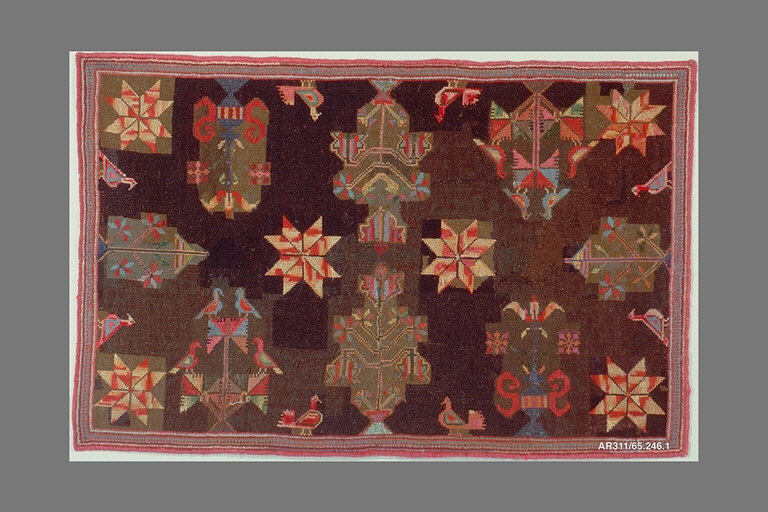
The Artisanal Dialectic: An Embroidered Rug as a Blueprint for 2026 Couture Silhouettes
Within the hallowed archives of Natalie Fashion Atelier, we engage in a practice we term aesthetic archaeology. This is not a passive preservation of the past, but an active excavation of its foundational principles. Our subject today is an object of profound, yet seemingly humble, American heritage: a hand-embroidered wool rug, executed in the meticulous, democratic language of cross-stitch. At first glance, it is a domestic artifact. Upon deeper scrutiny, it reveals itself as a masterclass in structural tension, textural narrative, and the architectonics of surface—a lexicon that is uniquely suited to inform the luxury silhouettes of 2026.
Deconstructing the Classical Elegance of the American Cross-Stitch Rug
The classical elegance of this artifact is not born of opulent materials or aristocratic lineage. Rather, it is derived from a rigorous, almost architectural, logic. The wool substrate provides a tactile, grounded foundation—a matte, absorbent base that refuses visual flight. Its strength lies in its physical presence, its ability to hold form and resist drape. This is a material that speaks of endurance, not ephemerality.
The cross-stitch embroidery, executed with precision, creates a secondary, structural skin. Each tiny ‘x’ is a discrete unit of tension, pulling the wool ground into a grid of micro-relief. This is not a surface decoration applied from without; it is a structural intervention that alters the very behavior of the base material. The interplay between the flat, napped wool and the raised, thread-locked stitches generates a dynamic of compression and release. The unstitched areas remain soft and yielding, while the stitched zones become rigid, almost armored. This dialectic—between soft ground and hard stitch, between yielding and resistant—constitutes the artifact’s core elegance. It is an elegance of controlled tension, a lesson in how a surface can be both a canvas and a load-bearing structure.
Materiality as a Structural Dictate: Wool and Cross-Stitch in 2026
For the 2026 haute couture client, materiality is no longer a mere aesthetic choice; it is a philosophical declaration. The American rug’s use of wool—a natural, regenerative, and texturally complex fiber—aligns perfectly with the 2026 imperative for tactile authenticity. We will not drape a garment; we will construct a wool-based architecture. The silhouette will be informed by the rug’s inherent resistance to fluidity. Expect sculptural, columnar forms that stand away from the body, creating a negative space of quiet power. The wool’s weight will be leveraged not as a limitation, but as a tool for creating gravity-bound volumes—skirts that pool like a frozen landscape, jackets that hold their own rigid geometry.
The cross-stitch technique, translated into couture, becomes a system of micro-engineering. Each stitch is a point of structural articulation. We will employ a technique we call “Stitched Armature.” Here, dense fields of cross-stitch will be used to create internal boning without the need for plastic or metal. A bodice, for example, will be constructed from a single piece of wool felt, its shape and rigidity entirely determined by the density and direction of the embroidery. The unstitched zones will be left to softly collapse, creating a dynamic interplay of hard and soft within a single garment. This is not embroidery as embellishment; it is embroidery as structural engineering.
Informing 2026 High-End Silhouettes: The Rug as a Generative Matrix
From this aesthetic archaeology, three distinct silhouette families emerge for the 2026 collection, each a direct translation of the rug’s principles.
Silhouette I: The Grid of Tension
This silhouette is a direct homage to the rug’s geometric logic. The foundation is a sheath dress in heavy, undyed wool. Its surface is then overlaid with a precise, architectural grid of cross-stitch in a contrasting, matte silk thread. The grid is not uniform; it is denser at the shoulders and hips, creating a structural corset effect, and looser at the torso, allowing for subtle movement. The result is a silhouette that is both armored and fluid. The body is encased in a woven cage of its own making, a garment that breathes and moves within the strictures of its own embroidery. The hem is left raw, echoing the rug’s finished edge, a deliberate nod to the artifact’s honest construction.
Silhouette II: The Topographical Collapse
Here, we explore the rug’s potential for textural relief and volumetric contrast. A long, A-line coat is cut from a single, generous panel of wool. The embroidery is applied as a topographical map, with dense, concentric rings of cross-stitch at the shoulders and upper back, gradually dissolving into the unstitched wool at the hem. This creates a visual and physical gradient of structure. The upper body is rigid, almost sculptural, while the lower body is soft and flowing. The silhouette is a study in controlled collapse, where the garment’s own weight and the embroidery’s tension dictate its final form. The collar is a high, stitched mandarin, a pure architectural element that frames the face.
Silhouette III: The Fragmented Armature
The most avant-garde of the three, this silhouette deconstructs the rug’s unity. It is a modular ensemble consisting of a cropped, sculpted bodice and a full, floor-length skirt. The bodice is a fragment of the rug, a dense, heavily embroidered panel that is shaped through a combination of wet-molding the wool and the tension of the cross-stitch. It is a wearable artifact, a piece of architectural history. The skirt, by contrast, is a fluid cascade of unstitched wool, its only structure provided by the weight of the fabric and a single, embroidered seam that runs from the waist to the hem, like a fault line in a landscape. The silhouette is a dialogue between the fossilized past (the bodice) and the fluid present (the skirt), a testament to the enduring power of the stitch to define our form.
In conclusion, this American embroidered rug, isolated and analyzed through the lens of aesthetic archaeology, is not a relic. It is a generative blueprint. Its lessons in material tension, structural surface, and the dialectic between ground and stitch are the very principles that will define the architectural, tactile, and intellectually rigorous silhouettes of Natalie Fashion Atelier for 2026. We do not copy the past; we excavate its logic to build the future.