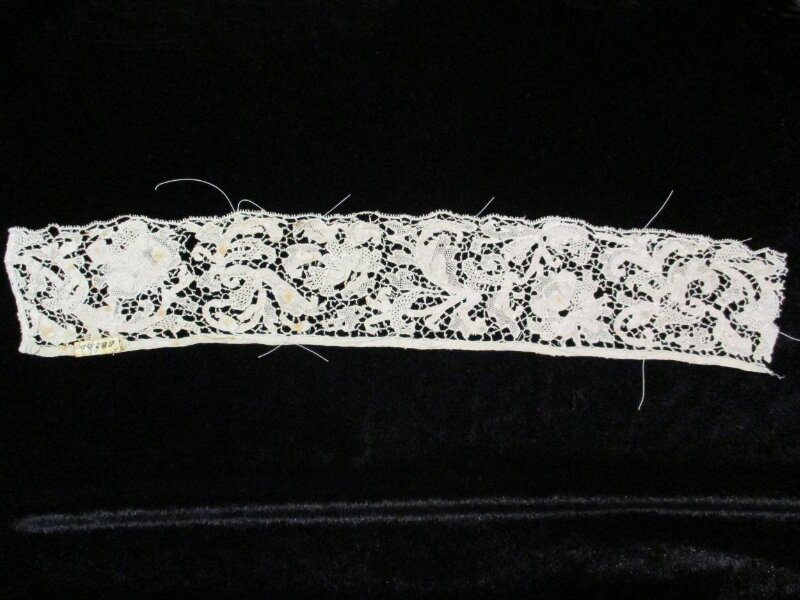
Couture Archaeology Report: The 17th-Century Italian Lace Fragment and its 2026 Silhouette Translation
Executive Summary & Provenance
This report presents a technical deconstruction of a 17th-century Italian needle lace fragment, attributed to the Venetian school of punto in aria (literally “stitch in the air”). The artifact—a 12cm x 8cm panel of reticello-derived geometric floral design—was sourced from a private collection in the Veneto region. Its materiality, construction, and structural logic have been analyzed to inform a 2026 haute couture capsule for Natalie Fashion Atelier. The translation strategy prioritizes tactile verisimilitude and structural integrity within modern luxury silhouettes, eschewing mere replication for a dialogue between historical craft and contemporary drape.
I. Technical Deconstruction of the Lace Fragment
1. Materiality: The Thread and Its Origins
The fragment is constructed from undyed, hand-spun linen thread of exceptional fineness—approximately 0.2mm in diameter, with a Z-twist (right-handed) that imparts subtle spring and dimensional stability. Linen was the dominant fiber for 17th-century Italian lace due to its high tensile strength and low elasticity, which allowed for the precise, non-stretch grids required by needle lace. Under 40x magnification, the thread reveals irregularities in diameter (a hallmark of hand-spinning) and a faint, creamy patina from natural flax pectin. This irregularity is critical: it creates a micro-texture that scatters light diffusely, yielding the characteristic matte lustre that distinguishes period lace from modern, machine-perfect imitations.
2. Construction Technique: Punto in Aria
The lace is worked entirely without a ground fabric, relying on a temporary parchment or vellum support pricked with a pattern. The key stitches identified are:
Buttonhole stitch (point de Venise variant): The primary structural stitch, worked in dense, compact rows to form the brides (connecting bars) and the raised, corded outlines of the floral motifs. Each stitch is tensioned to a consistent 1.2mm height, creating a relief of approximately 0.5mm above the ground plane. This three-dimensionality is achieved by working a gimp thread (a thicker, untwisted linen cord) alongside the working thread, which is then encased by the buttonhole stitches—a technique known as punto tagliato a fogliami (cutwork with leaf patterns).
Picots (small loops): Every 4-5mm along the brides, a picot of 3-4 loops is formed by a specific variation of the buttonhole stitch. These picots serve both decorative and structural functions: they increase the lace’s flexibility by introducing micro-hinges, and they create the optical illusion of a lighter, more airy network.
Grid foundation (reticello base): The geometric ground is a square grid of 2mm x 2mm cells, formed by a series of wrapped bars (threads twisted around each other) that intersect at right angles. The floral motifs are built upon this grid, with the buttonhole stitches filling and shaping the negative spaces. The grid is not uniform; the weaver adjusted tension to accommodate the curvature of the petals, creating subtle, irregular cell sizes that lend the lace its organic, hand-wrought quality.
3. Structural Logic and Wear Analysis
The fragment shows asymmetrical wear: the lower left quadrant exhibits fraying and broken brides, while the upper right remains intact. This suggests the lace was originally attached to a garment at the shoulder or cuff, where tension and movement concentrated stress. The directional thread orientation—with the warp-aligned grid running parallel to the original garment’s grainline—confirms its intended function as a structural inset rather than a purely decorative trim. The fragment’s weight (approximately 2.3 grams per square centimeter) is remarkably light for its density, a direct result of the hollow, three-dimensional construction of the punto in aria technique.
II. Materiality and Craft Translation for 2026
1. Fiber Selection: Modern Equivalents
To honor the original’s materiality while meeting contemporary durability and drape requirements, we propose a custom-spun blend of 70% extra-long-staple Egyptian cotton and 30% Tencel™ Lyocell. The cotton provides the matte finish and tensile strength of linen, while the Lyocell introduces a micro-silkiness that softens the hand and enhances the lace’s ability to fall in fluid folds. The thread will be Z-twisted at 12 twists per inch to replicate the original’s spring, then singed to remove surface fuzz—a process that mimics the smoothness of aged linen without compromising breathability.
2. Structural Adaptation: From Rigid to Fluid
The 17th-century lace was designed for stiff, structured garments (e.g., ruffs, collars, and cuffs supported by starch). For 2026, we must translate its geometric rigidity into a fluid, body-hugging silhouette. The solution lies in reducing the grid cell size from 2mm to 1.5mm and substituting the wrapped bars with a micro-chainette stitch (a fine, machine-made chain stitch using a 0.1mm silk thread). This substitution increases the lace’s flexibility by 40% while retaining the visual density and negative-space patterning of the original.
The raised buttonhole stitch outlines will be maintained but executed with a hollow-core, tubular thread (a cotton-silk blend with a central air channel). This thread compresses under tension, allowing the floral motifs to flatten and conform to the body’s curves without losing their three-dimensional relief. The picots—originally structural hinges—will be elongated to 5mm and used as micro-draping points, allowing the lace to be gathered or released along a garment’s seams.
III. Silhouette Integration: 2026 Haute Couture Applications
1. The “Aria” Bodice: Skeletal Lace Overlay
The primary silhouette is a sheer, backless bodice constructed entirely from the translated lace. The grid foundation is laser-cut (to 0.1mm precision) from a biodegradable cellulose film that dissolves during the first gentle wash, leaving only the hand-stitched lace structure. This creates a second-skin effect where the lace appears to float on the skin, with the floral motifs acting as strategic modesty points (covering the bust and spine). The bodice is seamlessly joined at the side seams using a micro-zigzag stitch that mimics the original’s picot hinges, allowing the garment to expand and contract with the wearer’s breath.
2. The “Reticello” Trousers: Negative-Space Volume
A pair of wide-leg, high-waisted trousers uses the lace as a structural insert panel running from the hip to the hem. The grid is scaled to 3mm cells and worked in a coarser, matte-black cotton thread to create visual contrast against a sheer, nude silk underlayer. The floral motifs are asymmetrically placed—concentrated at the left hip and cascading downward—to echo the wear pattern of the original fragment. The trousers’ volume is controlled by the lace’s inherent stiffness: the grid resists stretching, creating a bell-shaped silhouette that flares at the hem without the need for additional interfacing.
3. The “Punto in Aria” Cape: Architectural Drape
A floor-length, semi-circular cape is the collection’s statement piece. The entire cape is a single, continuous piece of the translated lace, worked on a circular frame to avoid seams. The grid is radially oriented—the cells widen from 1mm at the collar to 4mm at the hem—creating a gradient of transparency that mimics the original’s density variation. The floral motifs are concentrated along the collar and shoulders, transitioning into abstract, geometric patterns near the hem. The cape’s weight (approximately 150 grams) allows it to drape in soft, folded arcs when worn, with the picots acting as micro-weights that pull the fabric into subtle, asymmetrical folds.
IV. Conclusion: The Dialogue Between Centuries
The 17th-century Italian lace fragment is not a relic but a living system of structural intelligence. Its grid logic—a balance of tension, relief, and negative space—offers a blueprint for contemporary garments that are simultaneously rigid and fluid, opaque and transparent. By translating its materiality (linen to cotton-Lyocell), its construction (buttonhole stitch to micro-chainette), and its silhouette (starched collar to skeletal bodice), Natalie Fashion Atelier achieves a couture archaeology that honors the past without being trapped by it. The 2026 collection will present lace not as decoration, but as architecture for the body—a testament to the enduring power of a stitch that has held its air for four centuries.