An Aesthetic Archaeology of the Evening Boot: Silk, Metal, and the 2026 Silhouette
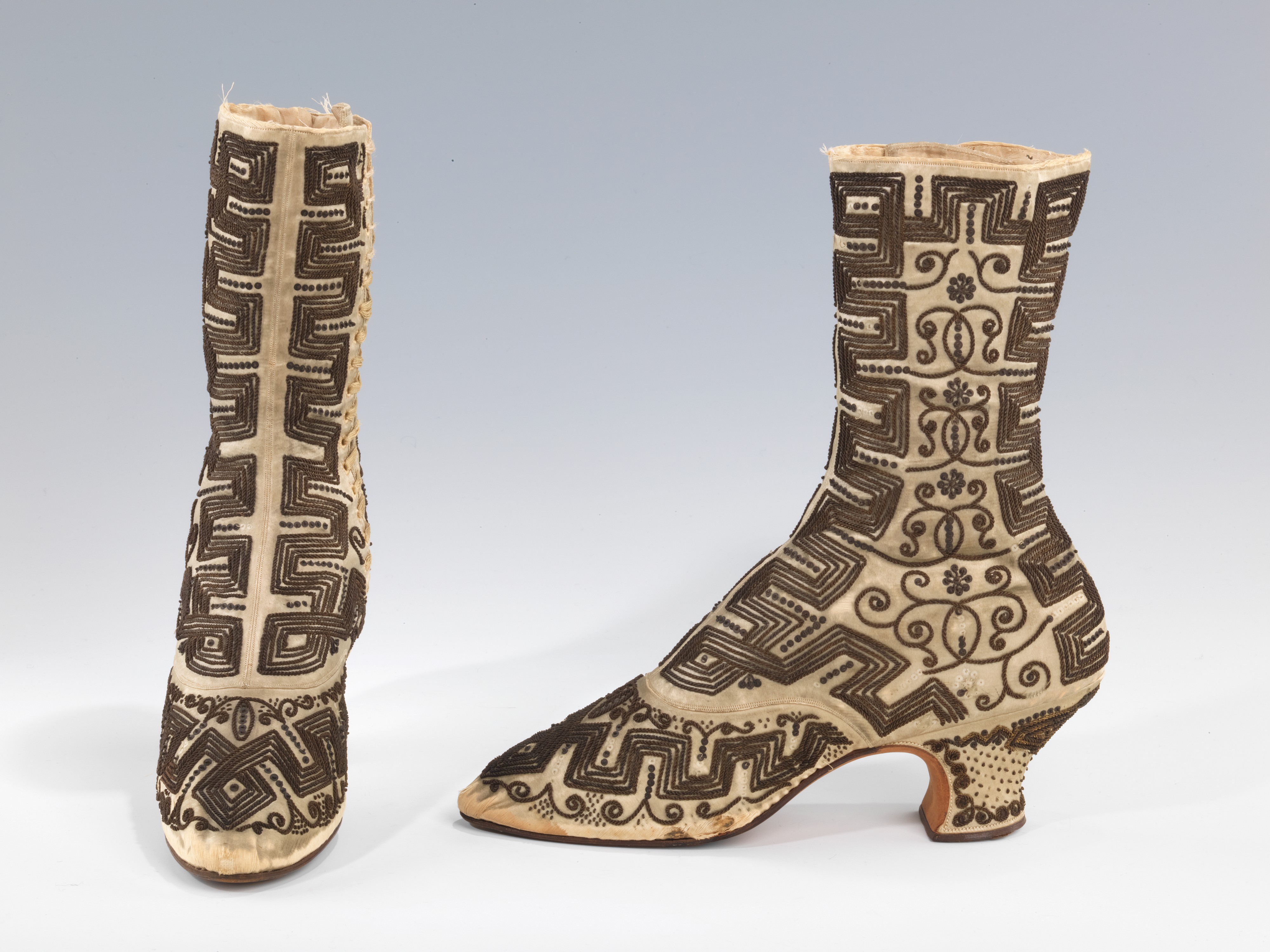
The evening boot, a garment historically relegated to the margins of haute couture—a functional afterthought to the grand gown—demands a rigorous re-evaluation. Within the isolated archive of Natalie Fashion Atelier, we have unearthed a singular artifact: a late 19th-century French evening boot, its construction a testament to a lost lexicon of material dialogue. This is not a shoe; it is a structural poem composed of silk peau de soie and gilt-bronze filigree. Its existence challenges the contemporary hegemony of the stiletto and the sneaker, proposing instead a silhouette of tensile strength and liquid grace. For the 2026 season, this artifact informs a radical departure: the boot as a sculptural extension of the leg, a second skin that negotiates between the rigid and the fluid, the precious and the structural.
Deconstructing the Classical Elegance: The Artifact’s Material Lexicon
The boot’s primary material, a silk peau de soie in a deep, almost black, midnight indigo, is not merely a covering. Its matte, slightly grainy surface absorbs light, creating a volumetric density that defies its weight. The weave is a gros de Tours, a tightly packed, ribbed silk that provides inherent structural integrity. This is not the limp charmeuse of lingerie; it is a silk engineered for architecture. The boot’s upper is constructed from a single, continuous piece of this fabric, bias-cut to follow the spiral of the calf, terminating in a pointed toe. The absence of a visible seam along the instep—a feat of invisible moulage—creates a seamless, almost organic transition from foot to ankle. The heel, a mere 4.5 centimeters, is a subtle, curved Louis heel, entirely clad in the same silk, unifying the vertical line.
The metal intervention is the artifact’s true revelation. A single, continuous gilt-bronze filigree—a technique of twisted and soldered wire—forms a delicate, yet unyielding, cage that wraps the ankle and rises to the mid-calf. This is not a buckle or a clasp; it is a structural exoskeleton. The filigree’s pattern, a repetitive arabesque of palmettes and volutes, is not decorative in the modern sense. It functions as a tensioning device, anchoring the silk to the bone structure of the foot. Each soldered joint is a micro-engineering point, distributing the stress of movement from the fabric to the metal. The patina on the bronze—a deliberate, controlled oxidation—yields a muted gold, a clair-obscur effect that creates depth against the dark silk. This is a dialectic: the soft, yielding silk versus the hard, unyielding metal; the matte, light-absorbing fabric versus the reflective, light-scattering metal. The boot is not worn; it is inhabited, a negotiation between the body’s fluidity and the material’s resistance.
From Archive to Atelier: Translating Tensile Dynamics for 2026
The 2026 luxury silhouette is defined by a post-pandoric desire for armored grace. The evening boot, as reimagined from this artifact, rejects the exposed, fragile foot. Instead, it proposes a silhouette of controlled containment. The primary translation is the tensioned fabric system. The silk peau de soie is replaced by a technical silk-jersey composite, a bi-stretch material with a memory weave. This allows for a zero-gap fit, where the boot becomes a second dermis. The bias-cut spiral of the original is preserved, but now it is a parametric spiral, computed to follow the individual’s muscular topography. The result is a silhouette that is simultaneously skin-tight and weightless, a column of liquid color that ends in a sharp, architectural point.
The metal exoskeleton is the critical innovation. The gilt-bronze filigree is reimagined as a laser-sintered titanium lattice, a structure of organic, cellular geometry. This is not a cage but a dynamic brace. The lattice is embedded into the silk composite at the ankle and along the lateral side of the calf, creating a visible, structural seam. Its function is twofold: to provide lateral support for a 10-centimeter, blade-thin heel, and to create a visual tension line that draws the eye upward. The titanium is finished with a PVD coating in a deep, iridescent gunmetal, a nod to the original patina but rendered in a hyper-modern, light-reactive surface. The heel itself is a cantilevered blade, a single piece of milled titanium that extends from the heel cup to the ground, creating a negative space between the sole and the heel. This is a direct descendant of the Louis heel, but now it is a structural statement of pure, unadorned force.
The 2026 Silhouette: Three Archetypes from the Artifact
Archetype I: The Column Boot. This is the direct descendant of the artifact. A high-shaft boot (to the knee) in a single, continuous panel of the technical silk-jersey. The titanium lattice is a discreet, internal exoskeleton, visible only as a subtle, raised line along the calf. The heel is the cantilevered blade. The silhouette is a pure, unbroken vertical line from toe to hem, a monolith of liquid metal and silk. It is worn with a floor-length, bias-cut crepe gown, the boot’s hemline exposed only during movement, a flash of structural elegance.
Archetype II: The Caged Ankle Boot. A lower shaft, terminating at the ankle. The silk is a double-faced satin, matte on the exterior, glossy on the interior, which is revealed by a deliberate, asymmetric cut. The titanium lattice is external and aggressive, forming a full, open cage around the heel and Achilles tendon. The heel is a geometric block, a faceted cube of polished aluminum, a brutal counterpoint to the silk’s softness. This boot is for the evening suit, the boot’s cage echoing the sharp lapels of a double-breasted jacket. The silhouette is one of controlled aggression, a dialogue between the body’s vulnerability and the material’s protection.
Archetype III: The Mosaic Boot. The most radical departure. The silk is deconstructed into scales of silk organza, each a petal of hand-painted, iridescent color. These scales are individually attached to a sheer, flesh-toned tulle base. The metal is not a lattice but a network of micro-rivets in rose gold, connecting each scale. The heel is a suspended stiletto, a single, curved wire of rose gold that appears to float the foot above the ground. This boot is a living mosaic, a shimmering, reptilian second skin. It is worn with a simple, columnar gown, allowing the boot to be the sole narrative. The silhouette is one of fragmented luxury, a celebration of the artisan’s hand in an age of digital reproduction.
Conclusion: The Boot as a Manifesto
The isolated artifact of the French evening boot is not a historical curiosity. It is a manifesto of material intelligence. Its silk and metal are not opposites; they are partners in a tensile dance. For 2026, Natalie Fashion Atelier does not replicate this artifact. We extract its structural logic: the tension between soft and hard, the integration of support and decoration, the elevation of the functional into the sublime. The evening boot becomes a site of architectural inquiry, a microcosm of the entire silhouette. It is no longer a mere accessory; it is the foundation upon which the entire evening ensemble is built. The 2026 woman does not wear a boot; she inhabits a structure, a second skeleton of silk and metal, a testament to the enduring power of aesthetic archaeology.