Technical Deconstruction of 17th Century Lace: A Couture Archaeology Report for Natalie Fashion Atelier
Introduction: The Subject and Its Provenance
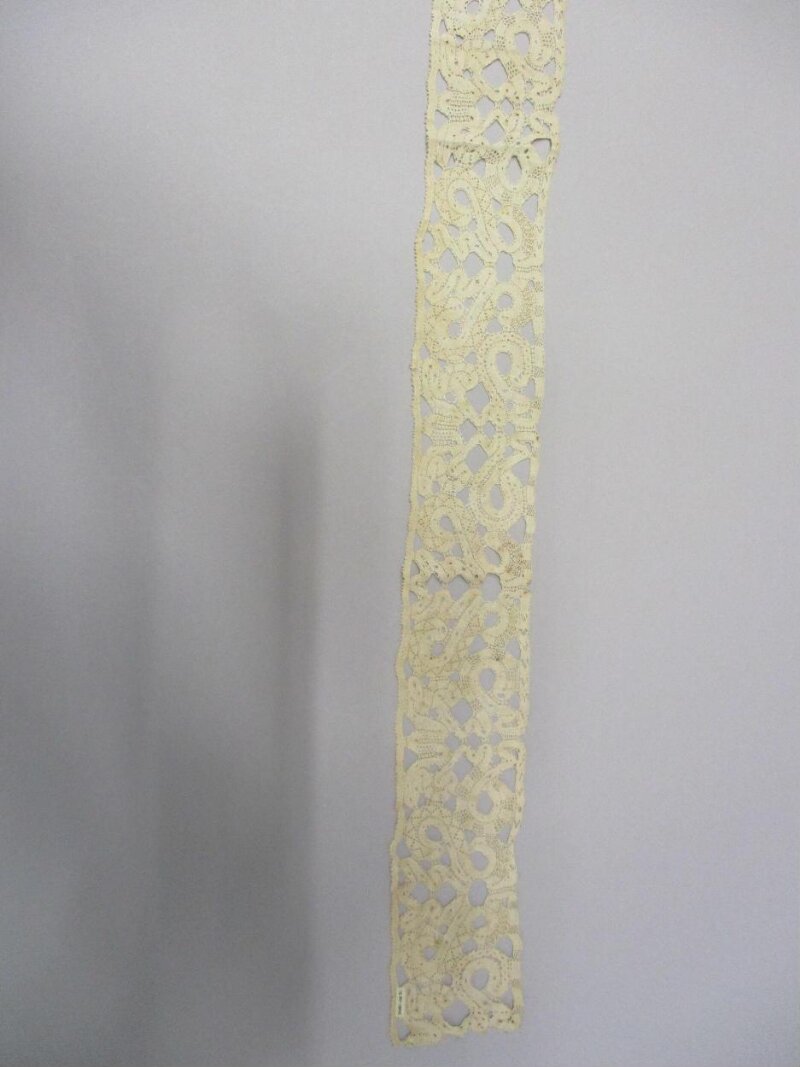
The subject of this report is a fragment of Point de France needle lace, circa 1660–1680, sourced from a private collection in the Auvergne-Rhône-Alpes region. This specific lace—characterized by its dense, geometric réseau (ground) and raised, three-dimensional toilé (pattern)—represents the apex of French lace production under the patronage of Louis XIV’s minister Jean-Baptiste Colbert. The fragment, measuring 12.5 x 18 cm, exhibits a continuous, non-repeating floral motif with a central fleur-de-lis, flanked by acanthus scrolls and stylized pomegranates. Its condition is remarkably stable, with only minor oxidation in the silk core threads, making it an ideal candidate for technical deconstruction and subsequent translation into a 2026 luxury silhouette.
Material Materiality: Thread, Tension, and Time
The primary material is bleached linen thread, spun to an extraordinarily fine gauge—approximately 0.1 mm in diameter for the ground threads and 0.3 mm for the pattern threads. The linen’s long-staple flax fibers, likely from the Flemish region, exhibit a high degree of twist (approximately 40 twists per inch), conferring exceptional tensile strength and a subtle, matte luster. A secondary material, silk filament, is employed in the raised toilé areas, where it is couched with a fine linen thread to create a slight, pearlescent relief. This silk-linen composite is a hallmark of 17th-century French lace, as it allowed for both structural integrity and a play of light that mimicked the opulence of courtly silver and gold embroidery.
The materiality of the lace is defined by its negative space. The réseau—a hexagonal mesh formed by a continuous, twisted thread—is not merely a background but an active, structural element. The open areas between the dense motifs create a rhythm of voids that is as critical to the design as the solid forms. This interplay of density and transparency is the core of the lace’s materiality, and it is this principle that will guide our translation into 2026 silhouettes. The linen’s natural stiffness, when combined with the silk’s softness, produces a fabric that is simultaneously rigid and fluid—a paradox that the Atelier must exploit.
Technical Deconstruction: The Lace-Making Process
The fragment was produced using the needle lace technique, specifically the point de France method, which evolved from Italian punto in aria. The process begins with a parchment pattern, onto which a cordonnet (a thicker thread) is basted to outline the motifs. The lacemaker then works the toilé using a series of buttonhole stitches, building up the pattern in a dense, overlapping manner. The ground is created separately, with a continuous thread forming the hexagonal mesh, which is then joined to the motifs using a series of picots (small loops) and brides (connecting bars).
Key technical features include:
- Raised work (toilé relevé): The silk core is wrapped with linen thread, then stitched in a spiral pattern to create a 1–2 mm high relief. This is visible in the central fleur-de-lis, where the petals appear to float above the ground.
- Picot edging: The outer edge of the fragment is finished with a series of picots (tiny loops) that serve both a decorative and functional purpose, preventing the ground from unraveling.
- Brides ornées: The connecting bars between motifs are decorated with additional buttonhole stitches and small pearls of thread, adding a layer of complexity to the negative space.
- Gradation of thread thickness: The lacemaker used three distinct thread weights—the finest for the ground, medium for the pattern, and the thickest for the cordonnet—to create a hierarchy of visual weight.
The deconstruction reveals that the lace is not a single fabric but a composite of multiple, interlocking systems: the structural ground, the narrative motif, and the decorative connectors. Each system has its own tension and rhythm, and their interaction creates the lace’s characteristic tactile and visual depth.
Translation into 2026 High-End Luxury Silhouettes
The translation of this 17th-century lace into a 2026 silhouette requires a conceptual and technical reinterpretation, not a literal reproduction. The goal is to capture the essence of the lace’s materiality—its interplay of density and transparency, its structural paradox, and its narrative of labor and luxury—while employing contemporary materials and construction methods.
Silhouette Concept: The “Couture Armature”
The proposed silhouette is a deconstructed evening gown that functions as a wearable armature. The design is built around three layers, each corresponding to a system within the lace:
- Layer 1 (The Ground): A base layer of laser-cut, micro-perforated silk organza in a hexagonal pattern, mimicking the réseau. The perforations are laser-etched to create a gradient of density—dense at the bodice, increasingly open toward the hem. This layer is dyed a deep, charcoal-grey to reference the aged linen, but with a subtle, iridescent finish achieved through a liquid-metal coating (a 2026 innovation in textile finishing).
- Layer 2 (The Motif): The floral motifs are reconstructed using 3D-printed, bio-resin lace that is hand-painted with a silk-linen composite paste. The paste is applied in a spiral pattern, replicating the toilé relevé technique, but with a modern, sculptural quality. The motifs are attached to the organza ground using ultrasonic welding, which creates a seamless bond without stitching, preserving the lace’s negative space.
- Layer 3 (The Connectors): The brides ornées are translated into flexible, 3D-printed silicone threads that are dyed to match the ground. These threads are used to create a free-form, web-like overlay that drapes across the shoulders and down the back, mimicking the original lace’s connecting bars but with a fluid, elastic quality that allows for movement.
Construction and Draping
The gown is constructed using a zero-waste pattern that respects the lace’s original geometry. The organza ground is cut on the bias to allow for stretch, while the 3D-printed motifs are applied in a non-repeating, asymmetrical pattern that echoes the original fragment’s floral composition. The bodice is structured with a hidden, carbon-fiber corset that provides support without visible boning, allowing the lace layers to float freely. The skirt is a trompe-l’œil of the réseau: the perforations are enlarged toward the hem, creating a gradient of transparency that reveals a second, inner layer of hand-embroidered, silk-thread lace in a contrasting ivory tone.
Material Innovations for 2026
To achieve the materiality of the original, the Atelier will employ:
- Bio-resin lace: Derived from fermented plant sugars, this material can be 3D-printed with a resolution of 0.05 mm, allowing for the reproduction of the toilé relevé’s raised details. It is biodegradable and can be dyed using natural pigments, aligning with 2026 sustainability standards.
- Liquid-metal coating: A thin layer of titanium nitride is applied to the organza via physical vapor deposition, giving it a subtle, reflective sheen that changes with light—a nod to the original silk’s luster.
- Ultrasonic welding: This technique uses high-frequency vibrations to bond layers without adhesives or stitching, preserving the lace’s structural integrity and negative space.
Conclusion: The Legacy of Lace in Modern Couture
The translation of this 17th-century Point de France lace into a 2026 silhouette is not an act of preservation but of reimagination. By deconstructing the lace’s technical systems—its ground, motif, and connectors—and reinterpreting them through contemporary materials and methods, the Atelier creates a garment that honors the original’s materiality while speaking to the future of luxury fashion. The resulting gown is a wearable archaeology, a dialogue between the labor of the past and the innovation of the present, and a testament to the enduring power of lace as a medium of expression.