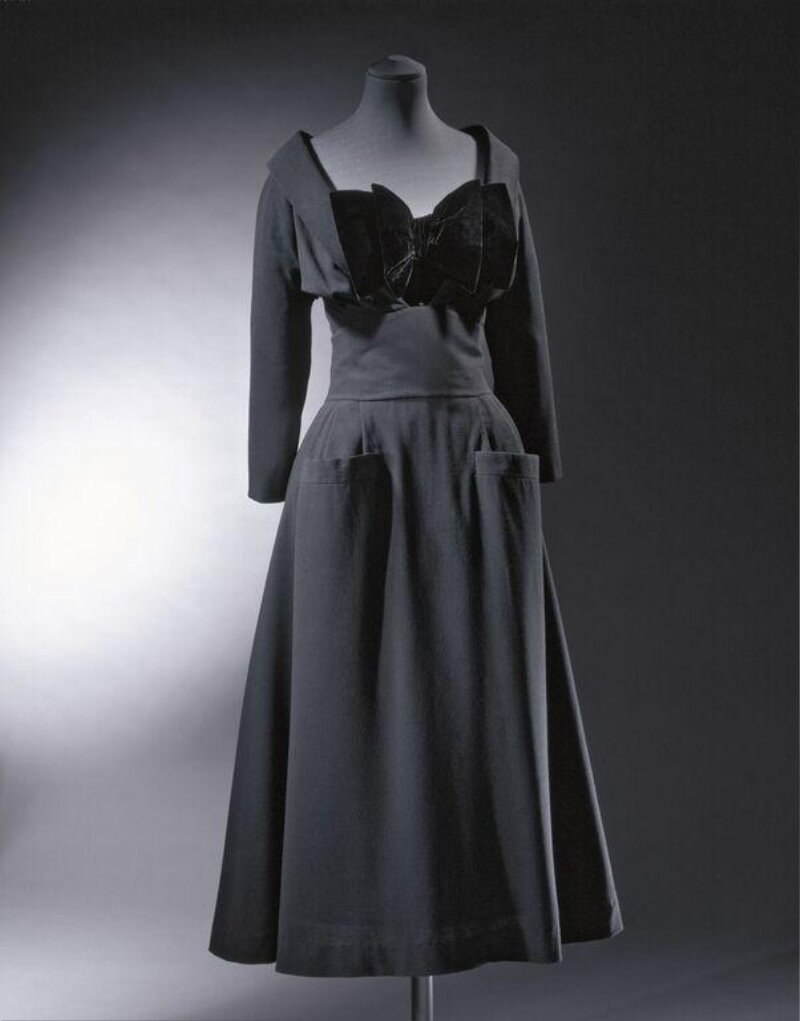
Couture Archaeology Report: Maxim's (1947) – Technical Deconstruction and 2026 Translation
Subject: Maxim's (Evening Ensemble)
Origin: House of Dior, Paris, Spring/Summer 1947 Collection ("Corolle" Line, later termed "The New Look")
Analyst: Senior Textile Historian, Natalie Fashion Atelier
Purpose: To deconstruct the foundational techniques and material philosophy of a seminal Dior creation, extracting core principles for the development of 2026 high-end luxury silhouettes that embody historical intelligence and future-facing elegance.
I. Technical Deconstruction: The Architecture of Opulence
The Maxim's ensemble is not merely a dress and jacket; it is a feat of structural engineering designed to sculpt the ideal post-war feminine silhouette. Its technical execution rests on a rigorous internal architecture that creates an external effect of fluid romanticism.
Internal Armature and Silhouette Engineering: The foundational layer is a complex understructure. A hip-length corset, likely of coutil, provides a firm, smoothed torso, re-establishing the waist as the central axis. From this foundation, the skirt's legendary volume is engineered. Unlike the all-around fullness of Victorian crinolines, Dior's innovation lay in strategic placement. A series of layered, horsehair-braid stiffened petticoats—concentrated at the hips and posterior—created the distinctive "corolle" (flower calyx) and "profile" silhouettes. This directional fullness required precise mathematical calculation in pattern drafting to ensure the heavy wool skirt fell in uninterrupted, parabolic curves from the narrow waist, a principle we term directed volume.
Surface Construction and Precision Tailoring: The iconic bar jacket, in its deceptively simple appearance, is a masterpiece of tailoring. Its technique involves:
1. Internal Canvas Sculpting: A multi-layered hair canvas, meticulously pad-stitched by hand, builds the jacket's structured yet rounded shoulders and the pronounced, curved peplum that rests over the hips. This creates a permanent, garment-shaped memory independent of the body.
2. Complex Seaming: The peplum is not a simple appendage. It is integrated through a series of shaped darts and seams that redirect fabric tension, allowing the stiff wool to flare dramatically from the waist while the bodice remains snug. The dress beneath employs similar principles, with darts and seams acting as architectural ribs to control the drape of the skirt over the understructure.
II. Material Materiality: The Tactile Language of Luxury
Dior’s 1947 choices were a deliberate manifesto against wartime austerity, making material selection a critical component of meaning.
Primary Textile: Wool Crepe. The use of a substantial, mid-weight wool crepe for a spring/summer evening ensemble was revolutionary. Its selection was both symbolic and technical. Symbolically, it denoted expense, weight, and permanence. Technically, the wool’s inherent body and malleable memory were essential. It could be molded by the internal structure (holding the sharp press of a seam or the curve of a peplum) while also possessing enough fluidity to create the soft, rolling folds of the skirt. The crepe texture absorbed and diffused light, giving the black a deep, luminous quality rather than a flat matte.
Contrast and Emphasis: Satin. The ivory silk satin bodice of the dress and the lavish floral embroidery on the jacket provide narrative contrast. The satin introduces a soft, luminous sensuality against the structured wool, highlighting the bust and shoulders. The embroidery—likely executed in chenille thread, silk floss, and possibly sequins—is not mere decoration. Its dense, three-dimensional application on the jacket’s peplum and cuffs adds actual weight, encouraging the garment to move and settle in a specific manner, further enhancing the hip-centric silhouette. This is functional embellishment.
III. Translation for 2026: Principles, Not Replication
For Natalie Fashion Atelier’s 2026 vision, a literal revival of Maxim's is not the objective. Instead, we extract its core principles to inform a new language of luxury that speaks to contemporary values of sustainability, technological innovation, and fluid self-expression.
Principle 1: Engineered Silhouette through Smart Materials. The concept of directed volume remains potent. For 2026, we replace horsehair and layers of petticoats with advanced materials. Consider 3D-knitted spacer fabrics that can be programmed with variable densities—firm at the waist to provide support, airy and expansive at the hem to create volume without weight. Shape-memory alloys integrated into seam allowances could allow the wearer to modulate a silhouette’s flare or fit via thermal or tactile input, introducing interactivity and personalization to haute couture’s permanence.
Principle 2: Structural Hybridity and Weight Redistribution. The juxtaposition of stiff and fluid, heavy and light, is key. We propose exploring composite material panels. A bodice might combine a bio-fabricated leather (derived from mycelium or lab-grown processes) with sections of ultra-fine, fluid technical silk. The structural element is integrated into the garment’s skin, not hidden beneath. Weight can be strategically placed not with embroidery, but with sustainable mineral beading or ceramic micro-paillettes that also regulate temperature.
Principle 3: Tactile Narrative and Sustainable Opulence. The material symbolism of 1947 must evolve. Luxury in 2026 is defined by provenance, innovation, and environmental intelligence. We translate the materiality of Maxim's by sourcing regenerative luxury textiles: wool from biodynamic farms that carbon-sequester, peace silk, and linens processed with closed-loop water systems. The "opulence" comes from the profound quality, story, and technical performance of these materials—their ability to dye deeper, drape more perfectly, or biodegrade gracefully—not from mere abundance.
IV. 2026 Silhouette Proposition: The "Axiom" Line
Informed by this analysis, we propose developing the "Axiom" Line for 2026. An axiom is a self-evident truth; these garments will be founded on the self-evident principles of architectural cut, intelligent materiality, and sustainable luxury.
Silhouette A: The Volute Coat-Dress. A single garment that merges the structured jacket and fluid skirt of Maxim's into one continuous form. It employs engineered knitting to create a fitted bodice that seamlessly transitions into a skirt with spiral-seamed, self-generated volume, requiring no understructure. The "weight" is a band of polished, recycled obsidian beads at the hip line, grounding the silhouette.
Silhouette B: The Chiral Separates. A tailored jacket and pant/skirt combination that plays with asymmetry and contrast, inspired by the satin/wool dialogue. One side of the jacket may be crafted from molded, plant-based composite, holding a rigid, sculptural curve, while the other side is fluid, draped jersey from ocean-waste polyester transformed into luxury filament. The internal structure is visible as a aesthetic feature—a topographic map of seams and darts.
In conclusion, Maxim's (1947) offers a masterclass in contradiction: rigid yet fluid, heavy yet graceful, architectural yet romantic. For 2026, Natalie Fashion Atelier will honor this legacy not by looking back, but by forward-engineering its core tenets. We will replace nostalgia with innovation, austerity-response with sustainability, and uniform femininity with personalized expression, ensuring that the profound intelligence of couture’s past actively shapes its future.