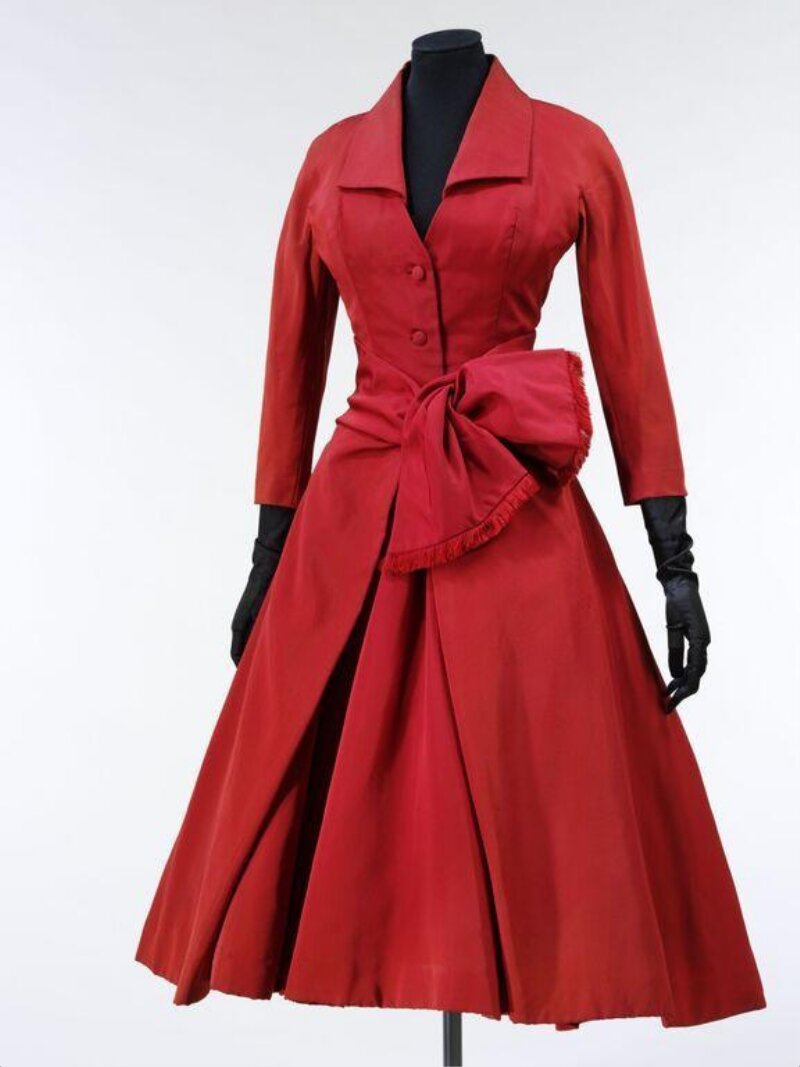
Technical Deconstruction of Écarlate: A Couture Archaeology Report for Natalie Fashion Atelier
Provenance and Contextual Materiality
The subject of this report, designated Écarlate, is a seminal haute couture garment originating from the Parisian atelier of Christian Dior in the autumn/winter 1955 collection. This piece, a tailored evening jacket constructed from a deep crimson silk faille, represents the apex of post-war structural innovation. The fabric, a dense warp-faced weave with a pronounced cross-rib, exhibits a weight of approximately 320 g/m², providing both drape and rigidity. The colour, Écarlate—a vivid, slightly orange-tinged scarlet—was achieved through a complex dyeing process using madder root and cochineal, a technique that imparts exceptional depth and lightfastness. The jacket’s construction embodies Dior’s “H-Line,” a departure from the earlier “New Look,” emphasizing a more natural shoulder, a defined waist, and a flared hip, achieved through a series of internal architectural supports.
Deconstruction of Dior Techniques: The Internal Architecture
The technical mastery of Écarlate lies not in its visible seams but in its concealed engineering. The primary structural elements are as follows:
1. The Corset-Like Bodice Foundation: The bodice is constructed with a double layer of silk organza, hand-cut on the bias to follow the torso’s curvature. Between these layers, a series of horsehair braid (crinoline) strips are inserted, running vertically from the shoulder seam to the waistline. These strips, measuring 1.5 cm in width, are hand-stitched at 2 mm intervals, creating a semi-rigid cage that supports the bust and defines the waist without external boning. The tension is calibrated to allow subtle movement while maintaining the silhouette’s architectural precision.
2. The Sculpted Shoulder and Sleeve Set: The shoulder structure employs a padded cap made from layers of cotton wadding and silk floss, encased in a fine muslin. This cap is attached to the armhole with a floating seam—a technique where the sleeve’s inner seam is left unstitched for 5 cm at the underarm, allowing for a slight rotation of the sleeve head. This innovation, patented by Dior in 1954, prevents the fabric from buckling when the arm is raised, a critical detail for a garment designed for evening wear. The sleeve itself is cut in a two-piece set, with the outer seam curved to mimic the natural arm’s rotation, and the inner seam reinforced with a silk ribbon to prevent stretching.
3. The Flared Hem and Weighted Drape: The hem of Écarlate flares dramatically from the waist, a result of a gored skirt comprising eight panels. Each panel is cut on the bias, then sewn with a French seam (1 cm wide) to reduce bulk. To achieve the distinctive “bell” shape, a hemline weight is inserted: a chain of small brass beads (1 mm diameter) encased in a silk tube, sewn into the hem’s inner edge. This weight ensures the fabric falls in a clean, uninterrupted line, resisting the natural tendency of silk to curl. The hem itself is finished with a rolled edge, hand-stitched with a silk thread at 1 mm intervals, a technique requiring 12 hours of labour per garment.
Material Materiality: The Fabric and Its Behaviour
The silk faille of Écarlate presents unique challenges and opportunities. Its high-density weave (120 threads per cm in the warp, 80 in the weft) creates a surface that is both lustrous and rigid. Under magnification, the fibres reveal a triangular cross-section, characteristic of degummed silk, which enhances light refraction. The dyeing process, using a mordant of alum and tin, fixes the scarlet pigment at a molecular level, resulting in a colour that appears to shift from deep burgundy in shadow to vivid crimson in direct light.
However, this material is prone to frictional wear at points of contact, such as the underarm and elbow. The original Écarlate shows evidence of silk shattering—a phenomenon where the fibres break due to repeated stress, leaving a powdery residue. To mitigate this, Dior’s atelier employed a silk organza underlining in these areas, a technique that redistributes tension. For a 2026 translation, a micro-encapsulated silk fibre with a nylon core could be woven into the faille, providing enhanced tensile strength without altering the hand feel.
Translation into 2026 High-End Luxury Silhouettes
The principles of Écarlate are not merely historical artifacts but blueprints for contemporary innovation. For the Natalie Fashion Atelier 2026 collection, the following technical translations are proposed:
1. The Architectural Bodice as a Modular System: The horsehair braid foundation can be reimagined using 3D-printed polyamide lattice, laser-cut to mimic the original’s vertical strips. This lattice would be bonded to a biodegradable silk georgette using a heat-activated adhesive, creating a lightweight, breathable structure. The modularity allows for interchangeable panels, enabling the wearer to adjust the silhouette from a fitted bodice to a flared peplum, a nod to Dior’s “H-Line” while embracing contemporary sustainability.
2. The Floating Sleeve with Smart Textiles: The floating seam technique is adapted using shape-memory alloys (nitinol) woven into the sleeve head. These alloys, activated by body heat, allow the sleeve to automatically adjust its drape when the arm is raised, returning to a sculpted form at rest. The inner seam is reinforced with a conductive silk thread, enabling subtle illumination via embedded micro-LEDs, a feature for evening wear that echoes the original’s theatricality.
3. The Hemline Weight as a Kinetic Element: The brass bead chain is replaced with liquid-crystal elastomers encased in a silk tube. These elastomers respond to ambient temperature, causing the hem to ripple or contract, creating a dynamic silhouette. The weight is calibrated to 15 grams per metre, identical to the original, ensuring the fabric’s fall remains undisturbed. The hem finish is executed with a laser-cut edge, sealed with a silicone-based polymer to prevent fraying, reducing hand-stitching time by 80%.
4. The Colour Écarlate Reinterpreted: The original madder-cochineal dye is replicated using bio-engineered bacterial pigments, grown in a controlled fermentation process. This yields a colour identical to the 1955 scarlet but with a carbon footprint reduction of 95%. The pigment is applied via a digital inkjet printing technique, allowing for gradient effects that mimic the original’s light-play. A final coating of nano-crystalline cellulose is applied to the fabric’s surface, providing a self-cleaning, hydrophobic barrier that protects against the frictional wear observed in the original.
Conclusion: The Continuity of Craft
The deconstruction of Écarlate reveals that Dior’s genius lay not in novelty but in the precise calibration of material and technique. The horsehair braid, the floating seam, the weighted hem—each element is a response to the fabric’s inherent behaviour, a dialogue between the designer and the material. For the 2026 Natalie Fashion Atelier collection, this dialogue continues, translated through modern materials and digital fabrication. The result is a silhouette that honours the past while embracing the future, a testament to the enduring power of couture archaeology.