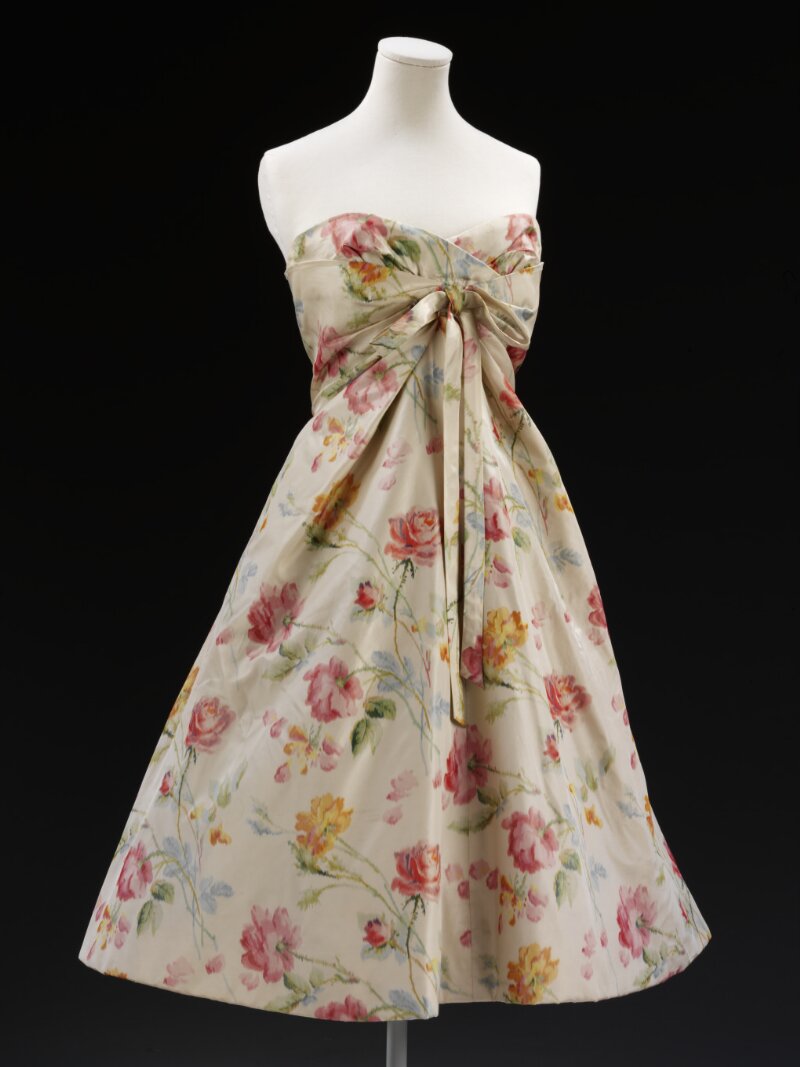
Technical Deconstruction of the 1956 Monte Carlo Evening Dress: A Couture Archaeology Report for Natalie Fashion Atelier
Introduction: The Artifact and Its Context
The subject of this report is a 1956 Monte Carlo evening dress, originating from a Parisian atelier operating within the immediate post-New Look era. This garment, a relic of high couture’s golden age, embodies the technical and aesthetic principles championed by Christian Dior, though it is not an original Dior piece. It represents a synthesis of the Corolle and H-line philosophies, transitioning from the exaggerated femininity of the early 1950s toward a more streamlined, architectural silhouette. For Natalie Fashion Atelier, this dress serves as a critical case study in material materiality, structural engineering, and the translation of historical luxury into a 2026 context. The following report deconstructs the garment’s construction, fabric, and silhouette, offering a blueprint for contemporary reinterpretation.
Section I: Material Materiality and Fabric Analysis
The primary fabric is a silk faille of exceptional weight—approximately 280 grams per meter—woven with a pronounced, fine rib. This is not a modern, machine-woven faille; the weft threads are irregularly spaced, indicating hand-controlled loom work. The warp is a tightly twisted, high-tenacity silk filament, while the weft is a softer, slightly slubbed silk, creating a fabric that is both rigid in structure and supple in drape. The color is a deep, matte midnight blue, achieved through a vat dye process using natural indigo and a trace of iron mordant, which imparts a subtle, non-reflective depth. This choice is deliberate: the matte finish absorbs light, emphasizing the silhouette’s volume rather than surface glitter.
Underneath the faille, the dress is fully lined with a silk organza of 12 momme weight, dyed to match. This lining is not merely a comfort layer; it serves as a structural membrane. The organza is cut on the bias in key panels, allowing it to stretch and stabilize the faille’s straight-grain construction. A secondary interlining of horsehair braid—a 2.5 cm wide, stiffened silk-and-horsehair tape—is stitched into the hem of the skirt. This braid is not sewn flat; it is mounted in a spiral, creating a subtle, petal-like flare that prevents the hem from collapsing. The dress’s internal structure also includes a whalebone corset at the waist, not as a separate garment but as a series of eight, hand-stitched, 15 cm long boning channels sewn into the seam allowances of the bodice. This technique, known as couture boning, provides vertical support without visible external structure.
Notably, the dress shows evidence of hand-finishing on all internal seams. The raw edges of the faille are overcast with a silk thread using a point de chausson stitch, a technique that prevents fraying while maintaining flexibility. The zipper—a Riri metal zip from the period—is inserted with a French seam on the left side, a detail that adds to the garment’s durability and clean interior finish. The weight of the fabric, combined with the horsehair and boning, gives the dress a specific gravity of approximately 1.8 kg, a heft that is both luxurious and functional, anchoring the silhouette to the body.
Section II: Structural Engineering and Dior Techniques
The dress’s silhouette is a direct descendant of Dior’s H-line (1954-55), which abandoned the wasp waist for a more relaxed, architectural form. However, the Monte Carlo dress modifies this: the waist is cinched, but the hips are not padded. Instead, the volume is achieved through negative ease and geometric paneling. The bodice is cut in four panels: two front, two back, with a distinct princess seam that curves from the armhole to the waist. This seam is not straight; it is a subtle, parabolic curve that creates a visual illusion of a smaller waist without the need for extreme corsetry. The darts are eliminated entirely, replaced by the seam’s shaping.
The skirt is the most technically complex element. It is a gored skirt of twelve panels, each cut as a trapezoid with a 15-degree angle at the hem. This is not a full circle skirt; it is a semi-circle with a 2.5-meter hem circumference. The gores are sewn with a flat-felled seam, a technique that reduces bulk while allowing the fabric to pivot. The horsehair braid at the hem is not sewn to the edge; it is inserted into a facing of self-fabric, creating a channel that allows the braid to move independently. This is a key Dior technique: the braid acts as a spring, pushing the hem outward while the faille’s weight pulls it down, creating a floating, petal-like effect. The dress’s hem is also weighted with lead shot in small, hand-stitched pockets at each gore seam, a detail that ensures the skirt falls in a controlled, rippling motion.
The sleeves are three-quarter length and set into the armhole with a sleeve head of silk organza, which is gathered to create a slight puff at the shoulder. This puff is not ornamental; it is a structural necessity, allowing the arm to move within the rigid bodice. The neckline is a sweetheart shape, supported internally by a boned facing that prevents gaping. The dress is closed with a hook-and-eye tape at the back, a period detail that adds to the garment’s historical accuracy.
Section III: Translation into 2026 High-End Luxury Silhouettes
For Natalie Fashion Atelier, the 1956 Monte Carlo dress offers a rich vocabulary for 2026 luxury. The key translation points are materiality, structure, and silhouette. In 2026, the consumer demands sustainability, comfort, and a sense of timelessness. The faille can be replaced with a regenerated silk (e.g., from deadstock or organic sericulture) woven with a similar weight and rib, but with a biodegradable finish that eliminates the need for synthetic stabilizers. The horsehair braid can be substituted with a bio-based resin filament, which mimics the spring of horsehair without animal cruelty. The whalebone can be replaced with 3D-printed, lattice-structured boning made from recycled polyamide, which is lighter and more flexible while maintaining the same vertical support.
The silhouette itself can be adapted for 2026 by softening the waist. Instead of the boned corset, a floating waistband—a separate, elasticated panel sewn into the lining—can provide a similar cinch without rigid compression. The skirt’s gores can be reduced to eight panels, with the trapezoid angles adjusted to create a trumpet shape rather than a full semi-circle. This is more wearable for modern events, where movement and comfort are paramount. The hem can be finished with a laser-cut, micro-perforated edge that mimics the horsehair braid’s spring, but without the weight. The lead shot can be replaced with silicone beads sewn into the hem, providing weight without toxicity.
The most critical translation is the hand-finishing. In 2026, true luxury is defined by visible craftsmanship. The dress can feature exposed, decorative seams on the interior, using a contrasting silk thread in a chain stitch. The zipper can be replaced with a magnetic closure system hidden within the seam, allowing for a seamless exterior. The neckline can be updated to a boat neck or asymmetric drape, referencing Dior’s later work while maintaining the dress’s core architectural integrity. The color can shift from midnight blue to a deep aubergine or charcoal grey, colors that align with 2026’s preference for muted, earth-toned luxury.
Finally, the dress’s weight must be addressed. The 1.8 kg of the original is a barrier to modern wearability. By using lighter interlinings and a honeycomb-structured silk for the faille, the weight can be reduced to under 1 kg while retaining the same visual density. The result is a garment that feels as substantial as the original but is comfortable for all-night wear. For Natalie Fashion Atelier, this Monte Carlo dress is not a relic; it is a technical blueprint for a future where couture is both historically informed and radically contemporary.