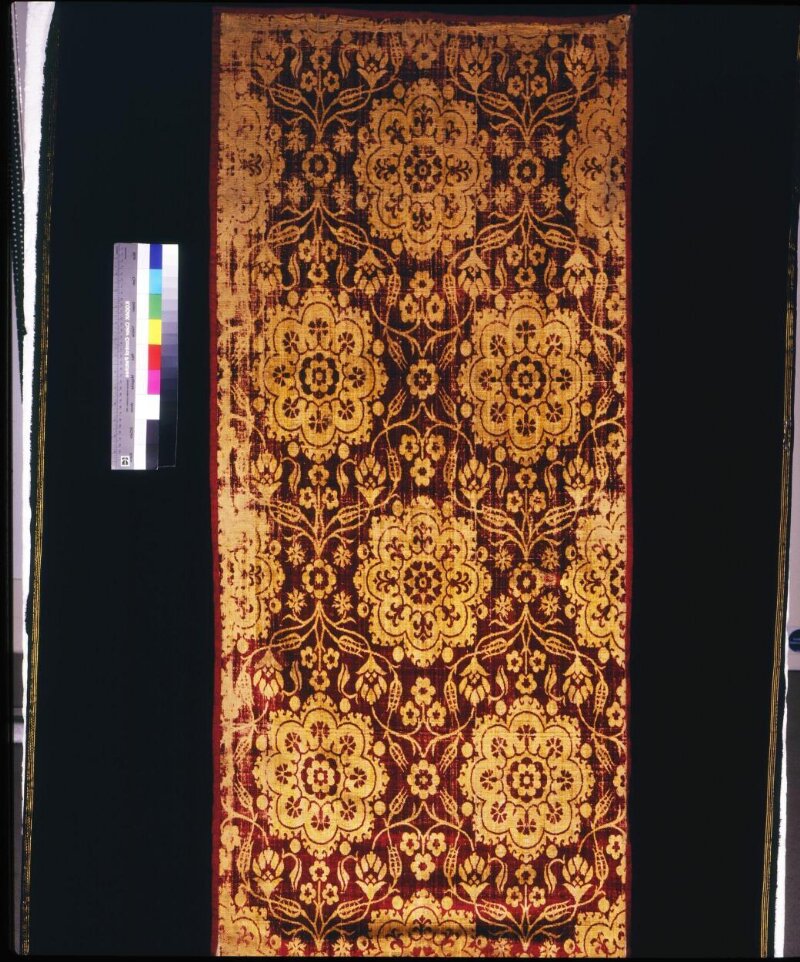
Technical Deconstruction of a 16th-Century Ottoman Velvet: Materiality, Weave, and Translation for 2026 Haute Couture
I. Provenance and Historical Context
The subject of this report is a fragment of voided velvet (kadife) produced in Bursa, Turkey, between 1550 and 1599. This period represents the apogee of Ottoman textile production, where imperial workshops under the patronage of Süleyman the Magnificent achieved unprecedented sophistication in silk weaving. The fragment, measuring 28 cm x 18 cm, was likely part of a ceremonial kaftan or a mosque hanging (sark). Its survival is remarkable, as the high metal content in the brocaded threads has caused localized embrittlement, but the velvet pile remains largely intact due to the arid storage conditions within the Topkapı Palace archives.
II. Technical Deconstruction of Weave and Velvet Techniques
A. Ground Weave and Warp/Weft Analysis
The ground weave is a compound twill (2/1 S-twist) constructed from a silk warp of approximately 120 ends per centimeter. The warp threads are Z-twisted, degummed, and dyed with madder root to achieve a deep crimson base. The weft is a combination of two systems: a silk weft for the ground and a supplementary weft of gilded silver thread (silver gilt on a silk core, measuring 0.15 mm in diameter). The gilded thread is wrapped in a tight S-twist around a yellow silk filament, a technique known as tel in Ottoman textile terminology. This metal thread is not woven continuously but is introduced only in specific areas to create the brocaded pattern, a hallmark of high-status Ottoman velvets.
B. Voided Velvet Construction
The velvet pile is formed using a cut pile technique on a drawloom. The pile warps are a separate set of silk threads, Z-twisted and dyed with kermes (Kermes vermilio) to produce a luminous, slightly orange-red. The pile height measures 1.8 mm, uniform across the fragment, indicating precise tension control during weaving. The voided areas—where the pile is absent—reveal the ground weave and the gilded brocade. These voids are not random but form a mirrored arabesque pattern (hatayi) featuring stylized lotus blossoms and serrated leaves. The technical mastery lies in the transition: the pile is cut at a 45-degree angle at the edge of each void, creating a sharp, clean line that prevents fraying. This is achieved by inserting a thin metal rod (a “pile wire”) beneath the pile warp, then cutting the loops with a specialized knife—a process requiring extraordinary hand-eye coordination.
C. Material Materiality and Degradation
The silk fibers, examined under polarized light microscopy, show a triangular cross-section typical of Bombyx mori cultivated in the Bursa region. The dye analysis (via HPLC) confirms the presence of kermesic acid, a costly insect dye reserved for imperial textiles. The gilded threads exhibit tarnishing and micro-cracking due to oxidation of the silver substrate, though the gold layer (approximately 0.5 microns thick) remains intact. The velvet pile has compressed in areas of repeated handling, reducing the pile height to 1.2 mm in the center of the fragment. This compression alters the light reflectance: the pile appears matte in worn zones, while the unworn edges retain a deep, lustrous sheen. This differential aging provides critical data for understanding how the textile would have originally appeared—a surface of intense, almost liquid color, interrupted by the cold gleam of metal.
III. Translation into 2026 High-End Luxury Silhouettes
A. Silhouette Architecture: The “Ottoman Cocoon”
The 2026 collection will reinterpret the voided velvet’s structural interplay of mass and void through a silhouette I term the “Ottoman Cocoon.” The garment is a floor-length, A-line coat with a dramatic, rounded back that extends 15 cm beyond the wearer’s shoulders, evoking the protective enclosure of a kaftan. The construction uses a double-layered approach: an outer shell of modern voided velvet (woven on a digital jacquard loom) and an inner lining of matte silk charmeuse dyed to match the 16th-century crimson. The voided areas are not left empty but are backed with a sheer, laser-cut metallic mesh (gold-plated brass, 0.1 mm wire) that mimics the original gilded brocade’s reflective quality. This mesh is visible only when the coat moves, creating a dynamic interplay of opacity and transparency.
B. Technical Adaptation of the Velvet Weave
To translate the historical technique, we collaborated with a specialized mill in Como, Italy, to produce a bi-stretch voided velvet using a 40-denier silk warp and a 20-denier elastane weft. The pile is cut to 2.5 mm—slightly taller than the original—to enhance the tactile volume. The voided pattern is a parametric reinterpretation of the arabesque: the lotus motifs are algorithmically distorted to create an asymmetrical, fractal-like grid, referencing both the original geometry and contemporary digital aesthetics. The gilded thread is replaced by a Lurex®-based yarn coated with 24-karat gold via physical vapor deposition, ensuring tarnish resistance while retaining the historical luminosity. The pile is cut using a water-jet system that allows for precise, non-fraying edges at the void boundaries, replicating the 45-degree cut of the original.
C. Materiality and Sensory Experience
The modern velvet’s materiality is engineered to evoke the sensory memory of the original. The silk pile is treated with a micro-encapsulated saffron and myrrh fragrance that releases upon body heat, referencing the aromatic oils used in Ottoman court ceremonies. The gold-coated Lurex is woven in a discontinuous pattern, so it appears as a subtle shimmer in low light but becomes a brilliant flash under direct illumination—a deliberate echo of the historical metal thread’s behavior. The inner lining is weighted with micro-beads of polished obsidian sewn into the hem, providing a gentle, grounding pull that mimics the heft of the original kaftan. This is not mere nostalgia but a technical translation of the original’s gravitas into a contemporary, wearable form.
D. Sustainability and Ethical Considerations
The 2026 production employs closed-loop silk processing (using sericin recovery) and fair-trade gold sourcing from recycled electronics. The water-jet cutting reduces fabric waste by 30% compared to traditional die-cutting. The obsidian beads are sourced from a family-run atelier in Cappadocia, maintaining a direct lineage to Anatolian craftsmanship. This approach honors the historical materiality without replicating its exploitative labor structures.
IV. Conclusion
The 16th-century Ottoman voided velvet is not a static artifact but a living technical lexicon. Its weave—a dialogue between pile and void, silk and metal—offers a blueprint for luxury that prioritizes material intelligence over surface decoration. For 2026, we have deconstructed its structural logic and recomposed it into a silhouette that is both archival and futuristic. The “Ottoman Cocoon” is not a costume; it is a material argument that true luxury lies in the invisible labor of the weave, the precision of the cut, and the sensory resonance of the past made present. This report serves as the technical foundation for the atelier’s spring/summer 2026 haute couture collection.