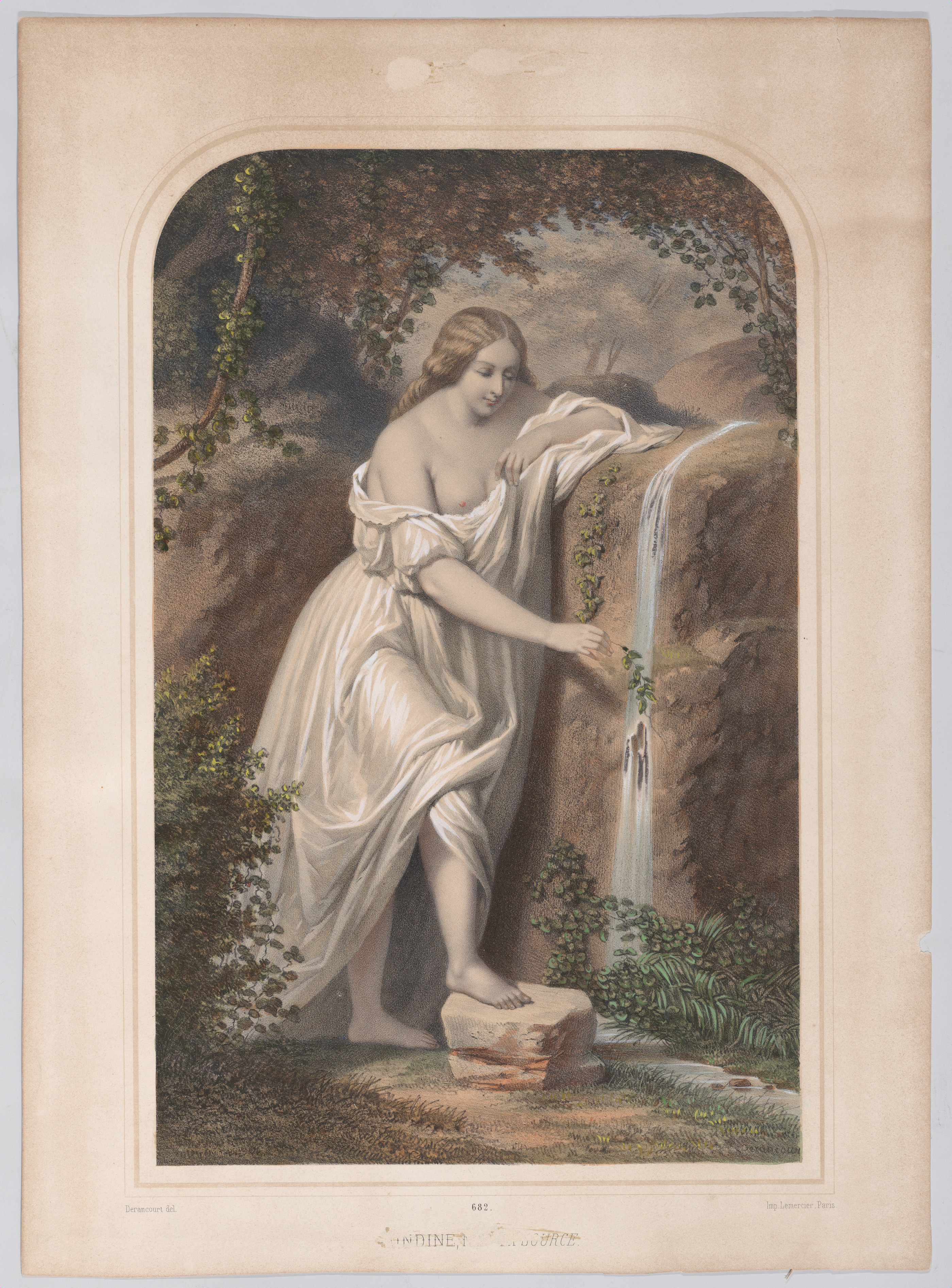
Deconstructing La Source: Aesthetic Archaeology and the 2026 Silhouette
The archive, for the haute couture house, is not a static repository of the past; it is a living lexicon of form, proportion, and narrative. Within the isolated aesthetic archaeology of the Natalie Fashion Atelier, the subject La Source—a color lithograph of the 19th-century academic tradition—presents a singular challenge and a profound opportunity. This is not a direct transcription of a painting into fabric, but a rigorous deconstruction of its classical elegance. The lithograph, with its layered pigments and precise linework, becomes a blueprint for the 2026 silhouette, demanding a translation of two-dimensional illusion into three-dimensional structure.
The Lithographic Lexicon: Materiality and Chromatic Structure
The color lithograph is a medium of exquisite tension. It relies on the chemical repulsion of oil and water to create a print, a process that inherently values separation and layering. For the 2026 collection, this materiality dictates a new approach to garment construction. The silhouette is no longer a single, monolithic form, but a composite of distinct, overlapping planes. We observe the lithograph’s characteristic key stone—the black or dark brown line that defines the figure’s contour. In the atelier, this translates to a structural seam, a sharp dart, or a contrasting piping that acts as the architectural skeleton of the gown.
The subsequent color washes—the transparent glazes of blue, ochre, and verdigris—inform the fabric’s handling. We are moving away from solid, opaque satins toward gazes de soie and organzas that allow for a chromatic layering effect. A single skirt panel might be constructed from three layers of silk tulle, each printed with a different, slightly offset color from the lithograph’s palette. The result is a vibrational depth, a living color that shifts with the wearer’s movement, mimicking the optical mixing of the lithographic process. The matte quality of the lithographic ink is also paramount; we reject high-lustre finishes in favor of sueded silks, matte crepes, and unbleached cottons that absorb light rather than reflect it, creating a quiet, scholarly luxury.
Deconstructing Classical Elegance: From Nymph to Silhouette
The classical elegance of La Source is not found in its idealized beauty, but in its dynamic equilibrium. The figure is poised, weight shifted, one arm aloft, the other resting. This is a study of asymmetrical tension. For 2026, the haute couture silhouette abandons the strict symmetry of the past decade. The new line is defined by a single, dominant shoulder—a draped, off-shoulder construction that references the raised arm of the nymph. The opposite side of the bodice is clean, almost architectural, creating a visual counterpoint.
The lithograph’s fluid lines, which suggest both the body and the flowing water, are reinterpreted as liquid geometry. A bias-cut skirt, cut from a single piece of matte crepe, will fall in a continuous spiral, echoing the water’s cascade. However, this fluidity is anchored by a rigid, almost sculptural element—a boned basque or a leather corset—that references the lithograph’s underlying structure. The silhouette is a dialogue between the fixed and the free, the architectural and the organic.
The drapery is not applied; it is engineered. Using moulage techniques on the dress form, we recreate the lithograph’s folds as three-dimensional volumes. A single, continuous piece of fabric is manipulated to create a pocket of air over the hip, a cascade of fabric from the back, a subtle twist at the waist. This is not decoration; it is structural narrative. Each fold tells the story of the garment’s construction, a visible record of the hand that shaped it.
Archival Translation: The 2026 Silhouette Manifesto
From the aesthetic archaeology of La Source, we derive three core principles for the 2026 collection:
Principle One: The Separated Line. The silhouette is no longer a continuous outline. It is a series of independent, intersecting volumes. The bodice, the sleeve, and the skirt are treated as distinct color plates in the lithographic process. A sharp, structural seam—often in a contrasting, darker tone—separates them, creating a graphic clarity. This is seen in a jacket where the sleeve is attached with a visible, top-stitched seam in a deep charcoal, while the body of the jacket is a soft, matte ivory. The separation is celebrated, not hidden.
Principle Two: Chromatic Depth through Transparency. The color is not on the surface; it is within the structure. We employ layered organza, double-faced crepes, and hand-painted silks to achieve the lithograph’s depth. A single gown might feature an underskirt of deep, translucent indigo, overlayed with a skirt of pale, matte celadon. The two colors mix optically, creating a third, ethereal tone. The hemline becomes a site of revelation, where the layers are allowed to separate and show their internal color.
Principle Three: The Sculpted Void. The most powerful element of the lithograph is the negative space—the air around the figure, the suggestion of the spring. In the 2026 silhouette, this is translated through strategic cutouts, suspended panels, and draped swags that create voids of air between the fabric and the body. A gown might have a single, large cutout at the waist, framed by a rigid, boned structure. This is not about revealing skin, but about creating a sculptural aperture, a moment of architectural breath within the garment’s mass.
Conclusion: The Future of the Archive
The isolated study of a single color lithograph, La Source, has yielded a rigorous, technical framework for the 2026 haute couture silhouette. We have not copied the image; we have extracted its structural DNA. The result is a collection that is simultaneously archaic and futuristic, a dialogue between the hand of the 19th-century lithographer and the precision of the 21st-century atelier. The silhouette is no longer a simple outline of the body, but a complex, layered, and separated architectural volume—a living, breathing artifact of aesthetic archaeology. The Natalie Fashion Atelier does not merely reference history; it deconstructs it, rebuilds it, and projects it into the future of form. This is the new classical elegance. This is the 2026 silhouette.