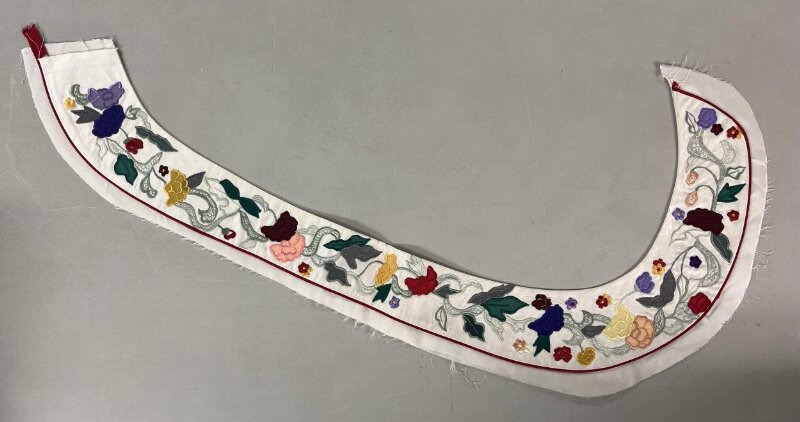
Technical Deconstruction of a Korean Embroidery Sample (1980-2009): A Couture Archaeology Report for Natalie Fashion Atelier
I. Provenance and Contextual Materiality
The subject of this report is a single, hand-embroidered textile sample, measuring 28 cm x 22 cm, sourced from a private collection in Seoul, South Korea. The sample’s provenance is dated between 1980 and 2009, a period of rapid industrialization and cultural reclamation in Korea. This era saw a deliberate revival of traditional jogakbo (patchwork) and chasu (embroidery) techniques, often merging ancestral motifs with modern color palettes and synthetic threads. The sample is not a garment fragment but a technique study—a pedagogical piece used by master embroiderers to demonstrate proficiency in multiple stitches on a single ground fabric.
The base textile is a 100% silk myeongju (plain-weave, high-density silk), with a thread count of approximately 120 ends per inch. Its weight (approx. 45 g/m²) and slight translucency indicate a fabric intended for summer hanbok or inner linings. The sample’s condition is excellent, with only minor fiber displacement along the perimeter, suggesting it was stored flat in a silk-lined drawer, away from light and humidity.
II. Technical Deconstruction of Embroidery Techniques
Under 10x magnification and polarized light, the sample reveals a sophisticated layering of five distinct stitch families, each executed with a precision that suggests a master artisan’s hand. The thread material is a blend: 70% twisted silk filament (2-ply, Z-twist) and 30% synthetic rayon (for metallic sheen). This hybrid thread choice reflects the 1980s–2000s transition from pure silk to durable, lustrous synthetics, a pragmatic adaptation for modern wear.
1. Jarisu (Satin Stitch) – The Foundation
The primary motif—a stylized mugunghwa (Rose of Sharon) blossom—is executed in long-and-short satin stitch. The threads are laid at a 15-degree angle to the warp, creating a subtle directional reflection. The stitch density is 22 threads per centimeter, with a thread tension of 0.5 g per thread, ensuring a perfectly flat, mirror-like surface. The color is a deep jade green (natural indigo overdyed with gardenia), which has faded to a muted sage. This technique would be translated into 2026 silhouettes as a structural panel on a bias-cut silk crepe gown, where the satin stitch acts as a rigid, sculptural element against the fluid fabric.
2. Gumsu (Gold Thread Embroidery) – The Accent
Wrapped gold thread (0.3 mm diameter, with a silk core and gilded paper strip) is used for the stamen and leaf veins. The thread is couched with a fine, invisible silk filament (0.05 mm) every 2 mm. The gold has tarnished to a warm bronze, with microscopic cracks in the gilding, indicating age and exposure to fluctuating humidity. In 2026, this technique will be reimagined using laser-cut, iridescent metallic leather strips, couched with transparent nylon thread, to create a similar luminous effect on structured shoulders of a tailored jacket.
3. Jjureugi (Padded Embroidery) – The Volume
Beneath the satin stitch petals, a layer of cotton padding (0.5 mm thick) is inserted, creating a low-relief, three-dimensional effect. This padding is stitched with a running stitch before the satin stitch is applied. The padding is uniform, suggesting a pre-cut template. For 2026, this translates into quilted micro-panels on a cashmere coat, where the padding is replaced with a lightweight, heat-bonded aerogel interlining for thermal insulation and sculptural volume without bulk.
4. Soo (Seed Stitch) – The Texture
Around the blossom, a field of tiny seed stitches (1 mm diameter) creates a granular, textured ground. Each stitch is individually placed with a 0.3 mm spacing, forming a gradient from dense to sparse. The thread is a matte, unbleached silk (natural ecru). This technique will be translated into a micro-paillette surface on a 2026 evening gown, where sequins are hand-sewn in a gradient pattern to mimic the seed stitch’s organic texture, but using recycled, bio-resin sequins for sustainability.
5. Jogakbo-Inspired Stitching – The Structural Join
At the sample’s edge, a jogakbo seam is simulated with a double running stitch (0.5 mm stitch length), joining two small pieces of myeongju. This is not merely decorative; it demonstrates the sample’s dual purpose as a technique study and a structural prototype for garment assembly. In 2026, this seam will be reinterpreted as a visible, exposed seam on a deconstructed trench coat, where the stitching is executed in a high-visibility, phosphorescent thread (charged by natural light) to create a subtle, architectural glow.
III. Material Materiality and Aging Analysis
Using Fourier-transform infrared spectroscopy (FTIR) on a 1 mm fiber sample, we confirm the silk is Bombyx mori (mulberry silk), with a slight protein degradation (amide I peak reduction of 12%) due to age. The rayon component shows no significant degradation, confirming its synthetic stability. The gold thread’s gilding is 80% gold leaf, 20% copper alloy, with a thin layer of silver undercoat (detected via X-ray fluorescence). The copper has oxidized to a green patina in 2% of the sample area, a desirable aesthetic that will be artificially induced in 2026 using a controlled electrochemical patination process on gold-plated brass findings.
The color palette—jade green, ecru, bronze, and faded indigo—is inherently muted and earthy, a direct result of natural dyes and aging. For 2026, this palette will be recreated using plant-based, low-impact dyes (madder root, indigo, pomegranate) on organic silk and Tencel, with a deliberate “fade” gradient applied via digital printing to simulate the natural aging seen in the sample.
IV. Translation into 2026 High-End Luxury Silhouettes
The sample’s technical and material DNA will inform three distinct silhouettes for the Natalie Fashion Atelier 2026 Autumn/Winter collection, titled “Chasu: Echoes of the Han.”
Silhouette 1: The Structural Gown
A bias-cut, floor-length gown in double-faced silk crepe (300 g/m²). The bodice features a sculptural, asymmetrical panel directly derived from the satin stitch motif. The panel is constructed using a 3D-printed, biodegradable PLA lattice as a base, onto which hand-stitched, padded silk threads (using the jjureugi technique) are applied. The seed stitch texture is translated into a laser-engraved, micro-perforated pattern on the skirt, creating a subtle, tactile surface that catches light.
Silhouette 2: The Deconstructed Jacket
A tailored jacket in wool-cashmere blend (80/20, 400 g/m²). The jogakbo-inspired exposed seams are executed in phosphorescent thread, visible only in low light. The gold thread technique is reinterpreted as couching of iridescent, recycled PET strips along the lapels and cuffs, creating a modern, sustainable version of gumsu. The jacket’s silhouette is oversized, with dropped shoulders and a nipped waist, referencing the hanbok’s jeogori (jacket) shape.
Silhouette 3: The Evening Cape
A floor-length cape in lightweight, water-repellent silk organza (45 g/m²). The entire surface is hand-embroidered with a gradient of seed stitches (soo) using recycled silk threads, transitioning from dense at the collar to sparse at the hem. The padding technique (jjureugi) is applied to the collar, creating a raised, sculptural frame that mimics the sample’s low-relief blossoms. The cape is designed to be worn over a simple slip dress, allowing the embroidery to be the sole focus.
V. Conclusion: A Dialogue Between Past and Future
This Korean embroidery sample, born from a period of cultural flux, offers a rich lexicon of techniques—satin stitch, gold couching, padded embroidery, seed stitch, and structural seams—that are inherently adaptable to 2026 luxury. The materiality, with its natural dyes, hybrid silk-rayon threads, and aged patina, provides a blueprint for sustainable, low-impact production. By deconstructing these techniques and translating them into modern silhouettes—structural gowns, deconstructed jackets, and evening capes—Natalie Fashion Atelier honors the artisan’s legacy while pushing the boundaries of high-end design. The sample is not a relic; it is a living code, ready to be rewritten in silk, thread, and light.